

Did you know that 36.5 percent of vehicle owners cannot cover an unexpected repair cost of 1,000 dollars or more? On Birmingham roads, where deep potholes can appear overnight, this lack of financial preparation creates unnecessary stress for every commute. You likely feel the same confusion many drivers face when trying to figure out exactly what does a tire warranty cover after a sudden blowout or premature wear. It's frustrating to realize that a standard manufacturer's promise might not protect you from a stray nail on the shoulder of Highway 280.
We are here to act as your reliable ally and clarify the fine print. This 2026 guide explains the three essential layers of protection, from treadwear mileage to road hazard coverage, so you can stop guessing and start saving. You will learn how to maintain your eligibility through routine service and discover the exact steps required to navigate the claims process with speed and precision. Let's ensure your tires remain a solid, protected foundation for your vehicle's performance and your family's safety.
Key Takeaways
- Identify the three distinct layers of protection that form a comprehensive tire warranty system.
- Learn exactly what does a tire warranty cover regarding manufacturing defects and workmanship standards.
- Understand how prorated mileage credits work and why regular maintenance is mandatory for eligibility.
- Discover why road hazard protection is the critical defense against Birmingham's unique road debris and potholes.
- Master the 5-step process for filing successful claims using your original documentation and DOT numbers.
Understanding the Three Different Types of Tire Warranties
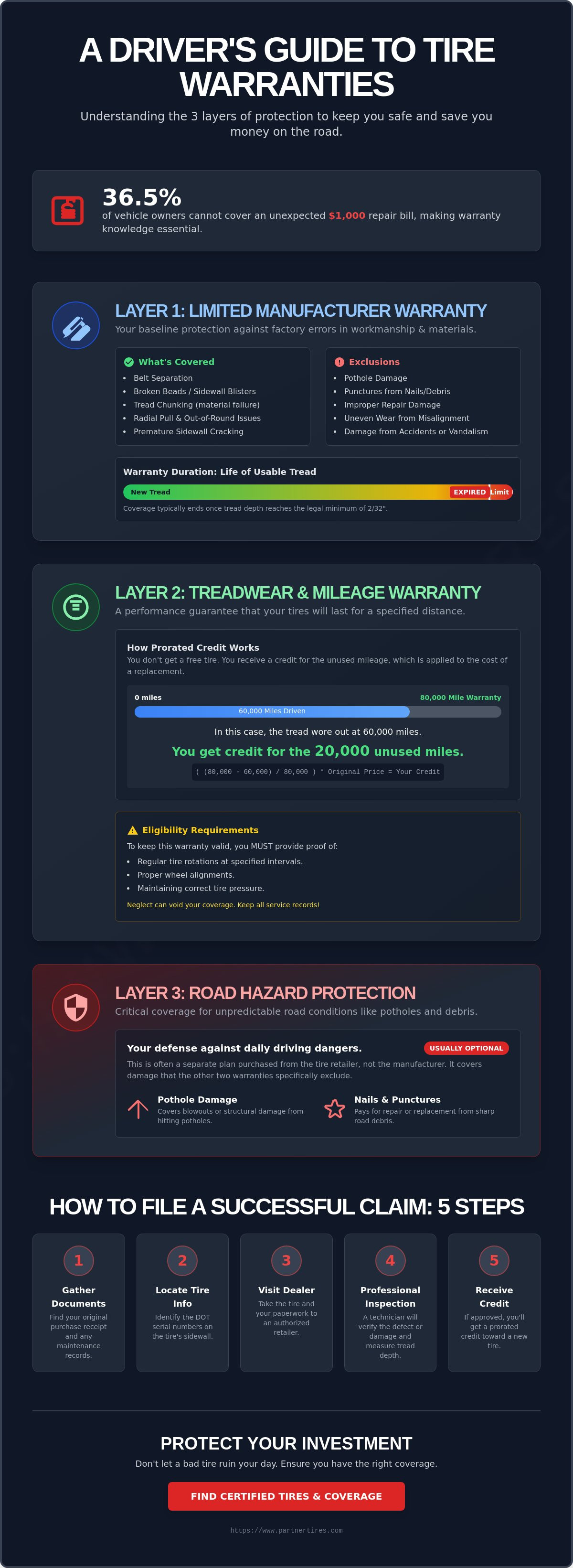
Birmingham drivers often face a confusing landscape when their tires fail prematurely. You need to know that your vehicle's bumper-to-bumper warranty almost never includes the tires. Instead, the tire manufacturer provides the coverage. This protection acts as a multi-layered shield for your wallet. To grasp the legal foundations of these promises, it helps to understand What is a Warranty? in a commercial context. When you ask what does a tire warranty cover, you are actually looking at three separate layers: factory workmanship, mileage longevity, and road hazard protection. Each layer addresses a different risk to your operational success.
Review this breakdown to see how these different policies function in the real world:
The Limited Manufacturer Warranty (Workmanship)
This first layer focuses exclusively on the manufacturing process. It protects you against errors made at the factory. Common issues covered include belt separation, broken beads, or sidewall blisters that appear without any external impact. This coverage typically lasts for the life of the usable tread. In Alabama, the legal minimum tread depth is 2/32 of an inch. Once your tires wear past this point, the workmanship warranty expires. This policy ensures you receive the high-quality product you paid for without bearing the cost of a factory defect.
The Treadwear or Mileage Warranty
The mileage warranty is a performance guarantee. It promises that a tire will last for a set distance, often ranging from 50,000 to 80,000 miles. If your tread wears down to 2/32 of an inch before hitting that target, the manufacturer provides a prorated credit toward a replacement. You don't get a free tire. Instead, you get a discount based on the miles you lost. Keeping this coverage valid requires discipline. You must provide proof of regular maintenance, such as alignments and rotations, to show the wear wasn't caused by neglect. This data-driven approach protects the manufacturer while rewarding drivers who care for their equipment.
Understanding what does a tire warranty cover is the first step in managing your vehicle's long-term operating costs. The final layer is Road Hazard Protection. This is usually an optional purchase. It covers the things the manufacturer didn't do wrong, like a puncture from a nail or a blowout from a deep Birmingham pothole. While the first two warranties focus on the tire's internal quality and longevity, road hazard coverage focuses on the unpredictable environment of your daily commute. Combining these three layers creates a stable foundation for your vehicle's financial health.
Manufacturer Defects and Workmanship Coverage Explained
The Limited Manufacturer Warranty is the most basic level of protection for your vehicle's rubber. When you ask what does a tire warranty cover, you must first look at factory standards. This coverage strictly addresses errors made during the production process. It ensures you don't pay for a mistake made on the assembly line. Understanding Tire Warranties requires a focus on "usable tread." Most manufacturers consider a tire's life over once it reaches 2/32 of an inch of remaining tread. In Alabama, 2/32 is the legal safety limit. If a defect appears after you've worn the tire down to this point, the warranty is effectively expired.
What Qualifies as a Factory Defect?
Industry standards in 2026 categorize defects into two areas: materials and workmanship. Workmanship is the quality of the assembly, while materials refer to the chemical makeup of the rubber. If these fail, you might see tread chunking, where pieces of the tire literally fall off. You might also experience "radial pull," which causes the vehicle to drift even when the alignment is perfect. Other covered issues include out-of-round conditions that cause persistent vibrations or "weather checking," which is premature cracking in the sidewall. Major brands like Michelin, Goodyear, and Continental all provide these warranties, though their specific time limits vary. Most follow the recommendation to replace tires after six years, regardless of tread depth.
Exclusions You Need to Know
This warranty layer is not a catch-all for daily driving hazards. It will not cover a blowout caused by a deep Birmingham pothole or a puncture from road debris. Those are external impacts, not factory flaws. You also lose coverage if the tire was damaged by improper mounting or balancing. Vandalism, fire, and racing are universal exclusions. Natural aging is another critical factor. Even if the tread looks deep, most manufacturers limit "dry rot" claims after a certain number of years. To protect your investment, always use a professional for your setup. If you are looking for a reliable partner for your next set, you can explore our inventory of new tires to find options with robust factory backing.
Maintaining your eligibility for a claim is simple but mandatory. You must keep records of your purchase and proof that the tires were used for their intended purpose. If you use passenger tires for commercial hauling, the manufacturer will likely deny your claim. This direct approach to coverage ensures that the manufacturer remains responsible for their craft while you remain responsible for how you drive on Birmingham's streets. Knowing what does a tire warranty cover in terms of workmanship provides the quiet confidence that your equipment is sound from the moment it leaves the warehouse.
How Treadwear and Mileage Warranties Actually Work
A treadwear warranty is a guarantee of a tire's operational lifespan. Drivers asking what does a tire warranty cover often expect a full replacement if the rubber wears down early. This is a common misconception. These policies act as financial tools designed to offset the cost of premature wear, provided you follow a strict maintenance schedule. Unlike the workmanship coverage discussed earlier, this layer relies heavily on your actions as a vehicle owner. It is a partnership between you and the manufacturer to ensure the product reaches its full potential.
The Math of Prorated Credits
Mileage warranties use a "prorated" system. This means the manufacturer gives you credit only for the miles you didn't receive. For example, if a tire rated for 60,000 miles hits the legal limit of 2/32 of an inch at 30,000 miles, you receive a 50 percent credit. This credit typically applies to the purchase of a new tire from the same brand. Understanding Tire Warranties means recognizing that these credits are designed to be fair to both the user and the manufacturer. You must remember that the credit covers the tire cost only. You remain responsible for local taxes, disposal fees, and the labor for mounting and balancing at the shop.
Maintenance Requirements for Mileage Claims
This is where many claims fail. Manufacturers require documented proof of professional care to process a credit. Regular tire rotation every 5,000 to 8,000 miles is a non-negotiable requirement. Without these records, a manufacturer can claim the wear was caused by neglect rather than a product failure. Similarly, a four-wheel alignment is critical. Uneven wear patterns like "cupping" or "feathering" usually indicate an alignment issue. These patterns instantly void a mileage claim. Keep every receipt from your service center in Hoover or Vestavia. These documents are your evidence in a dispute.
Not all tires carry the same promises. High-performance tires often have shorter warranties because their softer rubber compounds prioritize grip over longevity. If your vehicle uses a staggered fitment, where the rear tires are wider than the front, the mileage warranty is typically cut in half for the rear set. This happens because those tires cannot be rotated from front to back. Understanding these nuances ensures you have a realistic expectation of what does a tire warranty cover for your specific vehicle setup. Improper inflation pressure is another silent killer of claims. Even a few pounds of under-inflation can cause excessive heat and wear, giving the manufacturer a valid reason to deny your credit. This direct approach to maintenance protects your financial health and your safety on the road.
Road Hazard Protection: Coverage for Birmingham’s Potholes and Debris
The previous sections detailed factory quality and mileage guarantees. Road Hazard Protection is different. It covers the things the manufacturer didn't do wrong. When asking what does a tire warranty cover, many drivers are surprised to find that standard factory policies exclude damage from nails, glass, and jagged curbs. This layer is nearly always an optional add-on purchase made at the time of sale. It provides a financial safety net against the unpredictable debris found on I-20 or Highway 280.
Repair vs. Replacement Rules
Most road hazard policies prioritize safety and cost-efficiency. If a stray nail punctures the center tread, the policy typically covers a professional flat tire repair at no charge. Sidewall damage requires a more aggressive solution. A deep pothole that tears the sidewall compromises the tire's structure. These incidents result in a full replacement under most road hazard terms. You should check the duration of your policy. Many plans offer full coverage for the first 12 months, then shift to a prorated model as the tire ages.
Why Birmingham Drivers Need This Layer
Birmingham's roads demand extra protection. Heavy construction in Trussville and downtown Birmingham often leaves metal scrap and debris on the roadway. Alabama’s intense summer heat adds to the strain. High temperatures soften rubber and increase internal pressure. This makes a tire more likely to fail when hitting a sharp edge or a deep crater in the asphalt. If you experience a failure in Pelham or Bessemer, having this coverage can simplify the logistics of getting back on the road. Some plans even facilitate mobile service to minimize your downtime.
This protection is the most valuable tool for a local commuter. It handles the external threats that factory warranties ignore. You can strengthen your vehicle's operational foundation by reviewing our tire replacement warranties to ensure you have the right level of road hazard support for your next set of tires. Understanding what does a tire warranty cover helps you make better decisions at the service counter and keeps your financial health secure.
How to File a Tire Warranty Claim and Maximize Your Value
Filing a claim doesn't have to be a source of frustration. When you understand what does a tire warranty cover, the logistical steps become a simple checklist. You need to act quickly. Most warranties require you to report the issue as soon as it's detected. We act as your reliable intermediary, bridging the gap between your operational needs and the manufacturer's strict requirements. This collaborative effort ensures that your claim moves through the system with speed and precision.
The role of the tire dealer is essential in this process. We handle the technical communication with the manufacturer to ensure your claim is processed accurately. This partnership saves you time and prevents the common documentation errors that lead to denied claims. By choosing a professional service provider, you ensure that your investment is protected by experts who understand the industry standards for 2026. We prioritize your success by managing the details behind the scenes.
The Warranty Claim Checklist
Success starts with organization. You must provide a clear paper trail to prove you have met the maintenance standards mentioned in previous sections. Follow these five steps to prepare your claim:
- Retrieve your original purchase receipt showing the date and location of the sale.
- Document the vehicle mileage at the time of installation and your current odometer reading.
- Locate the DOT code on the tire sidewall. This 10 to 12-digit string identifies the specific production batch for the manufacturer.
- Find an authorized dealer in the Birmingham area for your specific tire brand.
- Schedule a professional inspection to verify the type of failure and confirm eligibility.
Partner Tires: Your Warranty Ally
We simplify the entire experience by bringing the solution directly to your location. Our experts identify whether the damage qualifies as a factory defect or a road hazard. This eliminates the guesswork and anxiety of dealing with "fine print" exclusions. We understand the busy schedules of Birmingham professionals. This is why we offer at-home tire installation for warranty replacements. Whether you are at your home in Mountain Brook or your office in Homewood, we handle the inspection and replacement on-site.
Our commitment to transparent, no-nonsense service ensures you never get lost in the shuffle. We provide the grit and regional expertise required to keep your vehicle moving. We focus on your financial health by maximizing the value of your existing coverage and providing clear answers about what does a tire warranty cover for your specific situation. Ready for a new set with real protection? Contact Partner Tires for a quote today and experience a higher standard of reliability.
Secure Your Investment on Birmingham Roads
You now possess the logistical roadmap to navigate the complexities of tire protection. Understanding exactly what does a tire warranty cover allows you to drive with quiet confidence. You can now distinguish between factory flaws, mileage promises, and the road hazards found on Alabama highways. Remember that documented maintenance is your strongest asset. Consistent rotations and alignments are the essential requirements that keep your financial shield intact.
Partner Tires is ready to serve as the backbone of your vehicle's performance. We provide mobile installation services throughout the Birmingham region. Our team includes computerized wheel balancing with every setup to ensure immediate efficiency. As a locally owned and operated ally, we value your trust and your time. It's our mission to ensure your operational needs are in capable hands.
Get Reliable New Tires Installed at Your Home or Office and experience a higher standard of service. We work behind the scenes to keep you moving forward safely. Your journey is our priority.
Frequently Asked Questions
Do tires have a warranty if I hit a pothole in Birmingham?
Standard manufacturer warranties do not cover pothole damage. You need Road Hazard Protection for these incidents. This optional layer specifically addresses the external impacts common on Birmingham streets like I-65. Without it, the cost of a replacement tire falls entirely on the vehicle owner.
How do I know if my tire damage is a factory defect?
A factory defect is characterized by structural failures that occur without signs of external impact. Look for tread chunking, sidewall blisters, or persistent vibrations that a professional balance cannot fix. Inspection is required to confirm these issues. Our experts help you determine if the tire's construction failed or if road conditions caused the issue.
What documents do I need to keep for my tire mileage warranty?
You must maintain your original purchase receipt and a detailed log of professional service records. Manufacturers require proof of tire rotations every 5,000 to 8,000 miles to honor mileage claims. Keeping these documents organized ensures you can prove the tire was maintained according to industry standards.
Is a tire warranty transferable if I sell my car?
Most tire warranties are not transferable and apply only to the original purchaser of the tires. When you sell your vehicle, the warranty typically voids for the new owner. It's a personal agreement between the buyer and the manufacturer or retailer. Always check the specific terms of your policy if you plan to sell.
Does a tire warranty cover the cost of mounting and balancing?
A tire warranty credit almost never covers the labor costs for mounting and balancing. When you ask what does a tire warranty cover, remember that the credit applies strictly to the price of the rubber. You remain responsible for local taxes, shop fees, and the professional labor required for installation.
What is the difference between a manufacturer warranty and road hazard protection?
A manufacturer warranty covers internal quality, while road hazard protection covers external accidents. The factory promise ensures the tire was built correctly. Road hazard coverage protects you against nails, glass, and jagged curbs. These are two separate layers of protection for your vehicle's financial health.
How long does a typical tire warranty claim take to process?
Most claims are processed within a single business day if an authorized dealer confirms the defect on-site. Some manufacturers require the tire to be shipped back to a facility for forensic analysis. This can extend the timeline to several weeks. Working with a reliable local partner often speeds up the initial inspection.
Can I use my warranty if I bought my tires online but need them installed in Birmingham?
You can use your warranty for online purchases if you visit an authorized dealer for that specific tire brand in Birmingham. The dealer acts as the intermediary with the manufacturer. You will still need to provide your original digital receipt and proof of mileage to satisfy the what does a tire warranty cover requirements during the claim process.


