What if the most critical safety data you own is hidden in plain sight on your wheel? Most drivers look at the rubber and see a confusing mess of symbols. Learning how to read tire sidewall markings is a professional necessity that ensures your vehicle stays safe and compliant with 2026 standards. You shouldn't have to guess when it comes to your operational safety or your budget. We know that technical jargon is frustrating and buying the wrong size is a costly mistake you cannot afford.
This guide promises to turn those random numbers into a clear blueprint for your vehicle's performance. We will break down everything from load indices to the critical DOT age codes. You will learn how to spot the new ice grip icon and verify manufacturing dates to ensure your rubber is still reliable. We also cover the latest 2026 regulations, such as the FMCSA 4/32-inch tread depth requirements for steer tires. This overview provides the exact knowledge you need to select the right stock and the grit to avoid being oversold at the service counter.
Key Takeaways
- Identify the "Big 6" primary size sequence to ensure you purchase the correct fit for your vehicle every time.
- Understand why matching OEM load and speed ratings is a non-negotiable requirement for maintaining vehicle safety and performance.
- Master how to read tire sidewall markings to locate the DOT serial number and verify the safety age of your rubber.
- Learn how Birmingham’s high temperatures and road conditions impact your specific needs for sidewall height and traction ratings.
- Discover how mobile installation services streamline your operations by bringing the right tires directly to your home or workplace.
Decoding the Primary Tire Size Sequence
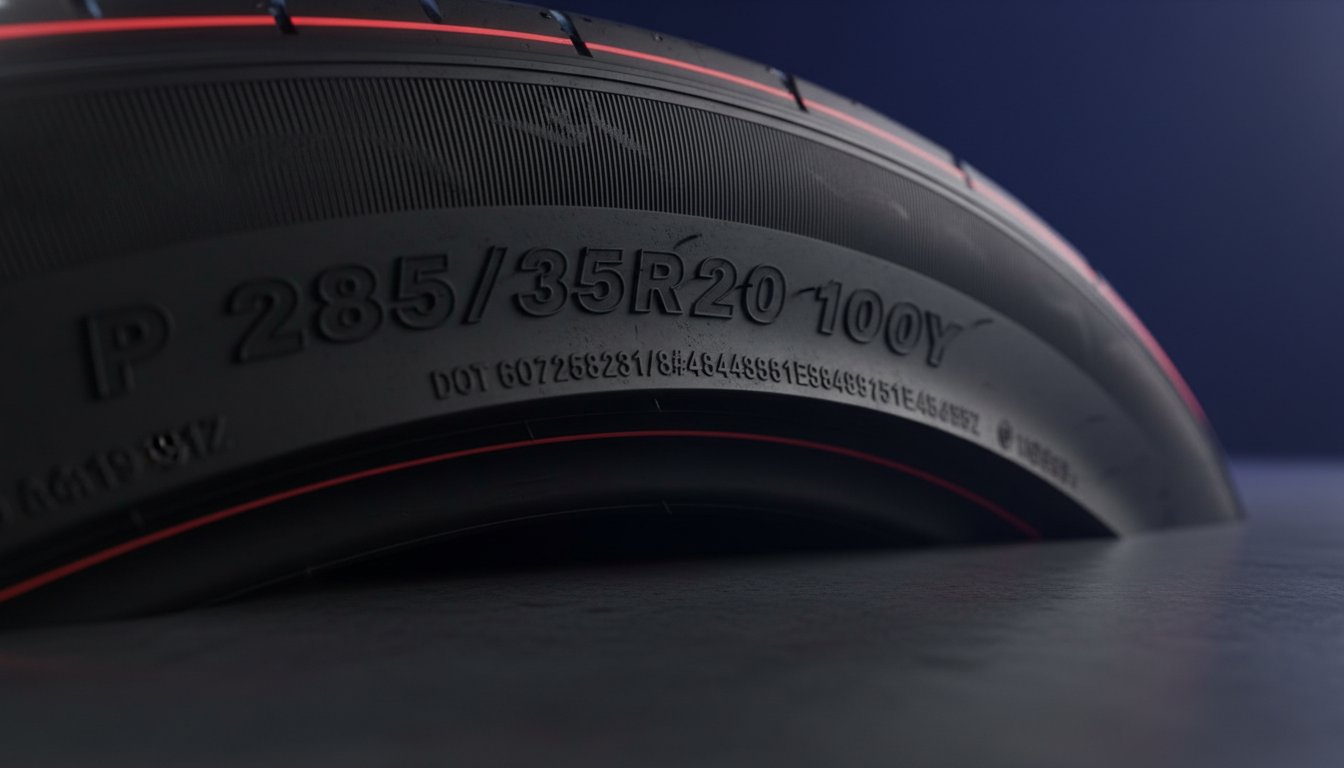
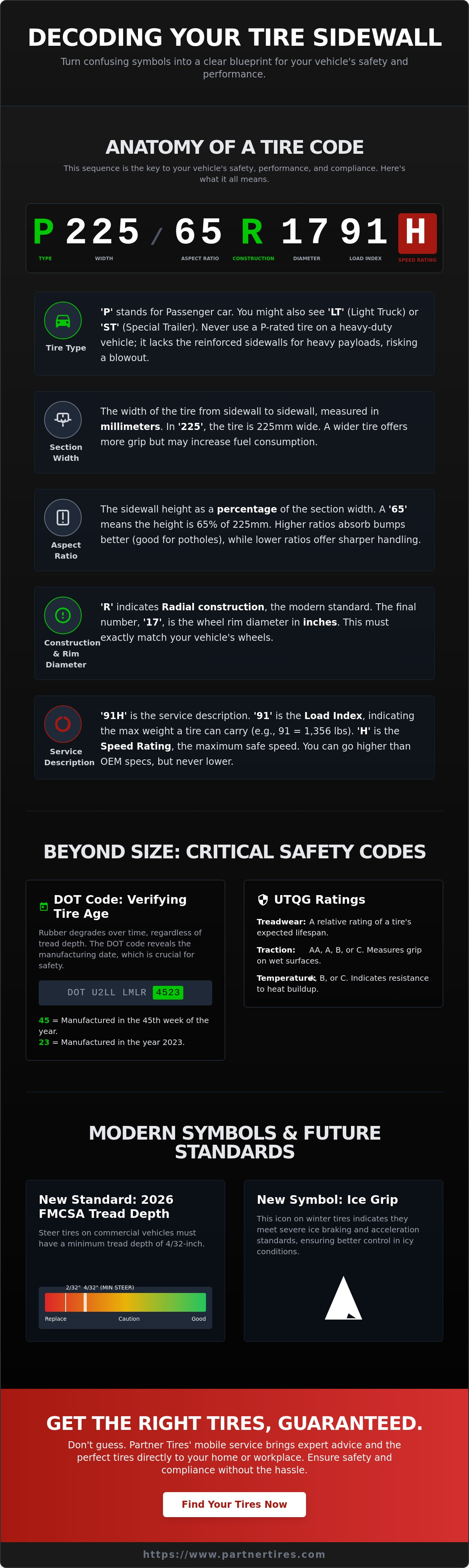
The alphanumeric string on your tire is more than a label; it is a standardized tire code that dictates your vehicle's safety and performance limits. This "Big 6" sequence, such as P225/65R17, is the first piece of data any professional tire dealer requires. It defines the physical footprint and structural capacity of your rubber. Choosing the wrong size does not just cause fitment issues. It directly impacts your speedometer accuracy because the vehicle's computer calculates speed based on the tire's outer diameter. If your new tires are taller than the originals, your speedometer will display a speed lower than your actual pace. This creates legal risks and safety concerns. You can find the manufacturer's recommended specs on the driver-side door jamb or in your owner’s manual. Always compare these to the current sidewall markings before ordering new stock to ensure your vehicle operates within its design parameters.
To better understand this concept, watch this helpful video:
Tire Type and Section Width
The first letter in the sequence identifies the vehicle class. "P" stands for Passenger, "LT" for Light Truck, and "ST" for Special Trailer. Using a P-rated tire on a heavy-duty truck is a liability. Passenger tires lack the reinforced sidewalls needed to support heavy payloads, leading to premature failure or blowouts. The following three digits represent the section width in millimeters. This is the measurement from sidewall to sidewall. A wider tire generally offers more traction but can increase rolling resistance and fuel consumption. Understanding how to read tire sidewall markings allows you to maintain the precise balance of grip and efficiency your vehicle was engineered for. If you operate a fleet or a heavy-duty work truck, checking the "LT" prefix is critical to supporting your equipment and avoiding downtime.
Aspect Ratio and Rim Diameter
The two-digit number after the slash is the aspect ratio. This is not a direct measurement in inches or millimeters. Instead, it is a percentage of the section width. A "65" means the sidewall height is 65% of the tire's width. In Birmingham, this number matters for your daily commute. A higher aspect ratio provides more rubber between the road and your rim, which helps absorb the impact of potholes on local routes. A lower profile tire offers sharper handling but less protection for your wheels. Finally, the last number indicates the rim diameter in inches. This must match your existing wheels exactly. You cannot mount a 17-inch tire on an 18-inch rim. Accuracy here is the foundation of a successful tire replacement and long-term operational success. It ensures the bead of the tire seats correctly, preventing air leaks and ensuring your computerized wheel balancing remains effective.
Understanding Load Index, Speed Ratings, and Construction
The alphanumeric string does not end with the wheel diameter. Immediately following the size is the service description, a combination of a two or three-digit number and a single letter. This code is the operational heart of your tire. It dictates the maximum weight the tire can support and the top speed it can safely maintain. While you can always install a tire with a higher rating than your original equipment manufacturer (OEM) specs, you must never go lower. Reducing these ratings compromises your vehicle’s structural integrity. Learning how to read tire sidewall markings ensures you don't accidentally downgrade your vehicle's capabilities. These ratings directly influence your car’s handling and braking distance. A tire with a higher speed rating often features a stiffer sidewall, which provides more precise steering response during emergency maneuvers.
The Load Index: Can Your Tires Carry the Weight?
The load index is a numerical code that represents the maximum weight a tire can carry when properly inflated. For example, a load index of 91 means the tire can support 1,356 pounds. Hoover drivers who frequently tow trailers or carry heavy equipment must pay close attention to this figure. Overloading a tire with a low index causes excessive heat buildup. This leads to internal structural damage and increases the risk of a high-speed blowout. Always calculate your total vehicle weight, including passengers and cargo, against the combined load capacity of all four tires. When you are ready to upgrade, consulting experts ensures you select the correct new tires for your specific load requirements.
Speed Ratings: From L to Y
Speed ratings use letters to indicate the maximum speed a tire can sustain over time. Common ratings include H (up to 130 mph) and V (up to 149 mph). These letters are not just about top speed. They are a measure of heat dissipation. Alabama highway driving on I-65 during the summer puts immense thermal stress on your rubber. A higher speed rating means the tire is better at shedding heat, which preserves the life of the tread and prevents delamination. Beyond the speed rating, you should also consult the Uniform Tire Quality Grading System to compare temperature resistance across different brands. Most modern passenger vehicles use Radial (R) construction, which is the industry standard for fuel efficiency and durability. Understanding how to read tire sidewall markings allows you to choose a tire that matches both your driving habits and the demanding regional climate.
Safety and Age: The DOT Code and UTQG Ratings
The DOT serial number is your tire's birth certificate. It tracks the manufacturing history and safety record of every unit produced. While many drivers focus solely on tread depth, rubber compounds degrade over time regardless of mileage. Six years is the industry standard for tire retirement. After this point, the chemical bonds in the rubber weaken. This increases the risk of structural failure or delamination. Understanding how to read tire sidewall markings allows you to verify that a "new" tire hasn't been sitting in a warehouse for years before it reached your vehicle. Old stock is a liability, not a bargain. Mastering this data ensures you are investing in fresh, reliable rubber that meets 2026 safety standards.
Reading the 4-Digit Date Code
Locate the oval-shaped window at the end of the DOT string. It contains four numbers that reveal the tire's age. Use the 2+2 rule to decode it. The first two digits represent the week of manufacture. The last two digits indicate the year. For example, a code of "1224" means the tire was built in the 12th week of 2024. Checking this is vital when buying used tires in Birmingham, AL. Never gamble on tires that exceed the six-year threshold. Even if the tread looks deep, internal oxidation makes the tire a safety hazard. Always inspect both the inner and outer sidewalls, as the date code is often only printed on one side.
Temperature and Traction Ratings
The Uniform Tire Quality Grading (UTQG) system rates three performance metrics: Treadwear, Traction, and Temperature. Learning how to read tire sidewall markings for these grades helps you compare brands accurately.
- Temperature: A "Temperature A" rating is non-negotiable for Alabama's blistering summer heat. This grade measures a tire's ability to dissipate heat. Lower grades like B or C are more prone to failure when pavement temperatures soar on local interstates.
- Traction: Traction grades (AA, A, B, and C) measure a tire's ability to stop on wet pavement. An "AA" rating provides the maximum grip for rainy Southern afternoons.
- Treadwear: This numerical value helps you estimate the lifespan of your investment. A tire rated 600 should theoretically last three times longer than one rated 200 under identical conditions.
These ratings provide a clear logistical advantage. They allow you to select tires that balance financial outcomes with operational safety. High-traction, high-temperature tires protect your fleet and your family during the most demanding driving conditions.
Why Sidewall Markings Matter for Birmingham Drivers
Local driving conditions in Alabama turn technical tire data into operational survival. High humidity and extreme summer heat accelerate rubber oxidation faster than in cooler climates. Knowing how to read tire sidewall markings allows you to identify tires built to withstand these specific environmental stresses. If you ignore these codes, you risk premature failure on Highway 280 or I-65. Matching your markings is also essential when seeking a tire repair in Birmingham. Professionals need this data to ensure any patch or replacement aligns with your vehicle's safety requirements and structural integrity. This prevents costly rework and keeps your operational schedule on track.
Local Climate and Tire Degradation
Alabama's climate is brutal on rubber compounds. Intense UV rays cause sidewall cracking, commonly known as dry rot. This degradation happens even if your tread depth meets legal requirements. A tire that sits in the Birmingham sun for five years is often less safe than a two-year-old tire with higher mileage. You must look for the "Temperature A" rating mentioned in our decoding guide. It is your primary defense against blistering pavement temperatures. If you commute between Birmingham and Cullman daily, check for all-weather markings. These provide the necessary grip for sudden Southern rainstorms that turn dry interstates into slick hazards. Fresh rubber with the correct traction ratings ensures your financial investment doesn't wash away in a summer downpour.
Performance for Local Road Types
Birmingham's urban streets are notorious for rim-bending potholes. A tire with a higher aspect ratio provides more air volume to absorb these impacts. Conversely, SUV drivers in Vestavia often benefit from "XL" or Extra Load markings. These tires feature reinforced internal structures to handle the weight of larger vehicles on winding Jefferson County roads. Correct sizing is also the foundation of a proper maintenance routine. It is critical for wheel alignment shops near me to have accurate sidewall data before they adjust your suspension. Without the right tire dimensions, your alignment will never be precise. This leads to uneven tread wear and wasted capital. Don't leave your safety to chance. If your markings are faded or you're unsure of your current age codes, you can order new tires online and have our mobile team verify your fitment on-site.
Getting the Right Tires with Partner Tires' Mobile Service
Partner Tires acts as the logistical backbone for your vehicle's maintenance. Now that you have mastered how to read tire sidewall markings, you can provide the precise data our experts need to serve you efficiently. We don't just deliver rubber; we provide a complete mobile solution that respects your operational schedule. Our technicians use your sidewall information to pull the exact stock required from our inventory, ensuring a perfect fit the first time. This level of accuracy prevents delays and protects your financial health by avoiding incorrect orders or mismatched equipment. We treat every service call as a collaborative effort to keep your vehicle safe and your business moving.
Precision Mobile Service in Birmingham
We serve Hoover, Pelham, and the greater Birmingham area with professional mobile mounting and computerized wheel balancing. Reading your sidewall correctly is the first step in this partnership. When you provide the right sequence, we arrive with the specific equipment calibrated for your wheel diameter and aspect ratio. This precision is what sets Partner Tires apart from traditional shops that require you to wait in a lobby. We bring the service to your location, turning a time-consuming chore into a streamlined logistical win. Our mobile units are fully equipped to handle tire rotation and balancing on-site, ensuring your new investment performs at its peak from the moment it touches the pavement.
Book Your Mobile Tire Installation Today
The process is straightforward and designed for maximum efficiency. First, use your knowledge of how to read tire sidewall markings to identify your current size and service description. Second, visit our site to select your new tires or book a technician for at home tire installation. We also offer at work tire installation to keep your day moving without interruption. This service eliminates the need for towing or wasting hours at a brick-and-mortar garage.
Our commitment to safety is unwavering. Before mounting any tire, our technicians perform a final inspection of the sidewall markings to verify the load index and speed rating match your vehicle’s OEM requirements. Whether you need roadside assistance for a flat tire repair or a scheduled four-wheel alignment, Birmingham drivers trust us to deliver grit and expertise. We focus on the details so you can focus on your growth. Ready to upgrade your performance? Let Partner Tires come to you at home or work to handle your next installation with professional speed and precision.
Secure Your Operational Safety Today
Mastering how to read tire sidewall markings is more than a technical skill; it's a commitment to the longevity of your vehicle and the safety of your passengers. You now have the tools to identify the precise size, load capacity, and age of your tires. This knowledge prevents you from buying the wrong stock or operating on rubber that has exceeded its six-year service life. By understanding these codes, you protect your financial health and ensure your vehicle is ready for the intense Alabama heat.
Partner Tires stands ready to be the engine that drives your growth. We provide expert mobile service serving Birmingham and surrounding cities, bringing the tire shop directly to your location. Whether you need new or high-quality used tires, our team handles the logistics with grit and precision. Every appointment includes computerized balancing and professional mounting to ensure optimal performance. Don't let technical confusion slow your operations down.
Schedule Your Mobile Tire Installation with Partner Tires Now. We are the backbone of your operation, working behind the scenes to keep you moving forward with confidence.
Frequently Asked Questions
Where is the tire size located on my vehicle besides the tire itself?
You can find the manufacturer's tire specifications on the driver-side door jamb placard. This sticker lists the exact size, load rating, and cold inflation pressure required for your vehicle. If the placard is missing, check your owner's manual or the inside of the glove box door. Maintaining these original specifications ensures your safety systems and speedometer remain accurate.
What do the 'M+S' or '3PMSF' mountain snowflake symbols mean?
The 'M+S' marking indicates the tire meets basic standards for mud and snow traction. The '3PMSF' mountain snowflake icon signifies the tire has passed rigorous testing for severe snow conditions. As of February 2026, Colorado's Traction Law requires these specific designations on the I-70 Mountain Corridor. These symbols provide a clear indication of the tire's seasonal capability beyond a standard tread pattern.
Can I put a different tire size on my car than what is currently there?
You should only deviate from the original tire size if the new dimensions fall within the manufacturer's approved range. Changing the outer diameter alters your speedometer reading and can interfere with anti-lock braking systems. Learning how to read tire sidewall markings helps you identify if a proposed size change is safe. Consulting a professional ensures your new rubber doesn't rub against the wheel well.
How do I know if my tires are too old to drive on safely?
Tires are generally considered unsafe once they reach six years of age, regardless of how much tread remains. Locating the four-digit DOT date code is the most reliable way to verify age. The first two digits show the week and the last two show the year. If your tires were manufactured in 2018 or earlier, they are likely past their operational prime and require replacement.
What is the difference between a 'P' and an 'LT' tire marking?
'P' stands for Passenger and is designed for standard cars and light SUVs. 'LT' stands for Light Truck and features a reinforced construction for heavy payloads and towing. Putting a P-rated tire on a vehicle that requires an LT rating is a safety hazard. The LT sidewall is stiffer and can handle higher air pressures to support heavy equipment without overheating.
Does the tire sidewall tell me what the correct tire pressure should be?
The sidewall only lists the maximum cold inflation pressure the tire can structurally withstand. You must never use this number for daily driving. Instead, refer to the vehicle's tire information placard on the door jamb for the recommended PSI. Using the correct pressure improves fuel efficiency and prevents uneven tread wear. This protects your financial investment and ensures consistent handling.
What should I do if my tire markings are rubbed off or unreadable?
You must refer to the vehicle's documentation if the sidewall markings are unreadable due to curb rash or age. The door jamb sticker or owner's manual will confirm the required size and load index. If those are also missing, a professional technician can use your Vehicle Identification Number (VIN) to pull the factory specifications. Never guess your tire size as incorrect fitment compromises your braking.
Why do some tires have 'Inside' or 'Outside' markings on the sidewall?
These markings indicate an asymmetric tread pattern that must be mounted in a specific direction. The 'Outside' marking must face away from the vehicle to ensure the tread blocks function as designed for cornering and water evacuation. Incorrect mounting reduces traction and increases road noise. Understanding how to read tire sidewall markings for orientation is a critical step during professional mounting and balancing.


