

Would you trust your family's safety to a stranger's blurry smartphone photo and a "barely used" promise? We understand the pressure. High retail prices make a cheap set of used treads look like a vital financial win compared to a massive shop bill. However, you need to know: is it safe to buy tires from Facebook marketplace when you can't see internal structural damage or the true age of the rubber? A bad deal doesn't just waste your money. It puts your vehicle at risk of a high-speed blowout or a costly roadside failure.
This 2026 guide teaches you how to spot dangerous defects, identify common seller scams, and decide if those Marketplace savings are worth the potential safety hazard. You'll learn the specific technical markers of a healthy tire and how to verify DOT manufacturing dates. We will also show you how professional mobile mounting and computerized balancing can transform a private sale into a verified, road-ready solution for your vehicle. Your financial health depends on making smart, safe choices for your daily commute. Let's look at how to secure a reliable set of tires without the retail markup.
Key Takeaways
- Identify hidden structural defects that sellers often mask with low-resolution photos or temporary tire shine.
- Master the 4-digit DOT date code to ensure you aren't buying expired rubber prone to dry rot and catastrophic failure.
- Determine if is it safe to buy tires from Facebook marketplace by weighing the lack of consumer protections against the risk of high-speed blowouts.
- Calculate the total investment by factoring in professional mounting and computerized balancing fees before finalizing any private transaction.
- Discover why a certified inspection and pressure test are the only ways to guarantee a used tire's integrity before it reaches your vehicle.
The Real Risks of Buying Tires on Facebook Marketplace
Buying from a private individual on social media isn't a standard retail transaction. It's a gamble with your vehicle's safety. When you ask yourself if is it safe to buy tires from Facebook marketplace, you must realize there's zero consumer protection involved. Once the cash changes hands in a parking lot, you own those tires. If they leak, vibrate, or fail on the highway, you have no recourse. Unlike a professional service provider, a private seller won't offer a refund, a replacement, or a warranty. You're trading your peace of mind for a lower price tag.
Many tires look excellent in low-resolution photos but hide lethal defects. A tire might have deep tread but suffer from internal belt separation. This occurs when a driver hits a pothole or curb, damaging the underlying tire construction and safety standards. These internal failures aren't visible to the naked eye. They only reveal themselves when the tire is under pressure and heat at highway speeds. A "fresh" looking tire that is actually 10 years old is a common Marketplace scam that puts your safety at risk.
The "Invisible" Dangers of Used Rubber
Rubber is an organic compound that degrades over time regardless of mileage. Even if a tire sat in a shed for years, it can develop dry rot. This process makes the sidewalls brittle and prone to cracking. We also see many tires listed that were previously repaired with subpar plugs. A plug in the sidewall or shoulder area is a major safety violation. These tires are ticking time bombs. They look functional until they experience a sudden, catastrophic blowout during your commute.
Why Private Sellers Are Often Unreliable
Most Marketplace sellers lack the technical knowledge to judge tire health. They often store inventory in outdoor piles or hot garages. Exposure to UV rays and extreme temperature swings ruins the rubber's chemical integrity. Sellers also rely on the "penny test" for tread depth, which is dangerously inaccurate for modern safety needs. They don't have the specialized equipment to check for "cupping" or uneven wear patterns caused by a bad alignment on the previous vehicle. Without a professional diagnostic scan and inspection, you're betting your safety on a stranger's guesswork. Partner Tires provides a safe alternative by offering certified used inventory and professional mobile installation that ensures your tires are road-ready.
How to Inspect Used Tires: The 5-Point Safety Checklist
You cannot judge a tire's health by a quick glance in a parking lot. Determining if is it safe to buy tires from Facebook marketplace requires a systematic approach. Sellers often use tire shine to mask dry rot or highlight deep tread while ignoring structural failures. Adhering to NHTSA tire safety guidelines ensures you aren't ignoring critical warning signs. Use this 5-point checklist before any money changes hands:
- Step 1: Decode the DOT Date Code. Locate the 4-digit age stamp on the sidewall to verify the tire's manufacturing date.
- Step 2: Inspect for "Cupping." Rub your hand across the tread to feel for uneven dips or scalloped wear patterns.
- Step 3: Check for Bead Damage. Look for tears or chunks missing from the inner rubber ring where the tire meets the rim.
- Step 4: Look for Internal Repairs. Inspect the inside of the tire for patches or plugs that indicate previous punctures.
- Step 5: Feel for Sidewall Bulges. Run your hand along the sidewall to detect "bubbles" that signal internal cord failure.
Reading the DOT Date Code Like a Pro
Every tire has a Department of Transportation (DOT) string of 10 to 12 characters. The most vital information sits in the final four digits. This "Week-Year" format tells you exactly when the rubber was produced. For example, a code of 1226 indicates the tire was manufactured in the 12th week of 2026. Rubber compounds naturally break down over time. You should never buy a tire older than six years regardless of how much tread remains. Aged rubber loses its grip and becomes prone to sudden failure on the highway.
Beyond Tread Depth: Identifying Wear Patterns
Tread depth only tells part of the story. You must analyze how the tire wore down during its previous life. If the center of the tread is significantly thinner than the edges, the tire was consistently over-inflated. Conversely, "feathering" or sharp edges on the tread blocks suggest serious alignment issues from the donor vehicle. These patterns are detailed in our Partner Tires guide on wheel alignment. Buying a tire with existing wear issues will cause vibrations and noise on your own car. If you find a set that passes these tests, letting a professional handle the mobile tire installation provides the final layer of safety for your vehicle.
Hidden Costs: Why Marketplace Tires Often Cost More
The sticker price of a used tire is deceptive. Many buyers focus solely on the cash they hand over in a parking lot, but that transaction only represents about 50% of the total investment. When you evaluate is it safe to buy tires from Facebook marketplace, you must include the mandatory professional services required to get those tires on the road. You cannot simply bolt them on yourself. You'll need to pay for professional mounting, computerized wheel balancing, and the disposal fee for your old, worn-out set. These labor costs are fixed. They remain the same whether you're installing a premium new tire or a $40 Marketplace gamble.
Logistics also drain your wallet and time. Driving across Birmingham to meet a stranger in a parking lot consumes fuel and hours of your day. If you arrive and find the tires are dry-rotted or have hidden patches, you've wasted those resources for nothing. Even if the deal goes through, you're left hauling dirty, oily rubber in your clean trunk or backseat. Following NHTSA tire safety guidelines helps you avoid buying unusable inventory, but it doesn't solve the transport headache. Many local shops also refuse to install customer-supplied used tires due to liability concerns, leaving you with a set of rubber you can't even use.
The Math of "Cheap" Tires
The per-mile cost of used tires rarely favors the buyer. A $50 used tire with 40% tread remaining might seem like a bargain compared to a $150 new tire. However, you'll pay the full installation price again in a fraction of the time. Used tires often require balancing more frequently because they've already developed specific wear patterns from a previous vehicle. If a Marketplace tire develops a belt separation or a slow leak within three months, your entire investment is gone. There's no warranty to cover the loss. A new tire provides years of predictable service, making the annual cost significantly lower than a series of cheap, short-lived used sets.
The Convenience Gap
Finding a reliable partner to handle the installation is the final hurdle. Most traditional shops prioritize customers who buy their inventory. This creates a service gap for Marketplace buyers. Partner Tires solves this logistical bottleneck with professional mobile tire delivery and installation. We come to your home or office, bringing the shop to you. This eliminates the need to transport dirty tires or wait in a lobby. We provide the computerized balancing and certified inspection necessary to turn a private sale into a reliable automotive solution. By choosing a professional mobile service, you ensure your savings aren't erased by hidden fees and wasted time.
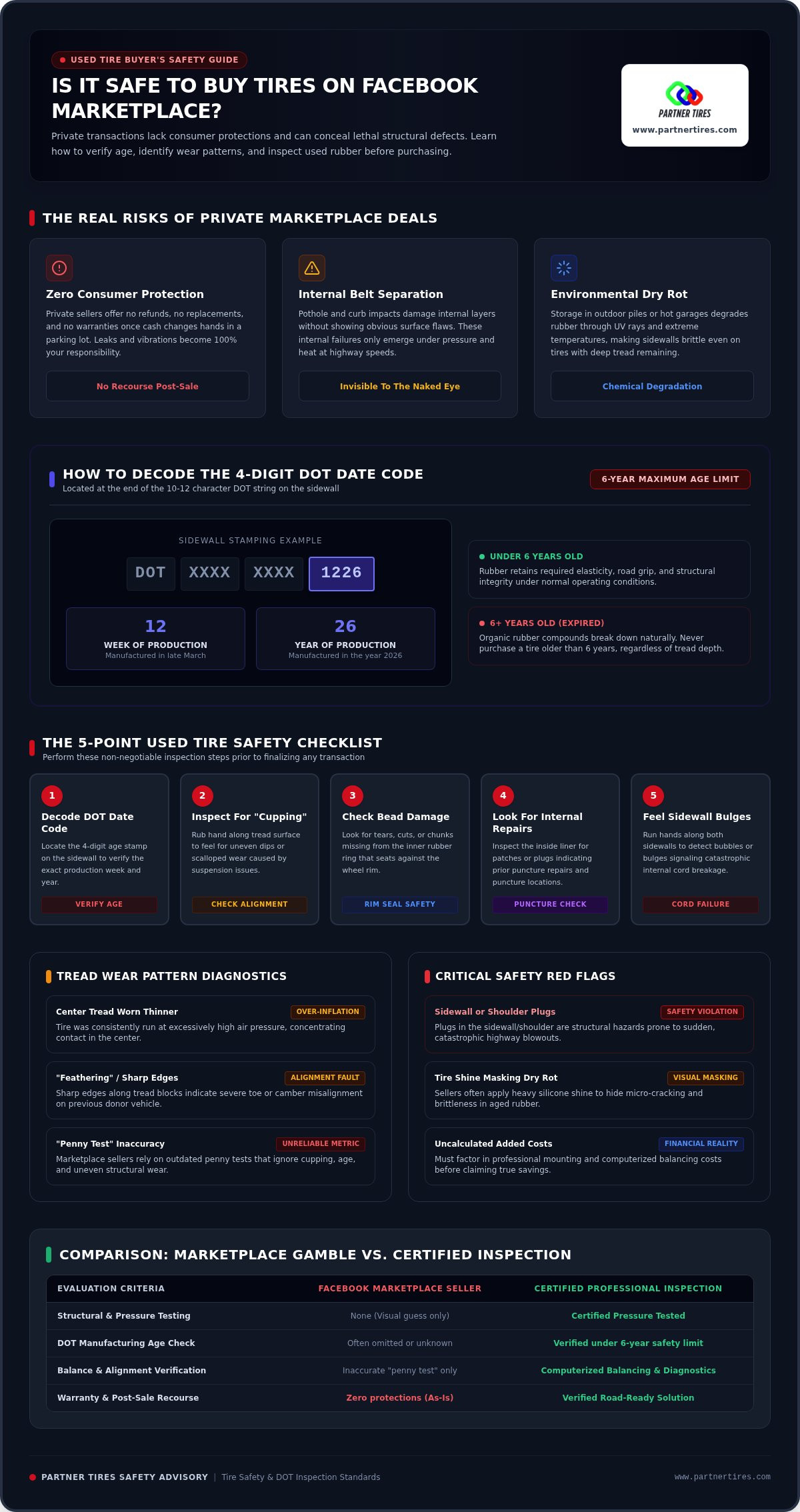
Marketplace vs. Certified Used Tires: Which Is Better?
Choosing between a "parking lot deal" and a reputable shop is a choice between a gamble and a guarantee. While a private seller might offer the lowest initial price, they cannot provide the technical verification your vehicle requires. When you consider is it safe to buy tires from Facebook marketplace, remember that liability rests entirely on your shoulders the moment the transaction ends. A certified retailer has a reputation to protect and a physical presence in the community. They stand behind their inventory with professional accountability that a stranger on social media simply won't match.
Professional retailers provide a level of safety through specialized equipment that private individuals don't own. A visual check in a gas station parking lot cannot replace a high-pressure test or a computerized diagnostic scan. If a tire from a certified shop fails to balance or reveals a hidden defect during installation, the shop handles the replacement. On Marketplace, you have no recourse and no return policy. You're left with a useless piece of rubber and a drained bank account. This lack of protection makes the professional alternative the only logical choice for maintaining your vehicle's operational health.
The Partner Tires Used Tire Standard
We don't rely on guesswork or blurry photos to judge tire quality. Every unit in our inventory undergoes a rigorous multi-point inspection process before it's listed for sale. We perform high-pressure tests to detect microscopic leaks and structural weaknesses that are invisible to the naked eye. This ensures that every used tire we deliver meets the same safety expectations as our new inventory. Our commitment to reliability means you get the financial benefit of used rubber without the traditional risks. For a deeper look at our selection process, read The Smart Shopper’s Guide to Used Tires in Birmingham.
Birmingham Market Comparison
Drivers in Hoover and Bessemer increasingly prefer certified shops over "curb-side" installers. These mobile or roadside sellers often use uncalibrated, outdated equipment that can damage your wheels or provide inaccurate results. We utilize computerized wheel balancing to ensure your tires rotate perfectly at highway speeds. This precision eliminates the vibrations and premature wear caused by amateur mounting. By choosing a professional partner, you avoid the technical failures common with Marketplace purchases. You deserve the peace of mind that comes from a verified, road-ready solution. If you're ready to upgrade your vehicle safely, browse our certified used tire inventory today and experience the difference of professional service.
Safe Installation: Getting Tires Mounted in Birmingham
Professional installation is the final barrier between a smart purchase and a highway disaster. You should never attempt to mount tires at home using pry bars or improvised tools. Modern rims are easily damaged; seating a bead requires high-pressure equipment that DIY setups lack. If you are questioning is it safe to buy tires from Facebook marketplace, the answer depends heavily on the quality of the mounting process. Professional computerized balancing is non-negotiable for used rubber. It compensates for the existing wear patterns we discussed earlier, ensuring a smooth ride and protecting your suspension components from excessive vibration.
Once your tires are mounted, the work isn't done. A set of used tires can feel different on your vehicle than they did on the previous one. Computerized wheel balancing identifies heavy spots in the rubber and corrects them with precision weights. Without this step, you'll experience steering wheel shake and premature tread wear. We also recommend scheduling a four-wheel alignment immediately after installation. This ensures your vehicle tracks straight and prevents the mechanical issues that often lead people to sell their tires on Marketplace in the first place.
Mobile Tire Service: The Ultimate Convenience
We eliminate the logistical struggle of transporting used tires to a traditional shop. Our mobile service vans bring professional-grade mounting and balancing equipment directly to your driveway or office parking lot. We provide comprehensive coverage across the region, serving clients in Birmingham, Hoover, and Pelham. Our service area extends from Trussville to Cullman and everywhere in between. This service allows you to remain productive while we handle the heavy lifting. By choosing a mobile partner, you avoid the risk of dirtying your vehicle's interior or waiting hours in a service lobby. We transform a Marketplace gamble into a verified, road-ready solution with the speed and precision your schedule demands.
Final Safety Checks Before You Drive
Our commitment to your safety extends beyond the mounting machine. Every installation concludes with a series of technical verifications. We torque every lug nut to your vehicle's specific manufacturer specifications using calibrated tools. This prevents wheel detachment and ensures even pressure on your brake rotors. We also set the correct PSI based on your door placard to maximize fuel economy and tire life. Finally, we perform a TPMS sensor reset to ensure your dashboard monitoring system functions correctly. Partner Tires is your dedicated ally in maintaining a safe, efficient vehicle. We provide the professional confirmation you need to drive with confidence.
Secure Your Vehicle with Professional-Grade Solutions
Determining if is it safe to buy tires from Facebook marketplace depends on your ability to verify structural integrity and manufacturing age. We've established that low prices often hide dangerous defects like dry rot and belt separation. These risks, combined with the hidden costs of mounting and disposal, frequently erase the initial savings. You deserve a reliable vehicle that doesn't compromise your safety or your financial health. Professional verification is the only way to ensure your rubber isn't a ticking time bomb on the highway.
Partner Tires serves as your dependable foundation for road safety. We eliminate the uncertainty of private sales by providing certified used inventory that has passed rigorous pressure tests and visual inspections. Our team brings the equipment to you with mobile installation at your home or work in Birmingham, Hoover, and surrounding areas. Every set includes computerized wheel balancing to ensure peak performance and a smooth ride from day one. We handle the logistics so you can focus on your business and your family.
Skip the Marketplace Gamble-Shop Certified Used Tires at Partner Tires. Invest in peace of mind and keep your vehicle moving forward with confidence and reliability.
Frequently Asked Questions
Is it legal to sell used tires on Facebook Marketplace?
Yes, it is legal to sell used tires privately in Alabama. However, private individuals aren't held to the same safety inspection standards as commercial retailers. When you consider is it safe to buy tires from Facebook marketplace, remember that the legal burden of safety rests on the buyer. Marketplace doesn't verify the condition of automotive parts. You must perform your own due diligence to ensure the rubber meets road safety standards before installation.
How old is too old for a used tire?
Industry standards suggest that six years is the point where rubber begins to lose its chemical integrity. Tires older than ten years are considered unsafe regardless of tread depth. You can find the manufacturing date by checking the DOT code on the sidewall. If a seller hides this code or the tires are over six years old, you should avoid the purchase to prevent sudden dry rot failures on Birmingham highways.
Will a tire shop mount tires I bought on Marketplace?
Many traditional shops in Hoover and Bessemer refuse to mount customer-supplied used tires due to liability concerns. They can't guarantee the internal safety of rubber they didn't source. Partner Tires provides a specialized solution by offering mobile tire mounting and computerized wheel balancing for tires you've already purchased. We bring professional equipment to your location, ensuring your Marketplace finds are installed correctly and safely without the wait at a retail lobby.
What is the "Penny Test" and does it actually work?
The penny test involves placing a coin into the tread groove to see if Lincoln's head is covered. While it's a popular DIY method, it only measures tread depth and ignores structural health. A tire can pass the penny test but still be ten years old or have internal belt damage. Relying solely on this test is a mistake. Professional depth gauges and visual inspections for dry rot provide a much more accurate safety assessment.
Can I tell if a tire has a broken belt just by looking at it?
You often can't see a broken belt until the tire is mounted and inflated. Look for a wavy appearance in the tread or a tire that looks "out of round" when rolling. These internal failures cause severe vibrations at highway speeds and can lead to a catastrophic blowout. If you're wondering is it safe to buy tires from Facebook marketplace, realize that internal belt separation is one of the most common hidden defects in private sales.
What should I do if I find a bubble in my Marketplace tire sidewall?
A bubble in the sidewall indicates a terminal structural failure. The internal cords have snapped, and only a thin layer of rubber is holding the air pressure. You must replace the tire immediately; it's not repairable. Driving on a bubbled tire in Birmingham's summer heat is extremely dangerous. If you discover this defect after a Marketplace purchase, do not mount the tire on your vehicle. It's a total loss that requires immediate replacement.
Is it better to buy two new tires or four used tires?
This depends on your vehicle's drivetrain and your immediate budget. For all-wheel-drive vehicles, having four tires with matching tread depth is critical for protecting your differential. In many cases, four high-quality certified used tires are a safer choice than two new tires paired with two bald ones. Our team can perform a diagnostic scan and inspection to help you determine the most cost-effective and safest configuration for your specific vehicle and driving habits.
How much does it cost to get tires mounted and balanced in Birmingham?
Mounting and balancing fees in Birmingham are standard labor costs that apply to every tire installation. These fees cover the use of specialized tire machines and computerized balancers. You must factor these expenses into your total budget when buying from a private seller. While we don't quote specific prices here, remember that professional installation is an investment in your vehicle's longevity. Proper balancing prevents the vibrations that damage your suspension and steering components over time.


