

That subtle steering wheel shake at 60 mph isn't just a minor annoyance. It's a silent tax on your vehicle's lifespan. You've likely felt that rhythmic vibration while driving through Birmingham and wondered how to know if tires are balanced correctly before the damage gets worse. It's a frustrating position to be in, especially when you want to protect an expensive new set of tires from premature wear. You need clarity to avoid overpaying for repairs that don't solve the core problem.
This guide identifies the specific symptoms that separate a simple balancing issue from a complex alignment problem. You'll learn to spot the warning signs before they lead to expensive suspension failure or unsafe handling. We'll provide a clear symptoms list, explain why computerized precision is the only solution for modern vehicle tech, and show you how to find a reliable mobile professional in Hoover or Mountain Brook. Let's get your vehicle back to peak performance and restore the smooth ride you deserve.
Key Takeaways
- Recognize how specific vibration locations, like the steering wheel or seat, pinpoint exactly which tires require immediate attention.
- Learn how to know if tires are balanced correctly by identifying subtle signs before they cause permanent damage to your suspension.
- Distinguish between wheel balancing and alignment to avoid unnecessary service costs. It's the best way to ensure you're investing in the right solution.
- Leverage computerized balancing to protect the lifespan of your tires and ensure your vehicle's tech performs at peak efficiency.
- Access professional mobile tire maintenance across the Birmingham metro area to save time without sacrificing precision.
Understanding Tire Balance: Why It Matters for Birmingham Drivers
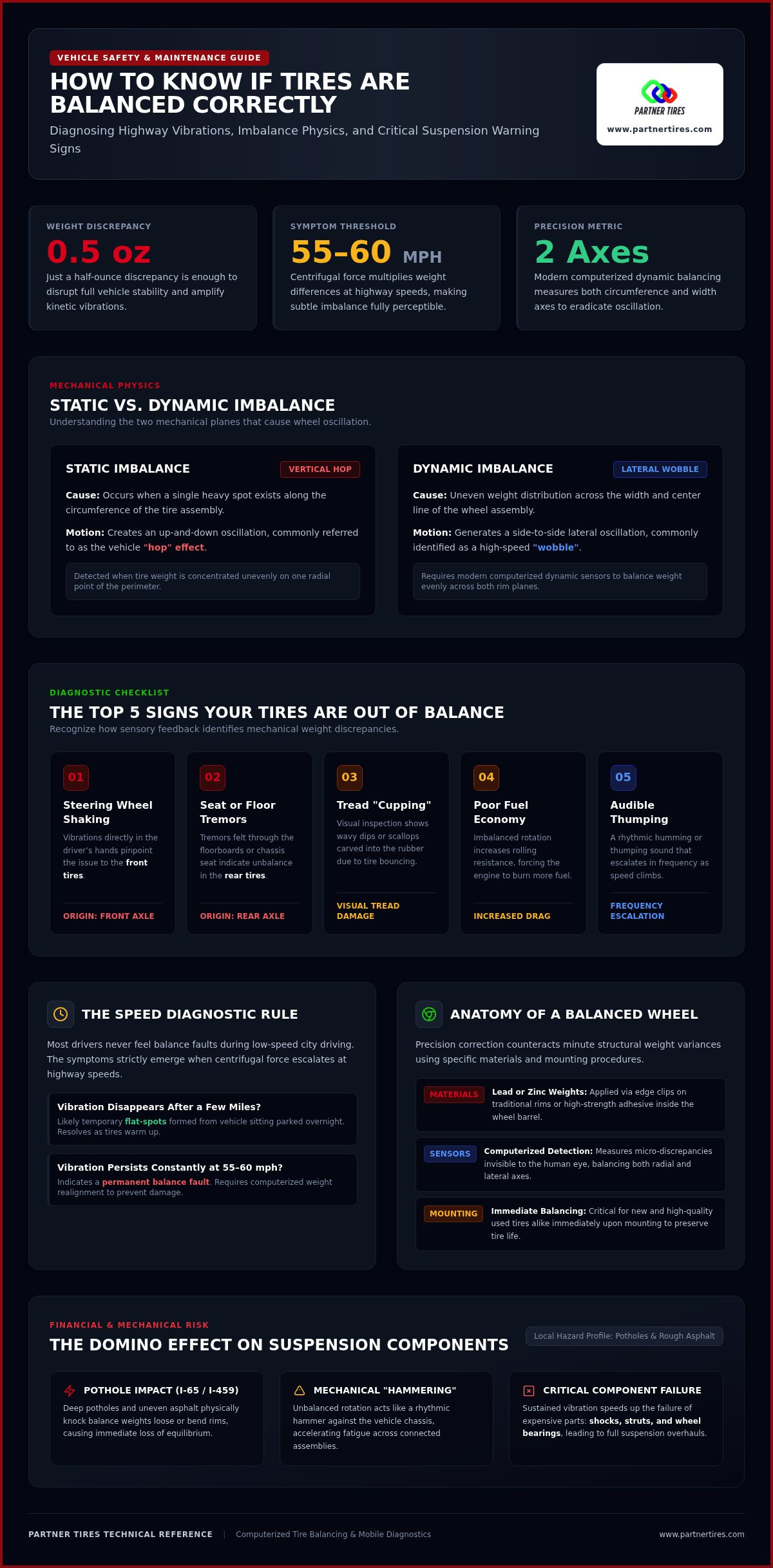
Tire balance is the precise equalization of weight within the tire and wheel assembly. When a wheel rotates, any heavy spot creates an uneven distribution of mass. This forces the tire to oscillate rather than roll smoothly. Understanding how to know if tires are balanced correctly begins with recognizing that even a half-ounce discrepancy can disrupt your vehicle's stability. It's a foundational requirement for safe operation and optimal fuel efficiency.
At highway speeds, centrifugal force amplifies these tiny weight differences. A small imbalance generates significant kinetic energy, manifesting as a rhythmic vibration that travels through the steering column or chassis. For drivers navigating Birmingham's varied terrain, the risks are higher. Our local roads, often scarred by deep potholes and uneven asphalt, can physically knock balancing weights loose or bend a rim. This immediate loss of equilibrium turns a smooth commute into a mechanical liability that compromises your control over the vehicle.
Ignoring these signs impacts your financial health. Unbalanced tires don't just wear down rubber; they act like a hammer against your vehicle's foundation. The constant vibration accelerates the failure of expensive components like shocks, struts, and wheel bearings. Addressing the issue early prevents a minor maintenance task from evolving into a major suspension overhaul. Reliability starts with ensuring every rotating component is working in harmony with your vehicle’s design.
Static vs. Dynamic Imbalance
Static imbalance occurs when there's a heavy spot on one side of the tire's circumference. This causes a vertical movement, often called the "hop" effect. Dynamic imbalance involves weight distribution across the width of the tire, leading to a side-to-side "wobble." Modern vehicles require dynamic balancing to handle higher highway speeds. Computerized systems measure both axes to eliminate these vibrations, ensuring the tire remains stable regardless of how fast you're traveling on I-65 or I-459.
The Anatomy of a Balanced Wheel
Technicians restore balance using small lead or zinc weights. These are either clipped to the rim's edge or applied with high-strength adhesive to the interior barrel of the wheel. Computerized sensors detect micro-discrepancies that the human eye cannot see. This precision is mandatory regardless of the tire's age. Even if you purchase high-quality used tires Birmingham AL drivers trust, they must be balanced immediately upon mounting. Proper installation ensures that every ounce of weight works with your vehicle, not against it.
The Top 5 Signs Your Tires Are Out of Balance
Identifying a mechanical issue early protects your investment. Learning how to know if tires are balanced correctly starts with your senses. Your vehicle provides physical and auditory feedback when the weight distribution is off. Don't ignore these signals; they're the first line of defense against more expensive suspension repairs. Most drivers notice five primary indicators during their daily commute.
- Steering Wheel Vibrations: If the wheel shakes in your hands, the issue usually lies in the front tires.
- Floorboard or Seat Vibrations: When you feel the tremor through your seat or the car floor, the rear tires are likely the culprits.
- Uneven Tread Wear: Inspect your tires for "cupping," which appears as wavy dips or scallops in the rubber.
- Poor Fuel Economy: Imbalanced tires increase rolling resistance. This forces the engine to consume more fuel to maintain speed.
- Audible Thumping: A rhythmic humming or thumping sound that increases in frequency with your speed often points to a heavy spot on the wheel.
Diagnosing Vibrations by Speed
Most drivers don't notice balance issues during low-speed city driving. These symptoms typically emerge once you reach highway speeds, specifically between 55 and 60 mph. If the vibration is constant at high speeds, it's a balance problem. However, if the shaking disappears after a few miles of driving, your tires may have had temporary flat-spots from sitting parked overnight. Consistent vibration is a clear indicator that your wheels need professional attention. Following tire safety guidelines from NHTSA ensures your vehicle remains safe and efficient on the road.
Visual Cues on the Tire Tread
A physical inspection can confirm what you feel on the road. "Cupping" occurs when an imbalanced tire bounces, causing specific parts of the tread to wear faster than others. You can use the "Penny Test" to check general depth, but look specifically for unevenness across the tire's surface. Regular tire repair Birmingham inspections help catch these patterns before the tire requires full replacement. If you notice these dips, the tire is no longer making consistent contact with the pavement. For a precision check, you can always reach out to Partner Tires for a professional diagnostic scan and computerized balancing.
Tire Balancing vs. Wheel Alignment: Clearing the Confusion
Drivers often use the terms balancing and alignment interchangeably, but they address different mechanical needs. Balancing corrects weight distribution within the tire and wheel assembly itself. Alignment adjusts the angles of the wheels so they remain parallel to each other and perpendicular to the road. Distinguishing between these two is the first step in learning how to know if tires are balanced correctly versus when your vehicle requires a suspension geometry reset. Both are essential for a smooth, safe ride through Birmingham.
You can use the "Vibration vs. Pulling" rule as a reliable diagnostic shortcut. If your vehicle shakes or vibrates at highway speeds, you likely have a balance issue. If the car drifts to the left or right while you're trying to drive straight, your alignment is off. Always balance your tires whenever you mount a new or used set. This ensures the heavy spots in the rubber don't fight against your steering system from day one. Proper weight distribution is the foundation of tire longevity.
When to Get a Wheel Alignment
Birmingham potholes are notorious for knocking suspension components out of place. A single hard impact can shift your wheel angles, even if your tires remain perfectly balanced. Common symptoms of poor alignment include an off-center steering wheel or the vehicle pulling hard to one side on a flat road. If you've recently hit a curb or a deep hole on I-65, a visual check of your tread for "sawtooth" wear is a smart move. For more localized advice, read our comprehensive guide on expert wheel alignment shops near me to find a specialist in the metro area.
The Synergy of Both Services
Balancing and alignment work together to protect your vehicle's foundation. Performing one without the other often provides only a partial solution to handling problems. Adhering to tire safety guidelines from NHTSA ensures you maintain maximum traction and braking efficiency. Most industry professionals recommend a maintenance check every 5,000 to 7,000 miles. This proactive approach saves you money by preventing the premature failure of expensive tires and suspension parts. Regular service turns your maintenance schedule into a predictable business expense rather than an emergency repair bill.
How Professionals Test for Perfect Balance
Precision is the difference between a temporary fix and a long-term solution. Professional testing moves beyond road feel to objective data. If you're wondering how to know if tires are balanced correctly, the answer lies in high-frequency sensors. Modern computerized balancers measure discrepancies down to the fraction of an ounce. This level of accuracy is mandatory for the high-tech suspension systems found in 2026 model-year vehicles. It ensures that every rotation is perfectly centered, preventing the mechanical fatigue that leads to expensive repairs.
The Computerized Balancing Process
Technicians start by mounting the wheel assembly onto a high-speed spindle. The machine spins the tire at high RPMs to simulate actual highway speeds. During this rotation, advanced lasers and sensors identify the exact heavy spots on both the inner and outer planes of the wheel. The computer then calculates the precise amount of weight needed and the exact location for placement. The technician's role is to apply these weights with surgical precision. This ensures the center of gravity is perfectly aligned with the axis of rotation, eliminating the "hop" and "wobble" described in earlier sections.
Road Force Technology Explained
Standard balancers measure weight distribution, but Road Force Balancing is the gold standard for sensitive modern suspensions. This specialized equipment uses a large load roller to press against the tire while it spins. It simulates the actual weight of your vehicle as it travels down I-65 or through the hills of Vestavia. This process detects "uniformity" issues, such as hard spots in the tire's internal structure or a slightly out-of-round rim, that standard balancers miss. If you're still searching for how to know if tires are balanced correctly after a standard check, Road Force technology provides the final word on wheel uniformity. It's an essential service for luxury vehicles and low-profile tires that are highly sensitive to road vibrations.
Weight placement also matters for the aesthetics and integrity of your wheels. Technicians use clip-on weights for standard steel rims, but alloy wheels often require adhesive stick-on weights hidden behind the spokes. This prevents damage to the wheel's finish while maintaining perfect equilibrium. If your steering wheel still shakes after a basic service, you likely need a more detailed Road Force diagnostic. You can schedule computerized wheel balancing with Partner Tires today to ensure your vehicle meets professional performance standards.
Restoring Your Ride: Mobile Balancing and Maintenance in Birmingham
Identifying a mechanical issue is only half the battle. Once you've used our symptoms list to determine how to know if tires are balanced correctly, you need a solution that fits your professional schedule. Traditional shops often require you to sacrifice hours in a waiting room. Partner Tires eliminates this friction by bringing computerized precision directly to your location. We serve the entire Birmingham metro area, ensuring your vehicle's safety doesn't come at the cost of your productivity.
Our service footprint covers Hoover, Vestavia, and Trussville, reaching busy professionals where they work and live. We've optimized our logistics to provide rapid response times across Jefferson and Shelby counties. This mobile approach is particularly effective when integrated with at home tire installation. It allows you to refresh your vehicle's foundation without leaving your driveway. We focus on efficiency so you can focus on your business.
Mobile Service: How It Works
Our fleet consists of custom-equipped vans designed for high-stakes automotive maintenance. Each unit carries state-of-the-art computerized balancers that deliver the same accuracy as a fixed-location shop. We provide the same precision as a traditional shop without the wait. This setup allows us to handle everything from standard tire rotations to complex diagnostic scans in your office parking lot. For families in Mountain Brook and Homewood, this means maintaining vehicle safety between school runs and client meetings. We bring the expert to you, eliminating the logistical headache of vehicle drop-offs.
Scheduling Your Diagnostic
Don't ignore the shake in your steering wheel. What starts as a minor vibration will eventually lead to uneven tread wear and compromised braking. Early intervention is the most effective way to protect your financial health and vehicle longevity. If you're still unsure how to know if tires are balanced correctly, a professional mobile diagnostic is the fastest way to get an answer. Partner Tires operates as a hardworking, no-nonsense ally for Birmingham drivers. We prioritize grit and regional expertise to keep your vehicle moving forward. You can Book your mobile tire balancing or installation today to restore your ride's performance and safety.
Restore Your Vehicle's Precision and Safety
Maintaining your vehicle's equilibrium is a direct investment in its longevity. You now understand how to know if tires are balanced correctly by identifying vibrations in the steering wheel or seat before they compromise your suspension. Distinguishing these symptoms from alignment issues ensures you apply the right fix at the right time. This proactive approach eliminates the silent tax of premature tire wear and protects your financial health.
Partner Tires bridges the gap between high-precision technology and your busy schedule. Our mobile units bring computerized wheel balancing directly to your home or office in Birmingham, Hoover, and surrounding metro areas. We provide the expert foundation your vehicle needs to perform reliably on every commute. Don't let a minor shake turn into a major repair bill. It's time to restore the smooth, predictable handling you deserve.
Get Your Tires Professionally Balanced in Birmingham: We Come to You!
Your safety and performance are our priority. We look forward to being the engine that drives your vehicle's growth and reliability on the road.
Frequently Asked Questions
How often should I have my tires balanced?
Industry professionals recommend balancing every 5,000 to 7,000 miles. This often aligns with your tire rotation schedule. Birmingham drivers navigating construction in Hoover or downtown should consider more frequent checks. If you feel a vibration before the mileage interval, schedule a diagnostic immediately. Maintaining this schedule ensures even tread wear and maximizes the lifespan of your tire set. It's the most reliable way to protect your long-term investment.
Can a tire go out of balance while driving?
Yes, tires frequently lose balance during normal operation. Hitting a large pothole in Vestavia or clipping a curb can dislodge the lead or adhesive weights. Additionally, uneven tread wear or a flat spot from emergency braking changes the weight distribution. Even mud or debris trapped inside the wheel barrel can cause a temporary shake. If the vibration persists after cleaning the wheels, you likely need a professional computerized re-balancing service.
What happens if I ignore unbalanced tires for too long?
Ignoring the signs leads to expensive mechanical failures. The constant vibration acts as a hammer against your vehicle's suspension, damaging shocks, struts, and wheel bearings. You'll also experience "cupping" on your tread, which ruins the tire permanently. This increased rolling resistance forces your engine to work harder, directly impacting your fuel economy. Prompt intervention saves you from a major overhaul and ensures your vehicle remains safe on Alabama highways.
Is tire balancing necessary every time I get a rotation?
While not mandatory for every rotation, combining these services is a smart maintenance strategy. A rotation moves tires to different positions to even out wear, but it doesn't correct weight discrepancies. If you want to know how to know if tires are balanced correctly, a professional check during rotation provides the most accurate data. Many Birmingham drivers prefer to balance their tires every 10,000 miles to maintain a factory-smooth ride.
Can I balance my own tires at home?
Effective tire balancing requires specialized computerized equipment that isn't available for home use. Traditional bubble balancers lack the precision needed for modern suspension systems and highway speeds. Professional machines simulate road force and detect weight discrepancies down to a fraction of an ounce. Attempting a DIY fix often leads to incomplete results and continued vibration. Partner Tires brings this high-level computerized technology directly to your driveway in Trussville or Bessemer.
How long does a professional tire balancing take?
A professional balancing service for a full set of four tires typically takes between 30 and 45 minutes. This timeframe includes mounting the wheels on the computerized spindle and applying the necessary weights. If you're using a mobile service in Hoover or Mountain Brook, you save the additional hours usually spent traveling to and waiting at a traditional shop. The process is efficient, ensuring your vehicle is back in operation with minimal downtime.
Why does my car shake only at certain speeds?
Vibrations usually emerge at specific speeds because of centrifugal force. An imbalanced heavy spot creates a rhythmic pull that matches the tire's rotation frequency. Most drivers notice this shake between 55 and 70 mph. At lower speeds, the energy isn't high enough to vibrate the chassis. If the shaking only happens during braking or at very low speeds, the issue might involve warped brake rotors rather than wheel balance issues.
Does tire balancing fix a car that pulls to one side?
No, tire balancing will not fix a vehicle that pulls or drifts to one side. Pulling is a classic symptom of poor wheel alignment, which involves the angles of your suspension. Balancing only addresses the weight distribution within the wheel assembly itself. If you're experiencing both shaking and pulling, you likely need both services. Our technicians in Birmingham can perform a diagnostic scan to determine exactly which maintenance task your vehicle requires.


