
Could that subtle steering wheel shake on I-459 be the warning sign that costs you an entire set of tires by next season? Many Birmingham drivers ignore minor vibrations, assuming they are just a side effect of our local road conditions. You need to know exactly how often should I get my tires balanced to avoid these unexpected expenses. Balancing isn't just a routine chore. It's a vital safeguard against uneven wear and mechanical strain that keeps your vehicle on the road longer.
We know your time is valuable and your vehicle must remain operational. This guide provides the exact mileage intervals and specific warning signs you need to protect your investment. You'll discover why the pothole-heavy streets of Birmingham require a more proactive approach to maintenance. We also clarify the common confusion between balancing and alignment so you can make informed decisions. This information ensures a smooth, vibration-free driving experience and helps you maximize the lifespan of your tires while staying on schedule. By following these professional standards, you can avoid the high costs of premature tire replacement and keep your business or commute moving forward.
Key Takeaways
- Master the standard maintenance schedule and understand how often should I get my tires balanced to prevent premature tread wear and protect your financial investment.
- Differentiate between steering wheel vibrations and vehicle pulling to determine if your car requires computerized wheel balancing or a four-wheel alignment.
- Protect your vehicle from Birmingham's unique road stressors, including pothole impact on I-65 and temperature-driven pressure changes in Jefferson County.
- Identify the specific "heavy spots" in your wheel assembly that cause highway-speed vibrations and lead to long-term suspension damage.
- Discover the logistical efficiency of mobile tire services that bring professional computerized balancing directly to your home or office.
What is Tire Balancing and Why Does It Matter?
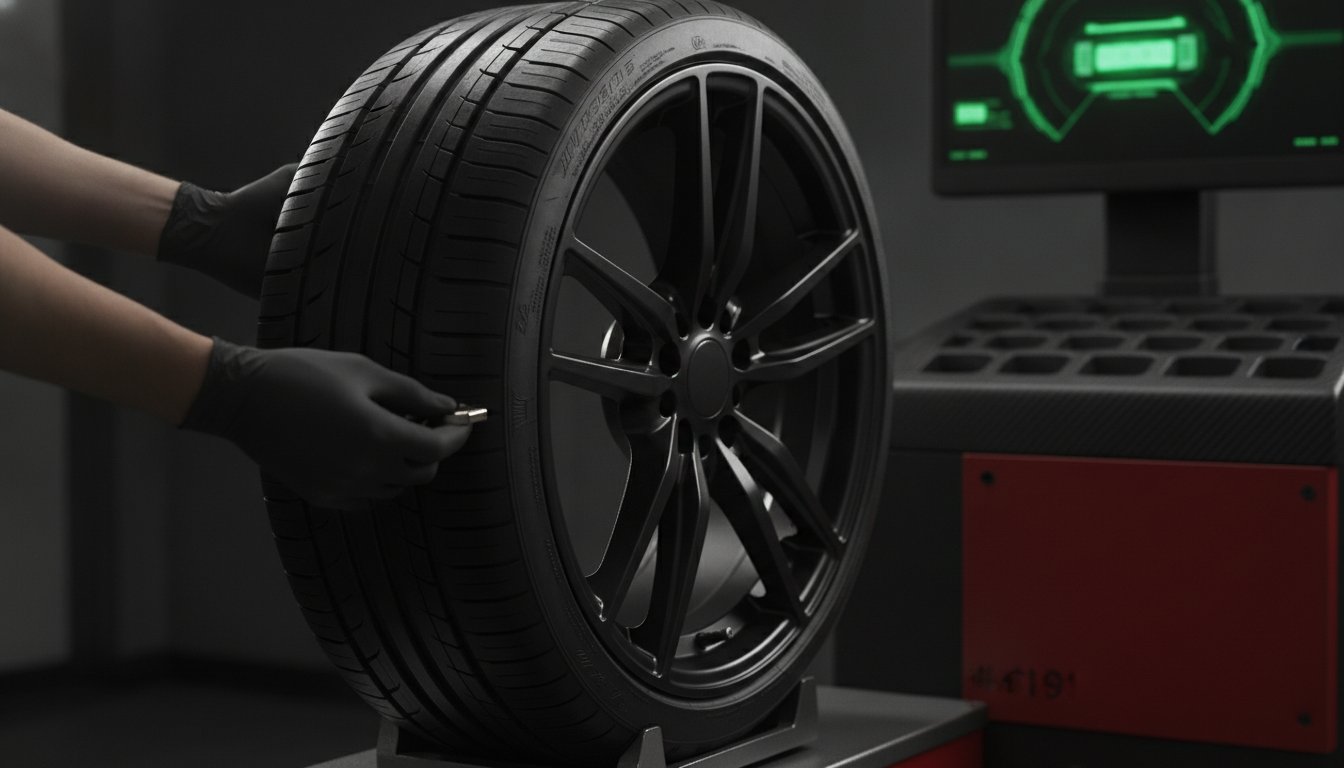
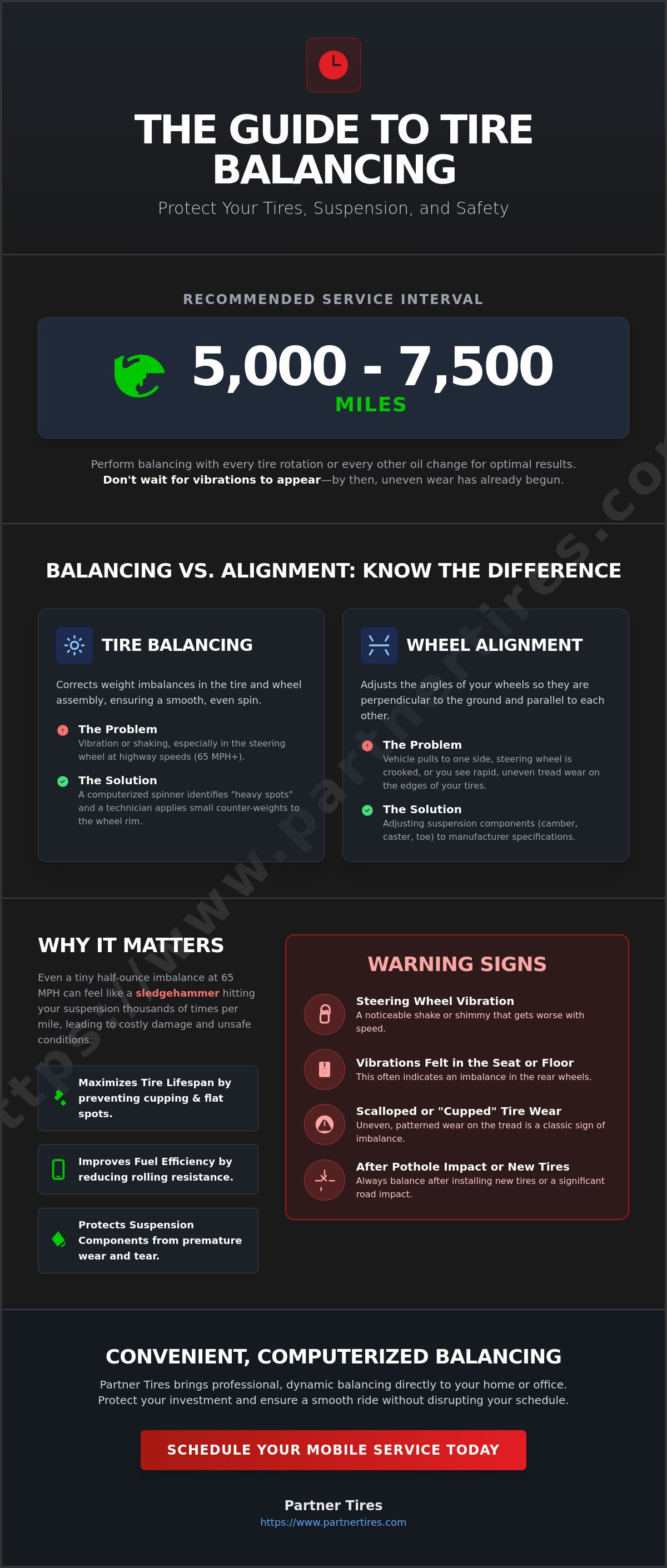
Tire balancing is the technical process of equalizing the weight of your combined tire and wheel assembly. When you ask What is Tire Balancing, you are looking at the solution for tiny manufacturing imperfections. Even a brand-new tire isn't perfectly symmetrical in weight. Modern computerized balancing identifies specific "heavy spots" that create a violent vibration at high speeds. This precision is essential because even a half-ounce imbalance generates significant force. At 65 MPH, that tiny weight discrepancy can feel like a sledgehammer hitting your suspension thousands of times per mile. Understanding how often should I get my tires balanced is the first step in avoiding these mechanical failures.
Professional service providers use computerized equipment to spin the assembly and map its weight distribution. Older static methods only addressed vertical movement. Today, dynamic balancing measures side-to-side wobble to ensure total stability. This level of accuracy is why many drivers ask how often should I get my tires balanced to maintain peak performance. Achieving a perfect balance requires advanced sensors that can detect weight differences thinner than a sheet of paper. This ensures your vehicle operates with the efficiency your business requires.
To better understand this concept, watch this helpful video:
The Science of Centrifugal Force
As your speed increases, centrifugal force amplifies any weight discrepancy in the wheel. A tiny heavy spot that is unnoticeable at 25 MPH becomes a major stressor once you reach highway speeds. The imbalance pulls the wheel away from the center of rotation, creating the shaking you feel in the steering wheel. Dynamic balance is the distribution of weight across the tire's centerline to neutralize these forces. Technicians use small lead or zinc weights to offset these heavy spots. These weights act as a counterforce; they ensure the wheel spins in a perfect circle without oscillating. Without these weights, the tire would hop and scuff along the pavement, destroying the rubber and reducing your control.
Long-term Benefits of Regular Balancing
Consistent maintenance protects your vehicle's structural integrity and your bottom line. Regular balancing shields expensive suspension components like struts, shocks, and wheel bearings from the constant pounding of an imbalanced wheel. It also improves fuel efficiency by reducing rolling resistance and parasitic vibration that drains engine power. By ensuring even tread wear, you maximize the ROI on your tire investment. This proactive approach keeps your operational costs low and your vehicle on the road. You avoid the early replacement of tires that still have plenty of tread but have been ruined by "cupping" or flat spots. We focus on these details so you can focus on your business.
The Recommended Interval: How Often Should You Balance Your Tires?
Consistency is the foundation of vehicle reliability. Most tire manufacturers and automotive experts recommend balancing your tires every 5,000 to 7,500 miles. This interval typically aligns with every other oil change, making it an easy milestone to track. Knowing exactly how often should I get my tires balanced depends on your specific vehicle usage and local road conditions. Waiting until you feel a vibration in the steering wheel is a common mistake. By the time a shake is noticeable, your tires have likely already suffered uneven wear that shortens their lifespan.
A professional best practice is to perform this service during every tire rotation. Moving tires to different positions on the vehicle changes the load and wear dynamics. Re-balancing during this process ensures that the transition to a new position doesn't introduce unwanted oscillations. While manufacturers provide a baseline, Birmingham drivers often find that how often should I get my tires balanced needs to be more frequent due to local infrastructure. High-performance driving or heavy stop-and-go traffic on Highway 280 puts more stress on the tire-wheel assembly than a steady highway commute in flatter regions.
The 'Every Other Oil Change' Strategy
Efficiency drives success for busy professionals. Syncing your balancing schedule with your oil changes creates a predictable maintenance rhythm. This strategy is the most effective way to prevent "cupping," which is a scalloped wear pattern that creates excessive noise and ruins tire integrity. Remember that any flat tire repair requires a fresh balance. The addition of a patch or plug changes the weight distribution of the assembly. Maintaining a strict schedule protects your vehicle's health. You can schedule professional tire services to keep your operations running smoothly.
New vs. Used Tires: Different Balancing Needs?
New tires are not perfectly balanced from the factory. They require an initial computerized balance to account for slight manufacturing variances in the rubber and the wheel. Many professionals suggest a follow-up check after the first 1,000 miles. This "break-in" period allows the tire to fully seat and settle on the rim. For those looking to manage costs, used tires in Birmingham are a viable option, but they require even more scrutiny. A used tire has a previous wear history; it must be balanced with precision to ensure it performs safely on your vehicle. We treat every used tire with the same rigorous standards as a new set to ensure your safety on the road.
Balancing vs. Alignment: Knowing the Difference
Distinguishing between tire balancing and wheel alignment is critical for maintaining your vehicle's operational health. These terms are often used interchangeably, but they address entirely different mechanical issues. Tire balancing corrects the weight distribution within the wheel assembly itself. In contrast, wheel alignment adjusts the suspension geometry to ensure tires make contact with the road at the correct angles. Misunderstanding these differences leads to wasted maintenance budgets and unresolved performance issues. While you track how often should I get my tires balanced, you must also monitor your vehicle's tracking and steering response.
The simplest diagnostic check is the "Shake vs. Pull" test. If your steering wheel or seat vibrates at high speeds, you likely have a balance issue. If the vehicle drifts to one side on a flat road or the steering wheel is crooked while driving straight, your alignment is off. Hitting a significant pothole in Hoover or Bessemer often necessitates both services simultaneously. A hard impact can knock a lead weight off the rim and bend a suspension component in a single event. Performing both services together is a cost-effective way to ensure your tires wear evenly and your suspension remains protected from unnecessary stress.
Signs You Need a Wheel Alignment
Alignment involves adjusting three primary angles: camber, toe, and caster. Camber is the inward or outward tilt of the tire when viewed from the front. Toe refers to whether the tires are pointed toward or away from each other, similar to being pigeon-toed. Caster affects the steering axis and stability. When these angles are incorrect, you will feel a persistent pulling sensation. Your steering wheel may also fail to return to the center position after a turn. For a deeper look at these technical specifications, consult our guide on Expert Wheel Alignment Shops Near Me. Proper alignment ensures your tires don't "scrub" against the pavement, which saves fuel and prevents rapid tread loss.
Signs You Need Tire Balancing
Vibration is the primary indicator of an imbalanced wheel. This shaking typically intensifies as you exceed 50 MPH. You can use the "seat vs. steering wheel" test to identify which tires need attention. If you feel the vibration in the steering wheel, the issue is usually in the front tires. If the vibration is felt primarily in your seat, the rear tires are likely the culprits. Imbalance also creates unusual noise patterns. A rhythmic humming or growling can mimic the sound of a failing wheel bearing. This is why knowing how often should I get my tires balanced is vital; regular checks catch these weight discrepancies before they cause permanent flat spots on your tread. We use computerized equipment to neutralize these heavy spots, restoring the smooth ride your schedule demands.
Birmingham Road Stressors: Why We Need Balancing More Often
Birmingham drivers face a unique set of road stressors that accelerate wheel imbalance. While national guidelines provide a baseline, local infrastructure often dictates a more frequent schedule. You must consider how often should I get my tires balanced based on your daily route through Jefferson County. Major interstates like I-459 and I-65 have seen significant pavement degradation according to 2025 and 2026 reports. These conditions turn a routine commute into a gauntlet for your wheel assembly. Every impact with a road defect slightly alters the relationship between the tire and the rim.
Stop-and-go traffic in Vestavia and Homewood also plays a role in your maintenance needs. Frequent braking and acceleration heat the tires unevenly. This creates localized wear patterns that disrupt the original balance of the wheel. Uneven surfaces and construction debris in downtown Birmingham further complicate this issue. Every bump and transition shifts the weight distribution of your tires. For professionals who rely on their vehicles for daily operations, these local factors make regular checks a necessity rather than an option. We focus on these regional details to keep your vehicle running efficiently.
Potholes and Curb Impact
A physical impact does more than just jar the driver. Hitting a deep pothole on Highway 280 can shift the internal steel belts of a tire. This structural change creates a permanent "heavy spot" that no amount of external cleaning can fix. You also run the risk of losing a clip-on wheel weight during a heavy strike. These small lead or zinc weights are held on by tension; a sharp jolt can easily eject them. A visual inspection is rarely enough after a hard hit. The damage often occurs on the inner rim or within the tire plies where it remains hidden until you reach highway speeds. If you have recently hit a major road hazard, you can request a computerized balance check to ensure your vehicle remains safe.
Climate and Tire Pressure
Alabama’s humidity and extreme heat affect more than just your comfort. High temperatures change rubber density and cause tire pressure to fluctuate rapidly. This relationship between heat and pressure often triggers TPMS warnings that signal deeper issues. When pressure is inconsistent, the tire's footprint on the road changes. This leads to uneven tread loss and disrupts the balance over time. We recommend a spring balance check every year. Winter road wear and cold-weather pressure drops often leave tires out of sync by the time the summer heat arrives. Staying ahead of these seasonal shifts is the best way to determine how often should I get my tires balanced to protect your financial health and vehicle longevity.
Convenient Computerized Balancing with Partner Tires
Partner Tires delivers professional computerized wheel balancing with maximum precision. We understand that your operational needs require speed and accuracy. Traditional tire shops often force you to sacrifice productivity for maintenance. We eliminate this trade-off by bringing the service directly to you. Whether you are managing a fleet or a personal vehicle, knowing how often should I get my tires balanced is only half the battle. The other half is finding a service that fits your busy schedule. We serve Birmingham, Hoover, and Pelham with a focus on grit and regional expertise. Our mission is to be the engine that drives your growth by keeping your vehicle in peak condition.
Our computerized process identifies weight discrepancies that manual methods miss. We use advanced sensors to map the tire's heavy spots with surgical accuracy. This ensures your vehicle operates without the parasitic vibrations that drain fuel and damage suspension components. We treat every service as a collaborative effort to maintain your vehicle's long-term health. Our technicians don't just add weights; they analyze the tire's condition to provide a complete logistical solution for your transportation needs. This directness ensures that the value of our service is immediate and measurable.
Mobile Service: We Come to Your Office or Home
Our mobile units are fully equipped with state-of-the-art balancing technology. We eliminate the downtime associated with waiting rooms and service queues. We provide at-home tire installation and mobile balancing for busy professionals in Mountain Brook and Trussville. This logistical strength ensures that your day remains uninterrupted. Our technicians arrive at your location, perform the computerized balance, and get you back on the road. This efficiency is a core pillar of our identity as a dependable foundation for our customers' businesses. You don't have to choose between a smooth ride and a productive workday.
The Partner Tires Reliability Guarantee
We prioritize your financial health through proactive maintenance. Regular balancing prevents the premature wear that leads to expensive tire replacements. Our expert technicians understand the specific needs of Alabama drivers and the stress our local roads place on your vehicle. We don't just fix problems; we work behind the scenes to ensure your operational success. If you are still wondering how often should I get my tires balanced, remember that any vibration is a signal for action. Partner Tires is your hardworking, no-nonsense ally in automotive care. Contact us today for a diagnostic scan and computerized balance to ensure your vehicle remains a stable asset for your company.
Protect Your Vehicle and Schedule with Professional Maintenance
Maintaining your vehicle's stability is a direct investment in your operational success. You now understand that while the 5,000 to 7,500-mile range is a standard baseline, the reality of Birmingham's infrastructure often requires a more proactive approach. Knowing exactly how often should I get my tires balanced allows you to catch minor vibrations before they escalate into expensive suspension repairs. By differentiating between weight imbalances and alignment issues, you can make smarter decisions for your vehicle's longevity. This strategy preserves your tread and protects your bottom line.
Partner Tires serves as your local, no-nonsense ally in this process. We provide expert computerized balancing and mobile service in Birmingham and Hoover to ensure you never have to choose between maintenance and productivity. As a locally owned and operated business, we prioritize the financial health of our clients through grit and regional expertise. We handle the technical details behind the scenes so your vehicle remains a reliable foundation for your daily commute or business operations.
Book Your Mobile Computerized Balancing in Birmingham Today and experience the stability your schedule requires. We look forward to keeping your ride smooth and your tires performing at their peak.
Frequently Asked Questions
How do I know if my tires need balancing or if it's an alignment issue?
Vibrations in the steering wheel or seat indicate a balance issue, while a vehicle pulling to one side signals an alignment problem. These two services address different mechanical needs. Balancing corrects weight distribution in the wheel assembly. Alignment adjusts the angles of the suspension. If you hit a pothole in Birmingham, you likely need both to restore your vehicle's handling and prevent uneven tread wear.
Can I drive with unbalanced tires for a long period?
Driving on unbalanced tires for an extended period is not recommended because it causes progressive damage to your vehicle. The constant vibration puts excessive stress on wheel bearings, shocks, and struts. This leads to premature mechanical failure and higher repair costs. Additionally, the resulting uneven tire wear will force you to replace your tires much sooner than expected, impacting your operational budget.
Does tire balancing include a rotation?
Tire balancing and rotation are separate services, though they are frequently performed during the same maintenance visit. Balancing ensures weight is distributed evenly around the wheel. Rotation involves moving the tires to different positions on the vehicle to promote even wear. Professionals suggest combining these tasks every 5,000 to 7,500 miles to maximize the lifespan of your tire investment and maintain a smooth ride.
Why does my steering wheel shake only at 60 MPH?
A steering wheel that shakes only at specific highway speeds, such as 60 MPH, is a classic symptom of a minor weight imbalance. At lower speeds, the centrifugal force isn't strong enough to cause noticeable oscillation. Once you reach a certain frequency, the heavy spot in the tire creates a violent vibration. This specific symptom is why many drivers ask how often should I get my tires balanced to maintain stability during high-speed Birmingham commutes.
How much time does a professional tire balancing take?
A professional computerized tire balancing typically takes between 30 and 60 minutes for a full set of four tires. The total time depends on the specific condition of your wheels and the amount of correction required. Our mobile service units prioritize efficiency to respect your busy schedule. We complete the process at your location, allowing you to remain productive while we ensure your vehicle is safe and vibration-free.
Can a lost wheel weight cause my car to pull to one side?
A lost wheel weight will cause a noticeable vibration, but it will not typically cause your vehicle to pull to one side. Pulling is almost always a result of improper wheel alignment or uneven tire pressure. However, the vibration from a missing weight can eventually lead to uneven tire wear. This secondary wear pattern might eventually cause handling issues that feel like pulling. This complexity makes it difficult to determine how often should I get my tires balanced without a professional diagnostic.
Is it necessary to balance brand-new tires?
It is absolutely necessary to balance brand-new tires because no tire or wheel is perfectly symmetrical from the factory. Even minor manufacturing variances in the rubber density can create heavy spots. Technicians must use a computerized balancer to identify these discrepancies and apply counterweights. Failing to balance new tires immediately results in vibrations and premature wear from the very first mile you drive in Birmingham.
What happens if I never balance my tires?
Neglecting tire balancing leads to accelerated tread wear, reduced fuel efficiency, and expensive suspension damage. The constant pounding of an imbalanced wheel ruins wheel bearings and struts over time. You will experience a degraded driving quality that becomes increasingly dangerous at highway speeds. Ultimately, you'll face the financial burden of replacing both your tires and critical mechanical components much earlier than necessary.


