
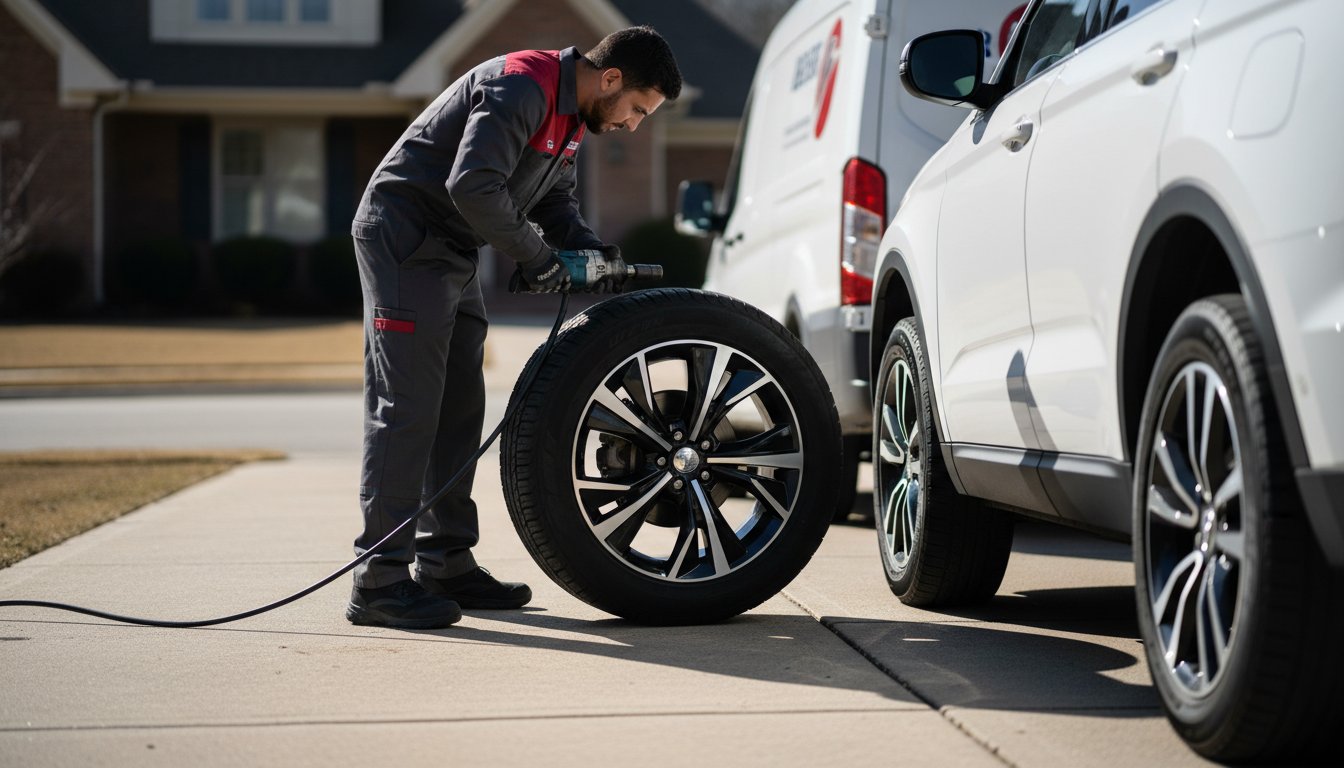
In Birmingham, a tire rotation isn't just routine maintenance. It's a tactical defense against high-heat tread breakdown and the punishing wear patterns of I-65. You've likely felt that subtle vibration at 70 mph or noticed your front tires balding faster than the rears. It's a common frustration that leads to early replacement costs you shouldn't have to pay. Since Alabama law doesn't mandate annual vehicle safety inspections as of April 2026, the responsibility for your vehicle's stability on wet roads rests entirely on your shoulders.
We agree that your time is too important to waste in a tire shop waiting room. This guide will show you how to maximize your tire lifespan and boost fuel efficiency without disrupting your schedule. You'll learn why local Birmingham experts recommend a service interval of 4,000 to 6,000 miles to stay ahead of the $72 national average service cost. We'll preview the specific drivetrain patterns required for your vehicle and explain how mobile service brings professional results to your home. At Partner Tires, we provide Wholesale Power, Local Touch. We're here to keep you moving because we're Driven by Service.
Key Takeaways
- Protect your investment against the specific heat and stop-and-go traffic patterns found in Hoover and on Highway 280.
- Identify the correct tire rotation pattern for your specific drivetrain to prevent vibrations and ensure even treadwear.
- Distinguish between rotation, balancing, and alignment to ensure you're investing in the right service for your vehicle’s stability.
- Master the visual inspection techniques used to spot "cupping" and "feathering" before they lead to costly, premature replacements.
- Leverage professional mobile service to handle your maintenance at home or work, keeping your schedule productive while we handle the grit.
Why Tire Rotation is Essential for Birmingham Drivers
Tire Rotation is the tactical practice of moving wheels from one position to another to ensure even treadwear across all four tires. In Birmingham, this isn't just a suggestion; it's a logistical necessity for your vehicle's health. The stop-and-go traffic patterns in Hoover and the high-speed heat of Hwy 280 create a brutal environment for rubber. Without intervention, your tires will degrade at different rates, leading to instability and premature failure.
Safety is the primary driver here. When you’re caught in a sudden April thunderstorm on I-65, your traction depends on consistent tread depth. Uneven wear reduces your ability to channel water away, which significantly increases hydroplaning risks. Neglecting this maintenance is also a gamble with your bottom line. Spending a small amount on service now prevents an $800 or higher bill for a full set of replacements later. We believe in being your partner in profit by helping you avoid these unnecessary costs.
To better understand this concept, watch this helpful video:
The Physics of Treadwear on Alabama Roads
Front tires handle the heavy lifting in most modern vehicles. They manage steering, the majority of braking forces, and weight distribution during every turn. In Birmingham, 90-degree July heat softens asphalt, which accelerates the degradation of rubber compounds. Combine this with "Magic City" potholes that knock wheels out of alignment, and you have a recipe for rapid, uneven wear. Implementing a regular tire rotation schedule is the most effective way to counter these forces and protect your vehicle's foundation.
Benefits Beyond Just Saving Money
Routine maintenance drives better fuel economy by reducing rolling resistance. When your tread wears evenly, your engine doesn't have to work as hard to move the vehicle. It also ensures a quieter cabin. You'll eliminate that annoying "cupped" tire hum that echoes through the cabin on long commutes. Most importantly, regular service keeps you in compliance with tire manufacturer warranty requirements. This protects your investment for the long haul. We're here to empower your driving experience because we're Driven by Service.
How to Rotate Tires: Patterns and Drivetrain Logic
A successful tire rotation follows a specific blueprint determined by your vehicle’s drivetrain. It is not a random swap. Each pattern is designed to move tires from high-stress positions to low-stress positions. According to NHTSA tire safety guidelines, this practice is vital for maintaining vehicle control and maximizing the life of your rubber. We use data-driven methods to ensure every wheel ends up exactly where it belongs.
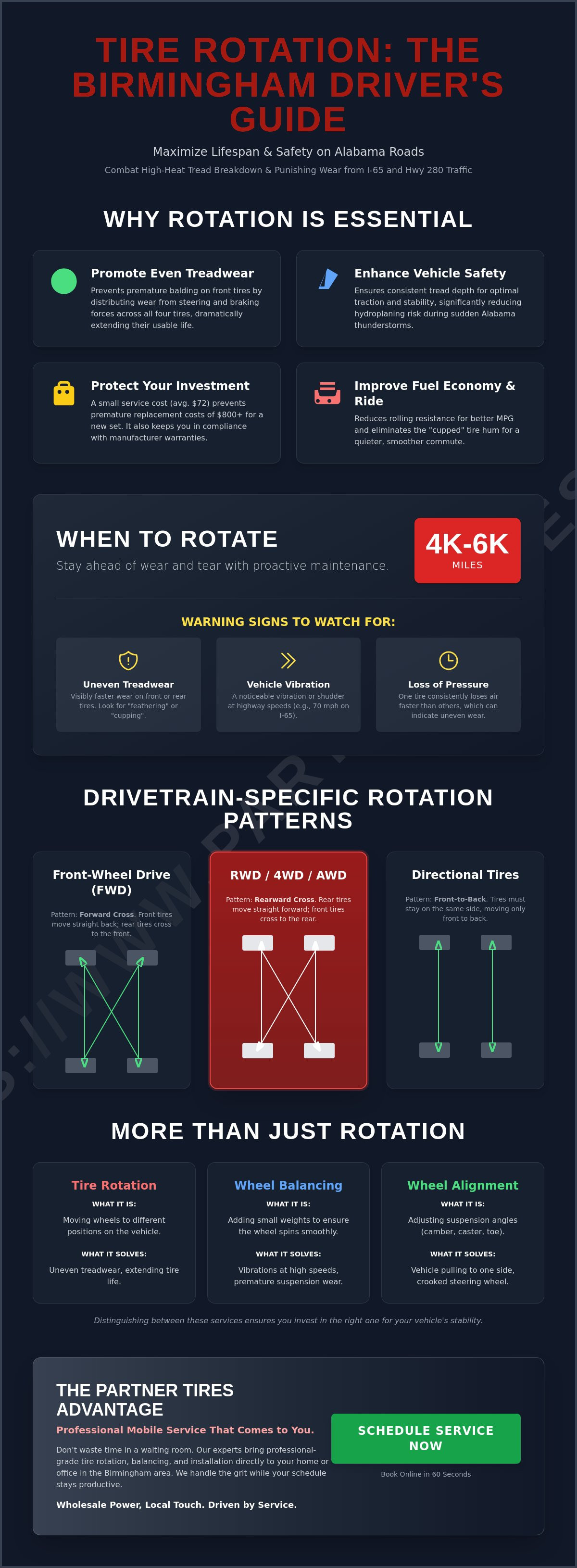
The "Forward Cross" is the standard for front-wheel drive (FWD) vehicles. In this sequence, the front tires move directly to the rear. The rear tires move to the front but switch sides. This counters the heavy steering and braking loads placed on the front axle of popular Birmingham SUVs like the Honda CR-V or Toyota RAV4. For rear-wheel drive (RWD) and 4WD vehicles, we employ the "Rearward Cross." Here, the rear tires move straight forward, while the front tires cross to the opposite rear positions. This logic balances the power delivery from the rear axle with the steering forces from the front.
Modern passenger cars often utilize the "X-Pattern." This involves moving all four tires diagonally to the opposite corner. However, this only works for non-directional tires. You can identify directional tires by an arrow on the sidewall. These tires are engineered to rotate in one direction only. They must stay on the same side of the vehicle, moving only from front to back. If you need help identifying your tire type, you can partner with our local experts for a professional assessment.
Specific Patterns for FWD, RWD, and AWD
All-wheel drive (AWD) vehicles like Subarus or Teslas require extreme precision. Because these systems distribute power to all wheels, even a 2/32-inch difference in tread depth can cause mechanical strain on the drivetrain. We prioritize uniformity to protect your vehicle's internal components. For performance vehicles with staggered fitments, where the rear tires are wider than the front, we utilize a "Side-to-Side" pattern. This ensures the tires stay on the correct axle while still evening out side-specific wear.
Special Considerations for Modern Tires
Your vehicle's technology must keep pace with the physical move. A TPMS sensor service is often required after a rotation to ensure your dashboard correctly identifies which tire is low on air. If your vehicle includes a full-size spare, we can integrate it into a five-tire rotation sequence. This ensures all five tires wear at the same rate, providing a reliable backup when you need it most. We focus on these details to keep your operation running smoothly because we're Driven by Service.
Tire Rotation vs. Balancing vs. Alignment
Maintenance confusion leads to wasted spend. Many drivers use these terms interchangeably, but they solve entirely different mechanical problems. A tire rotation is the physical act of moving wheels to different corners of the vehicle to even out treadwear. Balancing addresses weight distribution within the wheel and tire assembly. Alignment is a suspension adjustment that ensures your tires travel straight. Understanding these distinctions is the first step toward maximizing your vehicle's uptime.
We view these three services as the "Triple Threat" of tire longevity. When performed together, they create a foundation of stability and efficiency. Neglecting one often negates the benefits of the others. For example, rotating tires that are out of balance will not stop steering wheel vibrations. Similarly, perfectly balanced tires will still wear prematurely if your alignment is off. We focus on these logistical details to ensure your vehicle remains a reliable asset rather than a liability.
Diagnosis: Which Service Does Your Car Need?
Physical symptoms provide the best roadmap for service. If you feel a distinct vibration in the steering wheel or seat at highway speeds, you likely need balancing. Modern 2026 computerized balancers detect microscopic weight variances that cause these shakes. If your vehicle pulls to the left or right while driving on I-459, you need a wheel alignment. This service corrects the angles of your tires so they are perpendicular to the ground and parallel to each other. If you notice "choppy" or "feathered" edges on your tread during a visual check, it is time for a tire rotation.
The Synergy of Professional Maintenance
Bundling these services is the most efficient way to protect your bottom line. An improper alignment can ruin a brand-new set of rotated tires in fewer than 3,000 miles. This creates unnecessary replacement costs that could have been avoided with a simple suspension check. Computerized balancing is a non-negotiable part of the process because it prevents the uneven centrifugal forces that lead to suspension wear. Visiting a local tire garage for a combined maintenance package is a strategic move. It ensures every component of your wheel assembly works in harmony. We are here to empower your maintenance strategy because we are Driven by Service. Our "Wholesale Power, Local Touch" approach ensures you get precision results without the fluff of traditional shops.
When to Rotate: Intervals and Warning Signs
Consistency drives reliability. Most manufacturers recommend a tire rotation every 5,000 to 7,500 miles. This window typically aligns with standard oil change intervals, making it easy to track your maintenance schedule. However, Birmingham’s unique geography often demands a more aggressive approach. Our hilly terrain and the constant elevation changes near Red Mountain put additional stress on your tread. If you frequently tow heavy loads or navigate the steep grades of I-65, we recommend inspecting your tires every 4,000 miles to stay ahead of potential issues.
Visual inspections are your first line of defense. You can spot "feathering" or "cupping" by running your hand across the tread surface. If the rubber feels smooth in one direction but rough in the other, your tires are wearing unevenly. The "Penny Test" remains a reliable tool for measuring depth at home. Insert a penny into the tread with Lincoln's head upside down. If you can see the top of his head, your tread is below 2/32 of an inch. This is a critical safety threshold that requires immediate action to maintain traction on wet Alabama roads.
The "Every Other Oil Change" Strategy
Syncing your maintenance tasks ensures nothing falls through the cracks. While modern synthetic oils allow some vehicles to go 10,000 miles between changes, your tires cannot wait that long. We suggest a rotation at every oil change for maximum longevity, or at minimum, every other service if you use long-life synthetics. Birmingham drivers should secure a tire rotation every 5,000 miles to combat the accelerated wear caused by our local heat and hilly terrain.
Red Flags: When to Rotate Immediately
Your vehicle communicates its needs before a total failure occurs. Increased road noise while driving through Vestavia or Mountain Brook is a common warning sign of "cupping." This happens when the tire bounces slightly, creating uneven dips in the rubber. You might also feel a slight "wobble" at speeds under 30 mph that seems to disappear as you accelerate. Visible differences in tread depth between the front and rear axles are another clear signal that your tires are no longer working in harmony.
You don't have to waste your morning in a cramped waiting room to address these red flags. The mobile tire revolution has arrived in Alabama. We bring professional equipment directly to your driveway, allowing you to remain productive while we handle the grit. If you're ready to protect your investment and improve your fuel efficiency, schedule your professional service today. We are here to keep your operation moving because we are Driven by Service.
Professional Mobile Rotation: The Partner Tires Advantage
The traditional tire shop model is outdated. Birmingham drivers no longer need to sacrifice half a Saturday in a cramped waiting room. The mobile revolution is here, and it's changing how we maintain our vehicles. A professional tire rotation can now happen in your driveway or at your workplace. We've eliminated the logistical friction that causes many owners to delay essential maintenance. By bringing the expertise to you, we ensure your vehicle stays safe without disrupting your schedule.
We value efficiency. Whether you're at home in Hoover or managing an office in Pelham, our technicians arrive ready to work. You keep your focus on your business or family while we handle the grit. Our mobile units carry the same high-grade equipment found in top-tier service centers. We don't just swap positions; we provide a comprehensive check of your wheel assembly. This approach lowers the barrier to regular upkeep. When the service is this convenient, staying consistent with your 5,000-mile interval becomes effortless.
Our commitment to Birmingham is built on trust and reliability. We understand that your vehicle is a vital tool for your daily life or business operations. By choosing mobile service, you're not just buying a maintenance task; you're investing in a partnership that prioritizes your time. We work behind the scenes to deliver the results you need. Our goal is to be the backbone of your maintenance strategy, providing the stability and confidence required for Alabama’s diverse driving conditions.
Driven by Service: Our Local Birmingham Commitment
Our footprint extends across the entire metro area. We serve clients in Hoover, Trussville, Bessemer, and every neighborhood in between. We operate with "Wholesale Power, Local Touch," a philosophy that balances our massive distribution capabilities with personalized care. This allows us to offer competitive pricing that directly supports your bottom line. Safety is non-negotiable. Every professional at home tire installation or rotation we perform follows rigorous safety protocols. We are your hardworking, no-nonsense ally in vehicle maintenance.
Booking Your Mobile Rotation Today
Our 2026 mobile service units are built for speed and precision. When you book a service at your Leeds or Pelham office, you can expect a prompt arrival and a fast-paced workflow. Our technicians use computerized balancing tools to ensure every wheel is perfectly calibrated before the job is done. The process is transparent and highly organized. We don't want to be the center of attention; we want to be the engine that drives your vehicle's performance. Don't let a busy schedule compromise your safety on Alabama roads. Schedule your mobile tire rotation in Birmingham now! We are your partner in profit, always Driven by Service.
Secure Your Vehicle's Future on Birmingham Roads
Maintaining your vehicle shouldn't be a logistical burden. We've established that a regular tire rotation is the most effective way to combat the accelerated wear caused by Alabama's heat and hilly terrain. By aligning your service with a 5,000-mile schedule and utilizing the correct drivetrain patterns, you protect your investment and ensure maximum safety on wet roads. Consistency is the engine that drives your vehicle's long-term profitability.
Partner Tires is your hardworking ally in this process. We've earned our 5-Star Mobile Service Reviews by delivering precision maintenance directly to your driveway. Serving Birmingham, Hoover, and the surrounding suburbs, we combine wholesale pricing on new and used tires with a commitment to your productivity. You don't have to wait in a shop to get professional results. We bring the grit and the gear to you.
Take control of your vehicle's longevity today. Our "Wholesale Power, Local Touch" approach ensures you get the best value without the fluff. We are ready to bring our mobile units to your home or office to keep you moving safely. Get Mobile Tire Rotation at Your Home or Office and experience a partnership that is truly Driven by Service.
Frequently Asked Questions
How much does a tire rotation cost in Birmingham, AL?
A standard service in the Birmingham area typically follows the national average of $49 to $72 as of April 2026. Many national retailers provide free tire rotation for the life of the tires if you purchased the full set from their specific locations. We focus on providing transparent value that protects your bottom line and keeps your vehicle on the move. Our "Wholesale Power, Local Touch" approach ensures you get professional results without hidden fees.
Do I really need to rotate my tires if I have All-Wheel Drive (AWD)?
Yes, AWD vehicles require frequent rotation to protect the complex drivetrain from mechanical strain. All four tires must maintain nearly identical tread depths to prevent damage to the center differential. A variance of more than 2/32 of an inch can lead to costly drivetrain repairs. This service ensures your vehicle remains a reliable asset on Alabama roads and stays within manufacturer warranty specifications.
Can I rotate my own tires at home in my driveway?
You can perform a tire rotation at home if you have the correct equipment and safety gear. This requires a floor jack, at least two jack stands, and a calibrated torque wrench to secure the lug nuts to manufacturer specifications. Most Birmingham drivers prefer professional mobile service to ensure the job is done with industrial-grade precision and speed. We bring the expertise to you, so you don't have to handle the grit yourself.
What happens if I never rotate my tires?
Neglecting this maintenance leads to rapid, uneven treadwear and increased road noise. Your front tires will likely go bald while the rears still have significant tread, forcing you to buy a full set prematurely. This creates a safety hazard during heavy rain and increases your long-term logistics costs. We empower our partners to avoid these pitfalls through proactive service that's always Driven by Service.
How long does a professional tire rotation take?
A professional service typically takes 30 to 45 minutes when performed by an expert technician. Our mobile units are designed for rapid turnaround to respect your busy schedule and maximize your productivity. We deliver speed and precision directly to your location, ensuring your vehicle is back in operation without delay. This efficiency is a core pillar of our commitment to your success.
Does tire rotation include wheel balancing?
Rotation and balancing are distinct services that are often bundled for maximum efficiency. While rotation moves the wheels to different positions, balancing uses a specialized machine to correct weight imbalances in the wheel assembly. We recommend performing both every 5,000 miles to eliminate vibrations and extend the life of your inventory. Bundling these services is a strategic move for any vehicle owner.
Is tire rotation necessary for brand new tires?
Yes, the first tire rotation is the most critical for new rubber. New tires often wear most quickly during their first few thousand miles as they settle into the vehicle's alignment and suspension. Establishing a consistent pattern at the 5,000-mile mark ensures even wear for the remainder of the tire's lifespan. Proactive maintenance from day one is the best way to drive long-term profitability.
What is the most common rotation pattern for SUVs?
The "Forward Cross" is the most frequent pattern for modern FWD-based SUVs. In this sequence, front tires move straight back while the rear tires cross to the opposite front corners. For 4WD SUVs, the "Rearward Cross" is used to balance the power delivery from the rear axle. We apply the correct logic for every drivetrain to ensure your vehicle's stability and performance on Birmingham's hilly terrain.


