
What if that slight vibration you feel while cruising down I-65 is actually a $400 repair bill in the making? You shouldn't have to guess if your vehicle is safe or if you're being overcharged by a local shop. With the national road maintenance backlog reaching record levels in March 2026, the pavement is tougher on your car than ever before. For drivers of vehicles manufactured after 2018, a standard four-wheel alignment often requires precision ADAS recalibration that can drive costs between $250 and $400. We know that protecting your tire investment is about more than just a smooth ride; it's about your profitability.
You likely already suspect that uneven tire wear is a sign of trouble, but you might wonder if a full service is truly necessary for your vehicle. This article helps you identify the specific warning signs of misalignment and explains why a comprehensive calibration is essential for Alabama road conditions. We provide a clear checklist to self-diagnose your steering issues and the confidence to choose a Birmingham service provider that is truly Driven by Service. Our Wholesale Power, Local Touch approach empowers you to make the right call for your vehicle's health.
Key Takeaways
- Spot the 7 critical warning signs, such as a crooked steering wheel, to prevent premature tire wear.
- Learn how a precision four-wheel alignment corrects camber, caster, and toe to stabilize your drive on Alabama roads.
- Understand why Birmingham's summer heat and Hwy 280 construction demand more frequent suspension checks.
- Determine if your vehicle needs a 2-wheel or 4-wheel service by decoding the difference between solid axles and independent suspensions.
- Discover how state-of-the-art computerized sensors empower you to maintain peak performance and long-term profitability.
Is Your Car Fighting You? The 7-Point Alignment Warning Checklist
Driving through Birmingham shouldn't feel like a wrestling match. If you're constantly fighting the steering wheel to stay centered on I-65, your vehicle is likely out of spec. Misalignment isn't just a nuisance; it's a direct threat to your tire inventory and overall vehicle safety. When your wheels aren't parallel, they scrub against the pavement. This friction creates heat and rapid wear that can ruin a fresh set of tires in under 5,000 miles. Identifying these issues early is the key to maintaining your vehicle's profitability and performance. We're your partner in keeping your car on the road and your costs down.
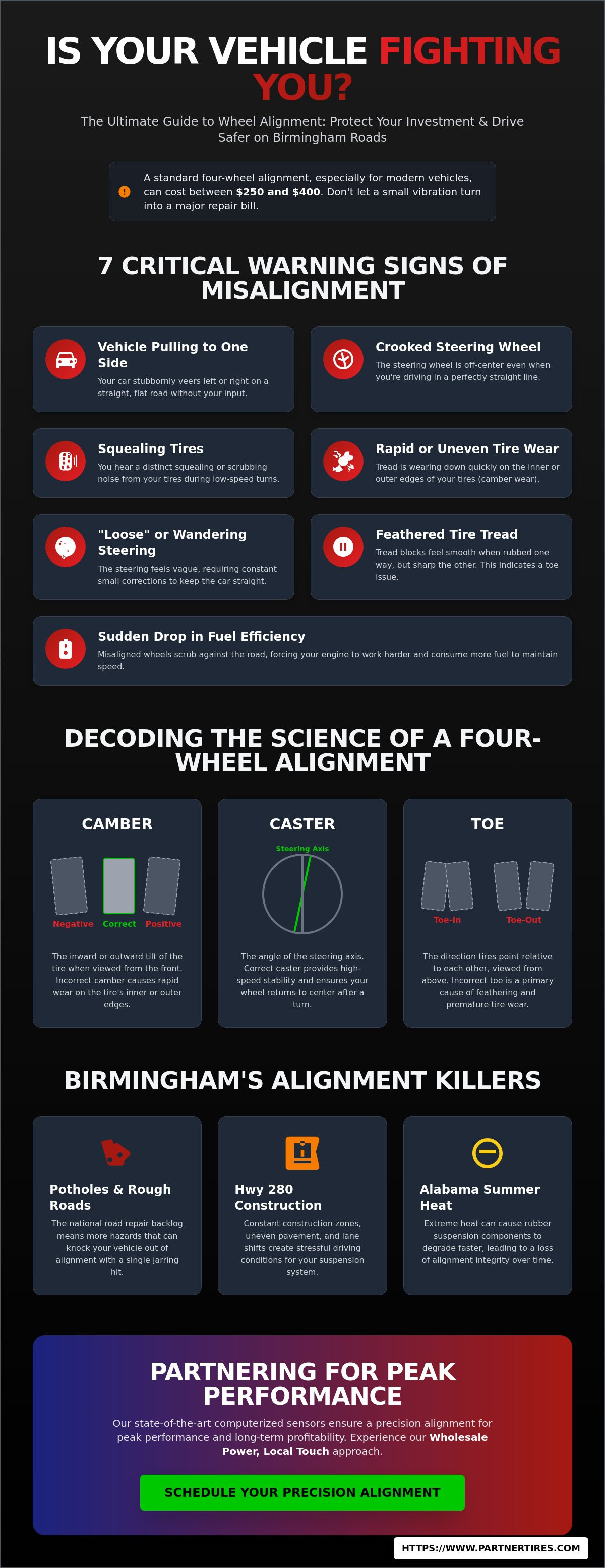
Watch for these seven critical warning signs during your daily commute. First, look for a vehicle that pulls stubbornly to one side. Second, notice if your steering wheel remains crooked when you're driving perfectly straight. Third, listen for squealing tires during low-speed turns, especially in tight Birmingham parking decks. Fourth, feel for a "loose" or wandering sensation in the steering that makes you feel disconnected from the road. Fifth, check for rapid tread wear on just one side of the tire. Sixth, watch for "feathering," where the tread feels smooth in one direction but sharp in the other. Finally, observe any sudden drop in fuel efficiency as your engine works harder to overcome the resistance of misaligned wheels.
To better understand the mechanics behind these symptoms, watch this helpful video:
The "Hands-Off" Test for Birmingham Commuters
You don't need a shop to perform an initial diagnosis. Find a flat, level stretch of road with minimal traffic to test your steering. Briefly relax your grip on the wheel while maintaining a steady cruising speed. If the car immediately veers, you likely need a four-wheel alignment. However, don't confuse a mechanical pull with the road crown. Road crown is the engineered slope of a street that directs water toward the gutter, often causing a subtle pull that drivers mistake for a mechanical issue. If the car pulls both ways on different roads, the problem is likely the pavement, not your suspension.
Visual Tire Inspections You Can Do in Your Driveway
Your tires are the best record of your vehicle's history. Inspect the edges of your front and rear tires for "camber wear," which appears as excessive baldness on the extreme inner or outer edges. Understanding the technical geometry of Camber, Caster, and Toe helps you see why these angles are vital for high-speed stability. You might also notice "heel-toe" wear, where one side of a tread block wears down faster than the other, often indicating worn struts. According to the March 2026 Asphalt Industry Alliance report, the record £18.6 billion road repair backlog means your suspension is hitting more hazards than ever. Learning how to check tire tread is the first step in protecting your investment before a small drift becomes a major expense.
Camber, Caster, and Toe: Decoding the Science of a Four-Wheel Alignment
A four-wheel alignment isn't just a basic mechanical adjustment. It is a high-precision calibration of three specific angles that dictate how your vehicle interacts with the Birmingham pavement. These adjustments focus on how the tires are angled relative to the vehicle's frame and the road surface. Camber is the inward or outward tilt of the tire when viewed from the front. If this angle is off, your tires lean too heavily on one edge, leading to rapid wear. Caster measures the angle of your steering axis. It's the reason your steering wheel returns to center after a turn and provides the high-speed stability you need on I-65. Toe refers to whether your tires point toward or away from each other when viewed from above. When these three angles aren't synchronized, your tires fight for grip, which directly impacts your fuel economy and tire longevity.
Modern vehicles manufactured after 2018 often feature Advanced Driver Assistance Systems (ADAS) that rely on these angles being perfect. Because these systems use cameras and radar to help with lane-keeping and braking, a physical misalignment can confuse the vehicle's computer. This is why a precision service often involves more than just turning a wrench. It's a technical process designed to protect your investment. We prioritize this level of detail because we're committed to being the engine that drives your growth.
Why "Front-End Only" Alignments are Outdated
Older trucks often utilized solid rear axles, which meant a front-end alignment was usually sufficient. Today's SUVs and sedans feature independent rear suspensions that require individual adjustment to stay safe. If the rear wheels aren't aligned, they create a crooked "thrust line" that forces the front wheels to steer in a different direction just to go straight. This causes the vehicle to "crab-walk," where the rear end tries to overtake the front on the highway. Partner Tires recommends a full 4-wheel check for every modern vehicle to ensure the rear wheels track perfectly behind the front ones. This precision eliminates unnecessary friction and keeps your fleet profitable.
The Precision of Computerized Wheel Balancing
Alignment and computerized wheel balancing are two halves of the same performance coin. While alignment fixes a pull to the left or right, balancing eliminates the vibrations felt through the seat or steering wheel at high speeds. Modern computerized sensors use laser-guided imaging to detect sub-millimeter deviations in wheel positioning that are invisible to the naked eye. This data allows technicians to place small weights with surgical accuracy. Combining these services ensures a smooth ride and prevents the suspension damage caused by constant shaking. If you're noticing a drift or a shimmy, it's time to consult with an expert partner who understands the grit and local knowledge required for Alabama roads.
The Birmingham Pothole Report: Local Road Hazards That Ruin Your Alignment
Birmingham drivers face a unique gauntlet every day. Between the heavy construction zones on Hwy 280 and the debris-laden stretches of I-65, your suspension takes a relentless beating. These aren't just minor bumps; they're mechanical stressors that compromise your vehicle's geometry. Alabama's extreme summer heat frequently exceeds 95 degrees for weeks at a time. This sustained heat softens the asphalt, causing it to rut under the weight of heavy commercial traffic. It also degrades rubber suspension bushings, making them brittle and prone to cracking. When these components fail, they lose their ability to hold a four-wheel alignment, leading to rapid uneven tire wear that can destroy your inventory investment.
The "Spaghetti Junction" effect adds another layer of risk. The high-speed ramps connecting I-65, I-20, and I-59 apply significant lateral stress to your suspension system. Constant high-velocity cornering can slowly nudge your wheels out of their factory specifications. If your route takes you into rural areas like Cullman or Walker County, the unpaved shoulders and uneven backroads demand even more frequent inspections. We recognize that your time is valuable, but neglecting these local hazards directly impacts your bottom line. Our grit and local knowledge ensure we understand exactly what your vehicle survives daily.
Sudden vs. Gradual Misalignment
A single "Curb Strike" in downtown Birmingham can bend a tie rod or strut instantly. You'll feel that damage immediately. However, the slow drift is often more dangerous because it's nearly invisible. Over 10,000 miles of commuting through Bessemer or Hoover, your suspension components naturally settle and wear. This gradual shift is why we recommend a regular 7-point checklist. In Southern climates, you should specifically monitor these components for aging:
- Rubber control arm bushings that dry out and shrink.
- Ball joints that lose lubrication due to high road temperatures.
- Tie rod ends that develop play after hitting recessed manhole covers.
Protecting Your New Tire Investment
Skipping a professional calibration when buying new tires in Birmingham is a mistake that costs you money. Just 1/16th of an inch of "toe-out" can scrub 25% of your tread life in a single summer season. For vehicles manufactured after 2018, this risk is amplified by the "ADAS Tax." As of May 2026, recalibrating the safety sensors during an alignment typically adds $250 to $400 to the service cost, but it's a necessary step to protect a $1,200 set of tires. We use our Wholesale Power, Local Touch to provide the logistical strength you need to maintain profitability. Partner Tires is the engine that drives your growth by ensuring your tires last as long as the manufacturer promised.
2-Wheel vs. 4-Wheel Alignment: How to Know Which Your Vehicle Requires
Determining which service your vehicle needs depends entirely on its suspension design. Older trucks and some rear-wheel-drive vehicles with a solid rear axle might only require a front-end adjustment. However, almost every modern SUV, sedan, and crossover on Birmingham roads today features independent rear suspension. For these vehicles, a four-wheel alignment is the only way to ensure all four tires are parallel and tracking correctly. If your vehicle is all-wheel drive (AWD), this service is mandatory. AWD systems rely on precise wheel speeds to manage power distribution; even a slight misalignment can cause the drivetrain to bind or wear prematurely.
If your car has a solid rear axle that isn't adjustable, a technician might perform a "Thrust Angle" alignment. This process aligns the front wheels to the fixed direction of the rear axle. It prevents the "dog-tracking" effect where the car seems to move sideways down the road. You can usually find your specific manufacturer requirements in your owner's manual under the maintenance or chassis specifications. We believe in providing the clarity you need to make informed decisions about your vehicle's health.
The Cost vs. Value Breakdown
A professional calibration is a proactive investment in your vehicle's profitability. While a standard service typically ranges from $100 to $200 as of May 2026, vehicles built after 2018 often require ADAS recalibration. This can push the four-wheel alignment price between $250 and $400. This might seem steep until you compare it to the price of a new set of premium tires. Replacing two tires prematurely because of poor alignment will always cost more than a single maintenance visit. Understanding the wheel alignment cost in the Birmingham market helps you budget effectively and avoid surprises at the shop. We empower our partners with transparent information to ensure every dollar spent drives long-term success.
Questions to Ask Your Birmingham Mechanic
Don't settle for a "toe-and-go" service that only fixes the most obvious issue. Ask your technician if they provide a before-and-after printout of all alignment angles. This document is your proof that the job was done to factory specifications. Inquire if they inspect ball joints, tie rods, and bushings for wear before they start the adjustment. Adjusting a car with worn parts is a waste of time and money. Finally, confirm their equipment is calibrated for modern Advanced Driver Assistance Systems. If your shop doesn't understand the intersection of physical alignment and sensor calibration, your safety features might not function correctly. To ensure your vehicle receives the highest standard of care, partner with a local service expert who prioritizes precision and reliability.
Partnering for Performance: Precision Alignments and Mobile Tire Service
Partner Tires operates on a simple principle: we are Driven by Service. Our commitment to Birmingham drivers goes beyond basic repairs. We provide a steadfast foundation for your vehicle's performance. In our local service centers, we utilize state-of-the-art computerized sensors to perform every four-wheel alignment. These systems deliver surgical precision, identifying deviations that traditional tools miss. For residents in Mountain Brook and Vestavia, this level of detail is non-negotiable. Luxury vehicles and high-performance SUVs require exact calibration to maintain their handling characteristics and safety systems. We combine wholesale power with a local touch to ensure your high-end investment remains protected.
Our approach treats every client as a collaborative partner. We don't just fix a problem; we empower you to avoid future costs. By ensuring your tires are perfectly synchronized, we drive your vehicle's profitability through improved fuel economy and extended tread life. This grit and focus on efficiency make us the backbone of the local automotive community. We understand that your time is an asset. Our logistical strength allows us to provide rapid turnaround times without compromising on the precision your vehicle demands. We work behind the scenes to ensure you stay on the move.
Mobile Support for Roadside Alignment Emergencies
Potholes don't wait for a convenient time to strike. If a severe impact on a backroad in Pelham or Leeds leaves your car undriveable, you need immediate solutions, not a long tow truck waitlist. We bridge the gap between traditional shop service and modern convenience. If an alignment issue has caused a sudden tire failure, our at home tire installation service brings the expertise to your driveway. We deliver fresh inventory and professional mounting directly to you. This reliability ensures that a bad road day doesn't derail your entire schedule. It is the Partner promise of stability and speed in action. Our mobile units are equipped with high-standard tools, ensuring your new tires are mounted with total accuracy wherever you are.
Scheduling Your 2026 Alignment Check
Birmingham's road conditions are evolving, and your maintenance schedule must keep pace. We recommend a professional inspection every 6 months or 6,000 miles to stay ahead of gradual wear. For many drivers, the most efficient strategy is to bundle this check with a routine oil change or tire rotation. This logical progression saves time and ensures your vehicle's geometry is verified at every service interval. Regular checks are the most effective way to prevent steering issues from becoming a recurring expense. Don't wait for a vibration or a pull to signal trouble. Schedule your 4-wheel alignment with Partner Tires today and experience the engine that drives your growth.
Drive Forward with Birmingham Expertise
Alabama road conditions are a daily challenge, but your vehicle's performance shouldn't be a liability. You now have the 7-point checklist to identify alignment drift before it compromises your safety or your bottom line. A precision four-wheel alignment is the most effective way to counteract the stress of Birmingham's high-heat summers and the heavy construction zones found on Hwy 280. We provide detailed computerized diagnostic reports with every service to ensure you have the facts. As a locally owned and operated business as of May 2026, we prioritize the reliability and efficiency that Birmingham drivers deserve.
Our team is ready to support you with in-shop expertise or mobile tire installation and roadside assistance when the road gets tough. We deliver the Wholesale Power and Local Touch necessary to keep your tires on the pavement and your repair costs under control. Book Your Precision Four-Wheel Alignment at Partner Tires. Let's work together to keep your vehicle running at peak performance and ensure your investment is protected for the long haul.
Frequently Asked Questions
How much does a four-wheel alignment cost in Birmingham, AL?
A standard four-wheel alignment in 2026 typically costs between $100 and $200. If your vehicle was manufactured after 2018 and includes Advanced Driver Assistance Systems (ADAS), you should expect to pay an additional $250 to $400 for sensor recalibration. These figures reflect national pricing guides and are essential for protecting your tire inventory. We prioritize transparency to help you maintain your vehicle's long-term profitability.
How long does a standard four-wheel alignment take?
A standard alignment service usually takes 60 to 90 minutes to complete. This timeframe includes the initial computerized diagnostic check and the physical adjustment of your suspension angles. If your vehicle requires ADAS recalibration, the process can extend to 2 or 3 hours. We focus on efficiency to ensure your vehicle returns to the road as quickly as possible without sacrificing the precision your safety depends on.
Can a bad alignment cause my steering wheel to vibrate?
No, a vibration is usually caused by an unbalanced tire or a bent wheel rather than a simple alignment issue. Misalignment typically causes the vehicle to pull to one side or creates uneven tread wear. However, severe suspension damage from a Birmingham pothole can cause both symptoms simultaneously. If you feel a shake in your steering wheel at highway speeds, computerized wheel balancing is likely the required solution for your vehicle.
Do I need an alignment if I just bought two front tires?
Yes, you should always verify your alignment when installing new tires, even if you only replace two. Installing fresh rubber on a misaligned vehicle leads to immediate "scrubbing" that can destroy 25% of your tread life in just one summer. A four-wheel alignment ensures that your new front tires track perfectly with the rear wheels. This proactive step maximizes your tire ROI and prevents premature replacement costs on Alabama roads.
What happens if I hit a major pothole on I-65?
A major impact on I-65 can instantly bend suspension components or knock your wheels out of factory specifications. You should schedule an inspection immediately if you notice a crooked steering wheel or a new pull after the strike. With the March 2026 road maintenance backlog reaching record highs, these hazards are increasingly common. Our mobile team can provide roadside assistance if the impact leaves your vehicle unsafe to drive through Birmingham.
Is a 4-wheel alignment necessary for a car with a solid rear axle?
Vehicles with solid rear axles generally require a "Thrust Angle" alignment rather than a full four-wheel service. This process aligns the front wheels to the fixed position of the rear axle to ensure the car travels straight. While the rear wheels aren't adjustable, measuring them is vital to prevent "dog-tracking." We use our local knowledge to determine the exact requirements for your specific truck or older SUV model.
Can Partner Tires perform alignments on lowered or modified vehicles?
Yes, we possess the specialized equipment and grit required to align modified or lowered vehicles. Standard factory specifications often don't apply to aftermarket suspensions; therefore, we use custom parameters to ensure proper handling. This precision prevents the extreme camber wear common in modified cars. We act as your partner in performance, ensuring your custom build remains both safe and enjoyable on the road.
Does a four-wheel alignment include tire balancing?
No, alignment and balancing are separate services with different mechanical goals. Alignment adjusts the angles of the suspension, while balancing ensures the weight of the tire and wheel assembly is distributed evenly. We recommend performing both services together to achieve the smoothest possible ride. This combination protects your suspension components from vibration damage and ensures your tires wear evenly across their entire lifespan.


