
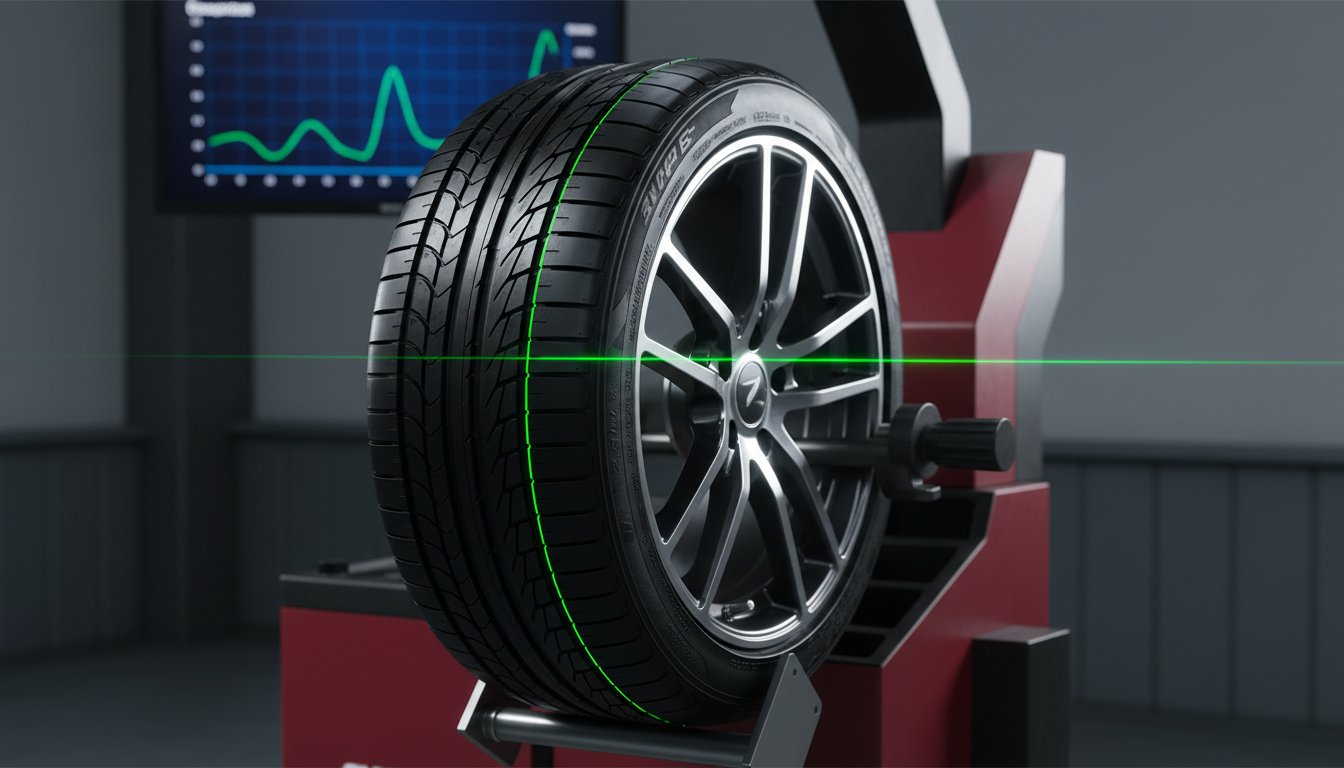
Imagine you're merging onto I-65 during the morning rush, but as you hit 65 mph, your steering wheel begins a rhythmic, annoying shake. This isn't just a minor inconvenience; it's a clear signal that your tires are out of sync with your vehicle. Most Birmingham drivers ignore these vibrations until they've already sacrificed 20 percent of their tire's tread life. Precision matters when you're dealing with the heavy traffic and varied terrain of Central Alabama. That's where computerized wheel balancing steps in to stabilize your ride. This advanced process uses laser-guided sensors to identify weight imbalances as small as 0.25 ounces, ensuring every rotation is perfectly centered.
You've invested hard-earned money into your vehicle, and you deserve a drive that feels safe and quiet. We know you want to avoid the headache of rapidly wearing out expensive rubber. This guide shows you how computerized wheel balancing protects your tires and ensures a vibration-free drive on Birmingham’s challenging roads. We'll explore the technical differences between balancing and alignment to keep your vehicle performing at its peak. As a partner driven by service, we're here to help you maximize your tire lifespan and enjoy a smooth, reliable journey on Hwy 280 and beyond.
Key Takeaways
- Precision matters. Learn how high-speed sensors detect microscopic weight imbalances to eliminate highway vibrations and ensure a safer drive.
- Stop the confusion. Understand the critical difference between weight distribution and wheel angles to keep your vehicle stable on the road.
- Protect your investment. Discover why computerized wheel balancing every 5,000 miles is the most efficient way to extend tire life and performance.
- Navigate Birmingham with confidence. Identify the local road triggers—from I-65 potholes to downtown curbs—that demand an immediate professional check.
- Drive efficiency. See how mobile service brings expert balancing directly to your home or office in Hoover, Vestavia, and the Birmingham metro area.
What is Computerized Wheel Balancing and Why Does It Matter?
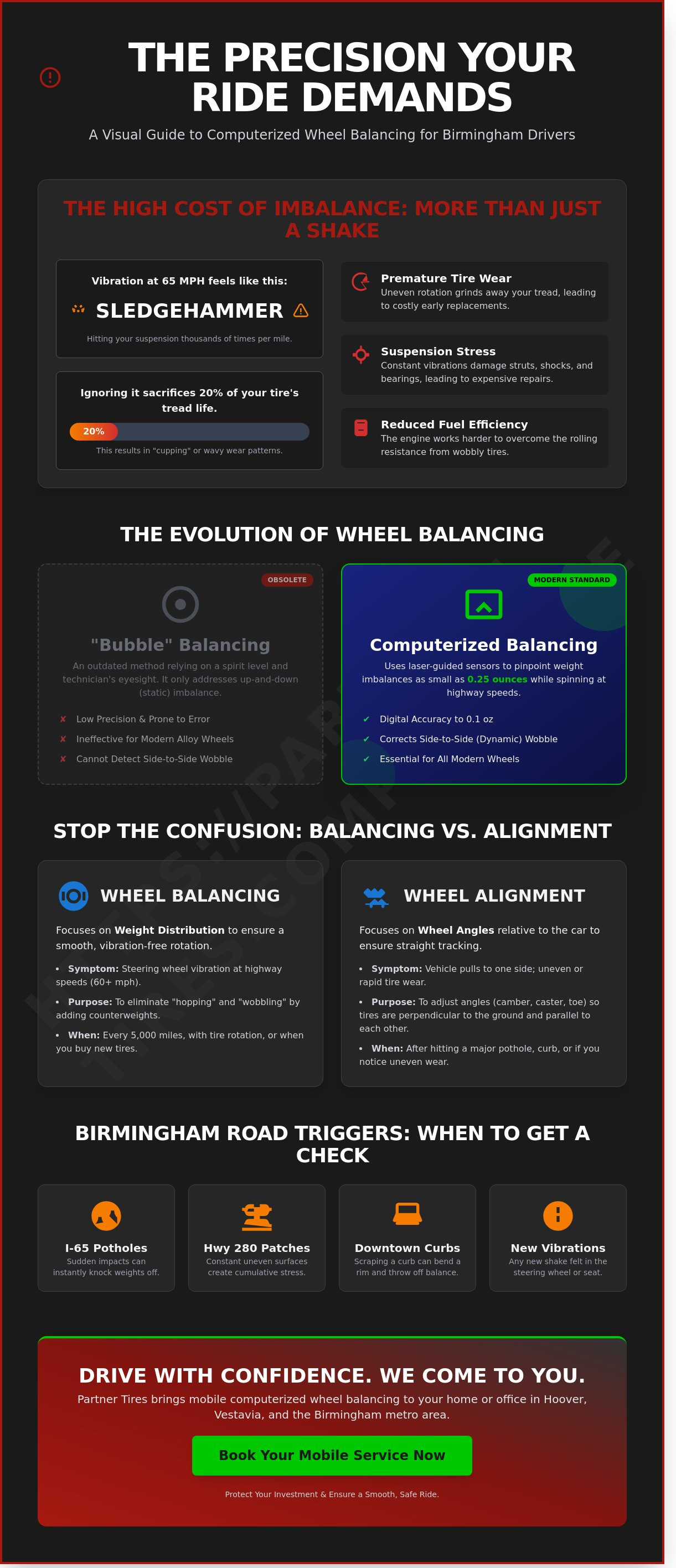
Computerized wheel balancing is a high-precision process that uses advanced digital sensors to identify weight distribution issues within a tire and wheel assembly. It isn't just a standard shop service; it's a technical requirement for modern vehicle safety. Even a weight difference of 0.5 ounces creates significant centrifugal force when the wheel spins. At 65 MPH, that tiny discrepancy feels like a sledgehammer hitting your suspension thousands of times per mile. In Birmingham, this isn't just a theoretical concern. Hitting a single deep pothole on Highway 280 or navigating the uneven patches of I-65 can shift your wheel weights or damage a rim instantly.
Modern service centers prioritize a dynamic approach over simple static methods. You can learn more about the fundamental mechanics of Tire balance to understand how weight is distributed across both the radial and lateral planes. While static balancing only addresses vertical movement, computerized wheel balancing corrects side-to-side wobble. This ensures the tire remains perfectly centered on the spindle, providing a stable foundation for every mile driven. It's the difference between a shaky steering wheel and a smooth, professional driving experience.
The Impact of Unbalanced Wheels on Your Vehicle
Unbalanced wheels don't just shake your steering wheel; they attack your vehicle's foundation. This constant vibration puts 20% more stress on critical suspension components like struts and shocks, leading to premature failure and expensive repair bills. You'll also see "cupping" or "scalloping" on your tire treads. These are dipped, wavy wear patterns that ruin tire life and increase road noise. Unbalanced wheels increase fuel consumption because the uneven contact patch creates higher rolling resistance and forces the engine to work harder to maintain speed.
Why Traditional "Bubble" Balancing is Obsolete
- Precision: Old-school "bubble" balancers relied on a spirit level and a technician's eyesight. This manual method is prone to human error and lacks the granularity needed for modern performance.
- Alloy Wheels: Modern alloy wheels are lighter and more sensitive than older steel versions. They require the pinpoint accuracy of a computer to place weights behind spokes where they won't interfere with brake calipers.
- Digital Accuracy: Computerized systems eliminate the guesswork, delivering a balance that's accurate to within 0.1 ounces.
Relying on outdated equipment is a risk to your inventory and your customer's safety. Modern automotive technology demands a digital solution that matches the speed and precision of today's logistics. We believe in being a partner in your success by providing the technical knowledge that keeps your fleet or your customers' vehicles on the road. This no-nonsense approach to maintenance is why computerized wheel balancing remains a non-negotiable service for any Birmingham driver who values reliability.
The Technology Behind Computerized Balancing Systems
Modern computerized wheel balancing transforms a standard tire service into a high-precision calibration. The process begins by mounting the wheel assembly onto a heavy-duty balancer spindle. This machine spins the tire to simulate highway speeds, often reaching 60 mph or more. As the assembly rotates, the system measures the centrifugal force generated by any heavy spots in the rubber or rim. Even a weight discrepancy as small as 0.25 ounces can cause significant vibration at 55 mph.
Sensors within the machine track two distinct types of movement. Lateral runout measures the side-to-side wobble of the tire. Radial runout tracks the up-and-down "hop" during rotation. Identifying these forces allows the technician to apply zinc or lead weights to specific locations on the rim. This neutralizing force ensures the tire stays in constant contact with the road surface. This technical precision is a core reason why industry experts recommend proper alignment and balance to maximize tread life and vehicle safety.
Precision Sensors and Data Processing
The onboard computer calculates the exact gram of weight needed to achieve perfect equilibrium. Technicians rely on a digital interface that displays the precise placement for adhesive or clip-on weights. This system is sophisticated enough to distinguish between a slightly irregular rim and a tire defect. By isolating these variables, the equipment ensures the fix is permanent and accurate. This level of detail helps drive your business success by delivering a superior product to your customers.
The Role of Laser-Guided Accuracy
Advanced balancing systems utilize lasers to identify the "heavy spot" with sub-millimeter precision. This eliminates the trial-and-error approach of older, manual methods. For high-end aesthetic rims, "hidden weight" modes allow technicians to place weights behind the spokes. This preserves the visual appeal of the wheel while maintaining peak performance. Partner Tires leverages these technologies to ensure every customer experiences a Partner-perfect ride. Research indicates that maintaining balance can improve fuel efficiency by nearly 3 percent by reducing rolling resistance. We focus on these technical details because reliability is the foundation of our partnership. Our commitment to accuracy is how we remain Driven by Service.
Wheel Balancing vs. Wheel Alignment: Knowing the Difference
Drivers often confuse wheel balancing with wheel alignment, but these services address two distinct mechanical needs. The difference is simple: balancing focuses on weight, while alignment focuses on angles. A vehicle can have factory-perfect alignment and still suffer from violent vibrations if the computerized wheel balancing is neglected. Balancing involves the wheel and tire assembly itself. Technicians use specialized machinery to identify heavy spots and apply lead-free weights to compensate. Alignment, conversely, is a suspension adjustment that ensures the tires meet the road at the correct angle.
Partner Tires operates with a "Wholesale Power, Local Touch" service standard. We know that precision matters for your bottom line. Proper maintenance requires both services to work in tandem. Ignoring one often leads to the premature failure of the other. Our goal is to keep your fleet or customer vehicles on the road longer with fewer repairs. We are Driven by Service, ensuring every rotation and mount meets high-performance benchmarks.
When to Choose Balancing
The most common symptom of poor balance is a vibrating steering wheel. If you feel a floorboard shaking or a seat vibration at speeds above 55 MPH, your tires are likely out of balance. Use the "shaking versus pulling" rule of thumb to diagnose the issue quickly. Shaking indicates a weight distribution problem in the tire assembly. Pulling indicates a suspension geometry issue. Balancing is mandatory 100% of the time a tire is mounted or rotated. Even a 0.25-ounce weight discrepancy can cause noticeable ride quality issues and uneven tread wear over time.
When to Choose Alignment
You need an alignment if the car pulling to one side occurs on a flat road. Other signs include an off-center steering wheel or rapid inner/outer edge wear on the tire tread. Environmental factors in Birmingham play a significant role here. Alabama’s summer heat frequently exceeds 95 degrees, which causes suspension bushings to soften and expand. This thermal stress can shift your alignment settings out of the manufacturer's specified range. For a deeper look at suspension geometry, refer to our four-wheel alignment pillar. Keeping these angles precise protects your tire investment and improves fuel efficiency by reducing rolling resistance.
When to Get Your Wheels Balanced in the Birmingham Metro Area
Consistency keeps your inventory moving and your customers safe. We recommend scheduling computerized wheel balancing every 5,000 to 7,000 miles. This interval aligns perfectly with standard tire rotations. It ensures wear stays even across the tread and prevents small vibrations from becoming major mechanical issues. Regular maintenance is the backbone of vehicle longevity.
Some situations demand immediate action. Birmingham drivers face unique hazards daily. Hitting a deep pothole on I-65 near the Malfunction Junction or clipping a concrete curb while parking in downtown Birmingham can instantly knock a wheel out of balance. You should also watch for the "lost weight" phenomenon. Adhesive or clip-on weights can fail due to extreme heat or road debris. If a weight falls off, your ride quality will suffer immediately. Finally, every new tire installation requires computerized wheel balancing before the vehicle leaves the shop. New tires have slight manufacturing variances that only a precise balance can correct.
Seasonal and Road-Specific Considerations
Birmingham temperatures often swing 40 degrees in a single 24-hour period. These fluctuations affect tire pressure and rubber elasticity, making minor imbalances more noticeable to the driver. Local enthusiasts in Cullman or Warrior who take their vehicles off-road need more frequent checks. Mud and rocks trapped in the tread act as unintended counterweights that disrupt the spin. Additionally, the constant stop-and-go traffic on Highway 280 increases the risk of flat-spotting. This occurs when tires sit in one position during heavy congestion, which mimics the symptoms of a poor balance.
The Cost of Neglect
Ignoring a vibration is a costly mistake for any vehicle owner. Industry data shows that neglecting wheel balance is like throwing away 20% of your tire’s lifespan with every mile. A standard set of quality tires might cost $800, while a balance service is a small fraction of that investment. Unbalanced wheels don't just kill tires; they destroy hardware. The constant shaking causes premature failure of expensive wheel bearings. These components can cost upwards of $400 per hub to replace once the damage is done. Our wholesale power and local touch help dealers provide these essential services to keep Birmingham drivers on the road.
Keep your shop stocked with the best inventory to serve your customers' needs. Partner with us for reliable tire solutions and grow your business today.
Mobile Computerized Balancing: Partner Tires Comes to You
Traditional tire maintenance often requires hours of waiting in a cramped shop lobby. Partner Tires eliminates that friction. We bring professional tire solutions directly to your location in Birmingham, Hoover, and Vestavia. Our mobile service reflects our "Driven by Service" philosophy. It allows you to continue your workday or enjoy your time at home while we handle the heavy lifting. We offer a comprehensive mobile suite that includes professional tire mounting, computerized wheel balancing, and emergency roadside assistance. We value your time as much as your safety. Our goal is to keep your vehicle moving without disrupting your schedule.
Professional Service in Your Driveway
Our mobile units aren't just delivery vans; they're fully equipped workshops on wheels. Each vehicle carries commercial-grade balancers designed for high-volume precision. We provide the exact same level of accuracy you expect from a brick-and-mortar shop. Our technicians serve a wide radius including Gardendale, Trussville, and Pelham. We focus on efficiency without sacrificing quality. By bringing the equipment to your driveway, we reduce the downtime of your vehicle by 50% or more compared to traditional service centers. You get precision results without the logistical headache of a shop visit. Our equipment handles everything from standard passenger cars to heavy-duty trucks with ease.
The Partner Tires Advantage
We build our reputation on reliability and supportive partnership. Every job is an opportunity to prove our commitment to your vehicle's performance. Our team handles both brand-new inventory and high-quality used tires with identical care. We use computerized wheel balancing to detect even the smallest weight discrepancies, ensuring your tires wear evenly and your suspension stays protected. This precision prevents vibrations that lead to long-term mechanical fatigue.
We act as the backbone of your vehicle's maintenance routine, providing grit and local expertise in every zip code we serve. We don't just fix tires; we drive your success on the road. Our "Wholesale Power, Local Touch" approach means you get elite technology with the personalized service of a local neighbor. It's time to experience a better way to maintain your ride. Schedule your mobile computerized balancing today and let our experts come to you.
Drive with Confidence Across Birmingham
Your vehicle's performance depends on precision. Ignoring vibrations leads to uneven tire wear and serious safety risks. Our specialized process uses modern sensors to pinpoint weight imbalances that manual methods miss. You don't have to sacrifice your workday or your weekend for routine maintenance. Partner Tires brings the shop directly to your driveway. We serve over 20 cities across the Birmingham metro area, providing wholesale power with a local touch that our customers trust. Our team arrives at your home or office equipped with the latest computerized wheel balancing technology to ensure your ride is smooth and stable. We're driven by service and dedicated to keeping your vehicle moving forward. Don't let a shaky steering wheel compromise your safety or your bottom line. Take control of your vehicle's health today with a team that values your time. We look forward to getting you back on the road with a smoother, more efficient ride.
Book Your Mobile Tire Balancing in Birmingham Now
Frequently Asked Questions
How do I know if my wheels are out of balance or out of alignment?
Vibrations indicate balance issues while pulling indicates alignment problems. Balance issues cause vibrations in the steering wheel or floorboards at specific speeds. Alignment issues cause the vehicle to drift to one side or result in an off-center steering wheel. According to the Car Care Council, 25% of vehicles on the road have tires that are improperly balanced or aligned, leading to uneven wear.
Can I balance my own tires at home without a computer?
No, you cannot achieve the precision required for modern vehicles without a computer. Static balancing with a bubble level is a 50 year old method that fails to address dynamic imbalance. Modern computerized wheel balancing detects weight discrepancies as small as 0.25 ounces. This level of accuracy is essential for the high speed driving conditions found on Alabama Interstates like I-65 where precision is vital.
How long does a computerized wheel balancing service take?
A standard computerized wheel balancing service takes between 30 and 45 minutes for a full set of four tires. Each wheel requires approximately 10 minutes to mount on the balancer, spin, and apply weights. As your logistics partner, we ensure Birmingham shops have the high speed equipment needed for rapid turnaround. This efficiency helps service centers maintain a high volume of daily appointments without compromising on precision.
Why does my steering wheel shake only at speeds over 55 MPH?
Shaking at higher speeds is a classic symptom of dynamic imbalance. Centrifugal force amplifies small weight discrepancies as tire rotations increase. A 0.5 ounce imbalance creates a 7.5 pound vibrating force at 60 MPH. If your steering wheel vibrates between 55 and 70 MPH, it's a clear indicator that your wheels need professional recalibration to restore stability and ensure a safe ride on the highway.
Will balancing my tires improve my gas mileage in Birmingham traffic?
Yes, properly balanced tires improve fuel efficiency by reducing rolling resistance. The U.S. Department of Energy states that improper tire maintenance can reduce fuel economy by up to 3%. Unbalanced tires create uneven friction and heat, forcing the engine to work harder. Keeping tires balanced ensures a smooth rotation, which is critical for the frequent stop and go traffic found on Highway 280.
Do used tires need to be balanced differently than new tires?
Used tires require the same computerized process but often need more frequent checks due to uneven wear patterns. A used tire has lost tread depth, which changes its weight distribution. Every time a tire is mounted to a rim, it must undergo computerized wheel balancing to ensure the assembly is centered. Industry standards suggest checking balance every 5,000 miles for used tires to maintain peak performance.
What happens if I ignore a vibrating steering wheel?
Ignoring vibrations leads to premature tire failure and expensive suspension damage. Constant shaking puts excessive stress on shocks, struts, and ball joints. Industry data shows that unbalanced tires can wear out 20% faster than those properly maintained. We act as a partner in profit by helping you identify these issues early, preventing a simple maintenance task from turning into a major, expensive repair bill.
Is computerized balancing included with a tire rotation at Partner Tires?
Partner Tires provides the wholesale inventory and equipment solutions; individual service packages are determined by the local dealer. We empower Birmingham service centers with the logistics and tools they need to succeed. Most professional shops recommend balancing every 5,000 to 8,000 miles during a rotation. Our role is to ensure your local shop has the right weights and machinery to keep you Driven by Service.


