It's 5:15 PM on a Tuesday in Hoover, and your dashboard just lit up with a low-pressure warning while you're merging onto I-65. You know the immediate stress of navigating Birmingham's heavy evening traffic on a temporary spare tire. Most drivers feel the same pressure to get a quick fix without being overcharged at a big-box shop. We agree that you deserve a solution that prioritizes your safety and your schedule. This guide explains exactly when a flat tire repair is a viable option and how to find expert help across the metro area in 2026.
You'll learn the specific safety standards that dictate a permanent fix and how to weigh the cost of a repair against a full replacement. We provide a clear path to getting back on the road with confidence. Our team is driven by service, combining wholesale power with a local touch to keep Birmingham moving. We focus on the facts so you can make the best decision for your vehicle and your wallet. This overview ensures you understand the logistics of a professional repair before you even pull into the service bay.
Key Takeaways
- Identify if your puncture is safe to fix by applying the 1/4 inch rule and official RMA safety standards.
- Learn why the "Plug-and-Patch" combo is the industry gold standard for a permanent flat tire repair compared to temporary string plugs.
- Evaluate the time-saving benefits of mobile tire services versus the hidden costs of towing your vehicle to a traditional shop.
- Master essential safety protocols for managing a tire emergency on high-traffic Birmingham routes like Highway 280.
- Discover how a local ally "Driven by Service" provides the professional support needed to keep your vehicle on the road.
Can My Flat Tire Be Repaired? Understanding the Safety Zone
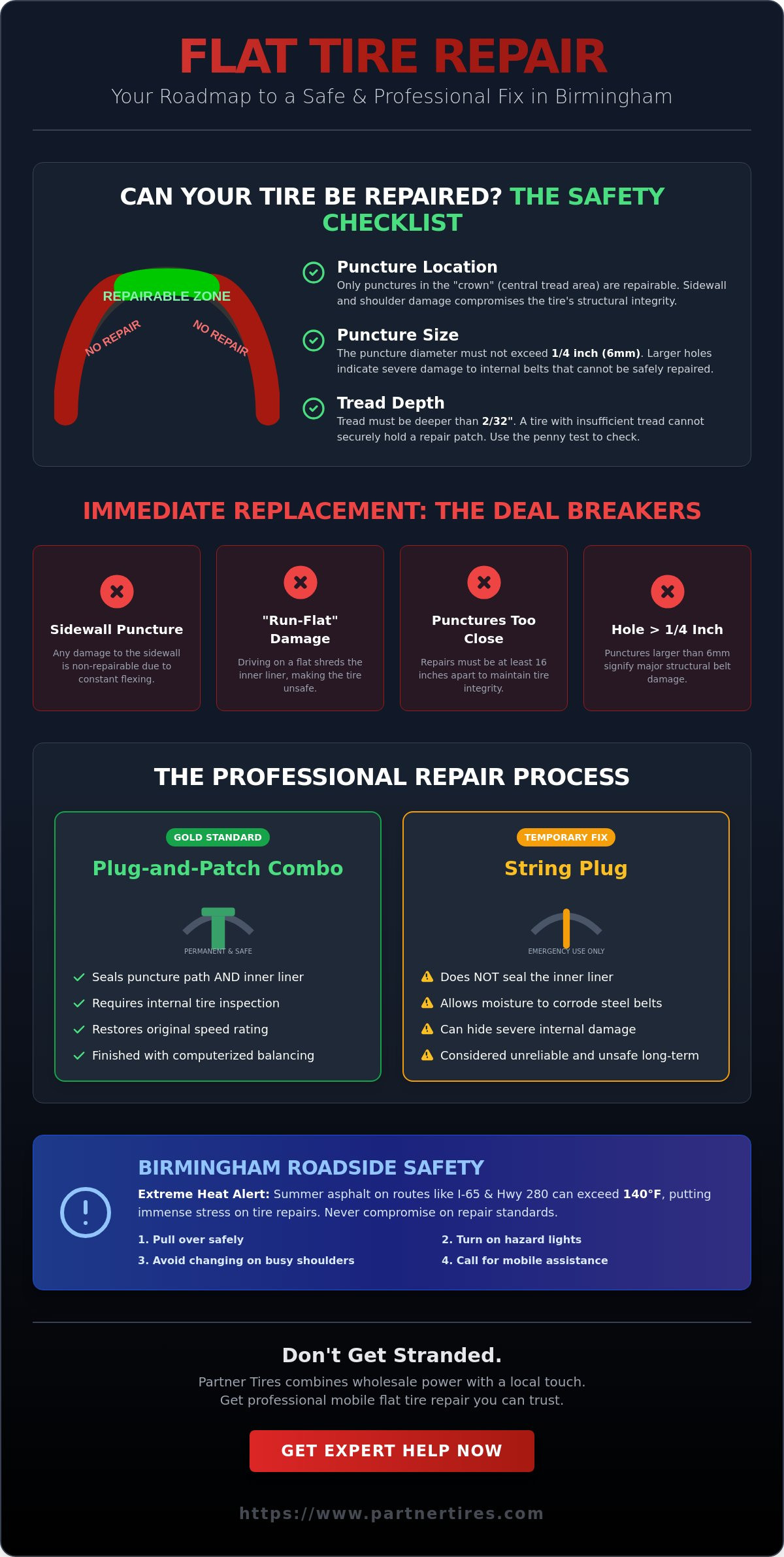
Identifying the exact location of a puncture is the first step in understanding flat tires and their recovery. Not every hole allows for a safe fix. The Rubber Manufacturers Association (RMA) sets strict criteria to protect drivers and service centers. A professional flat tire repair must only occur within the "crown" of the tire. This area sits between the shoulder ribs. If the damage lands outside this specific zone, the tire's structural integrity is compromised.
Size matters as much as location. Any puncture larger than 1/4 inch (6mm) is too big for a standard plug and patch. Large holes indicate significant internal belt damage that a simple repair cannot stabilize. In Birmingham, the stakes are higher during peak summer months. July and August bring average highs of 91°F, but Alabama asphalt temperatures often exceed 140°F. This extreme heat softens rubber compounds and puts immense pressure on repair seals, making strict adherence to the 1/4 inch rule vital for safety.
To better understand this concept, watch this helpful video:
The Anatomy of a Non-Repairable Puncture
Sidewall damage is an automatic dealbreaker. The sidewall flexes constantly to absorb road shock; any patch applied here will eventually fail due to this movement. Driving on a flat, even for a short distance, creates "run-flat" damage. This shreds the inner liner and makes the casing unsafe. We also evaluate puncture proximity. If two punctures are within 16 inches of each other, the tire requires replacement. Multiple repairs in one area prevent a proper seal and weaken the tire's internal structure.
Tread Depth and Repair Eligibility
Safety regulations prohibit flat tire repair on any unit with less than 2/32" of remaining tread. At this level, the tire lacks the thickness to hold a patch securely. You can check this in your Birmingham driveway using the "Penny Test." Place a penny into the tread with Lincoln's head facing down. If you see the top of his head, your tread is too thin for a safe repair. If your tire is past its prime, check out The Smart Shopper’s Guide to Used Tires in Birmingham, AL (2026) for reliable replacement options.
The Professional Repair Process: Patch vs. Plug
A roadside emergency often leads to a quick string plug. While this gets you moving, it's a temporary fix. A string plug doesn't address the internal structure. It leaves the inner liner vulnerable to moisture and air loss. For a permanent solution, professional shops in Birmingham utilize the plug-and-patch combination. This method is the industry-standard tire repair for a reason. It seals the puncture path and the inner liner simultaneously. This dual-action approach ensures the tire retains its original speed rating and safety profile.
Reliability drives every successful flat tire repair. Technicians must remove the tire from the rim. You can't see internal damage from the outside. Once the repair is complete, computerized balancing is the final step. Adding a patch or a plug-patch combo changes the tire's weight distribution. Precise balancing prevents vibrations at highway speeds, protecting your suspension and ensuring a smooth ride on I-20. This level of detail is what keeps local service centers profitable and their customers safe.
Why Internal Inspection is Mandatory
Driving even a short distance on an under-inflated tire generates extreme heat. This creates "heat mottled" inner liners where the rubber becomes charred and brittle. This damage is invisible until the tire is dismounted. Birmingham potholes cause internal bruising in approximately 14% of all puncture cases documented in 2026. This structural separation leads to sudden blowouts if ignored. A visual check of the interior prevents these catastrophic failures and identifies tires that are no longer fit for service.
The Vulcanizing Process Explained
True repair requires a molecular bond. Chemical vulcanizing fluid acts as a catalyst. It fuses the rubber patch to the tire's inner liner. The integrated stem fills the puncture path. This creates a moisture-tight seal. Without this seal, water reaches the steel belts. Corrosion can begin within 48 hours of moisture exposure. A vulcanized repair protects the tire's integrity for the remainder of its tread life. It turns a liability back into a reliable asset for your vehicle. This process ensures the repair is as strong as the original tire structure.
Mobile Tire Repair vs. Traditional Shops in Birmingham
Birmingham drivers often face a difficult choice when a nail ruins their commute. You can call a tow truck to haul your vehicle to a shop in Vestavia or Pelham, or you can choose on-site flat tire repair. Towing involves heavy hidden costs. You pay for the hook-up fee and the mileage, which often exceeds the cost of the actual repair. You also lose hours of productivity. Sitting in a big-box retailer's waiting room for three hours isn't an efficient use of your schedule. Partner Tires changes this dynamic. We bring the shop to your location. If you work in downtown Birmingham, we fix your vehicle in the parking deck while you attend your 9:00 AM meeting. This eliminates the "waiting room" experience entirely.
Safety is the primary concern on local interstates. Changing a spare on the narrow shoulder of I-65 is a high-risk move. Traffic moves at 70 mph just inches from your bumper. Statistics show that roadside incidents increase significantly during peak traffic hours. Mobile service keeps you inside a building or safely away from the road while an expert handles the heavy lifting. We are driven by service, ensuring you never have to risk your safety for a simple puncture.
When to Call for Roadside Assistance
Driving even 400 yards on a flat can destroy a $300 alloy rim. If your pressure light is on and the tire looks visibly low, stop immediately. Partner Tires manages on-site repairs in residential areas like Mountain Brook with total precision. We arrive with the right inventory to get you moving again. Our team follows strict safety protocols to ensure every plug or patch holds up under Alabama heat. For more details on our residential capabilities, read our Professional At Home Tire Installation in Birmingham, AL: The Complete Guide. We act as your no-nonsense ally when your vehicle is sidelined.
The Logistics of Mobile Service
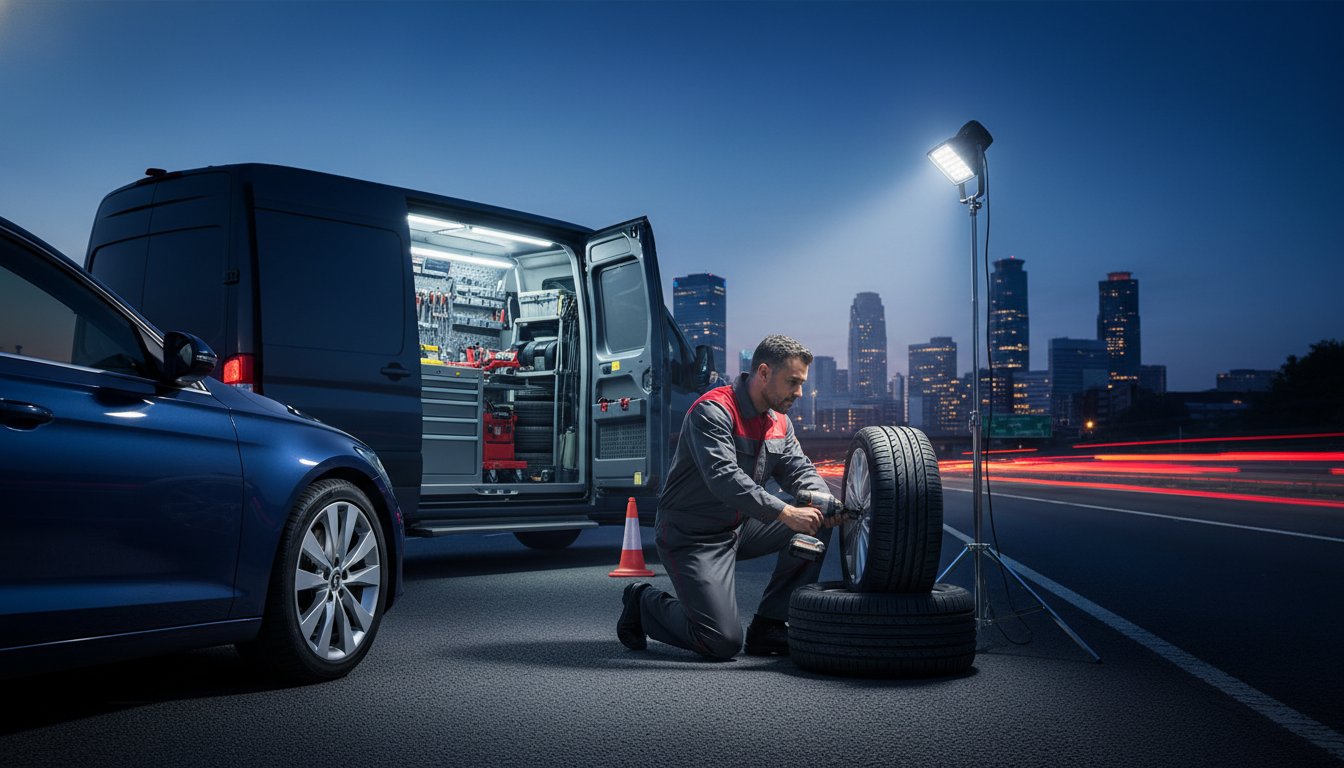
Our technicians arrive in specialized service units equipped for any flat tire repair scenario. These vehicles carry high-grade air compressors, impact tools, and computerized balancing machines. We don't just patch the hole. We ensure the wheel is balanced to prevent vibrations at highway speeds. We also perform TPMS resets on-site to clear your dashboard lights. Every repair we perform aligns with NHTSA tire safety standards to guarantee your vehicle remains roadworthy. During peak hours, a traditional shop might have a four-car backlog. Our mobile units bypass that queue. We deliver wholesale power with a local touch. This logistical edge drives your day forward without the typical delays of a brick-and-mortar facility. We are the partner that keeps your schedule on track.
Safety Guide: What to Do When You Get a Flat in Birmingham
If your TPMS light flashes while driving Highway 280, stay calm. Do not slam the brakes. Maintain a firm grip on the steering wheel to counteract any pulling. Slow down gradually and signal your intent to move toward the right shoulder. In high-traffic areas like Malfunction Junction, where I-20/59 and I-65 converge, finding space is difficult. If the shoulder is narrow, try to reach the nearest exit. It is better to ruin a rim than to risk a collision in a live lane of traffic.
Alabama Code Section 32-5A-58.2, known as the Move Over law, requires drivers to move over or slow down for stationary emergency and service vehicles. This law protects you and the technicians performing your flat tire repair. When calling for assistance, be precise about your location. Use mile markers or local landmarks like the Vulcan Statue or the Sloss Furnaces. Providing a specific cross-street or business name helps help arrive faster.
Managing the Spare Tire (Donut)
Temporary spare tires have strict limitations. You should not exceed 50 mph or drive more than 50 miles on a "donut." Birmingham's topography adds extra risk. Steep grades on I-65 near Shades Mountain put massive stress on a smaller spare. Since Birmingham averages 56 inches of rain annually, remember that donuts have poor traction in wet weather. Check your spare's air pressure every 30 days. A flat spare is useless in an emergency.
Identifying Local Road Hazards
Construction zones in Jefferson County are prime spots for tire damage. Areas undergoing active transit improvements often have stray nails and metal debris. Birmingham's "pothole season" typically peaks in February and March after winter freeze-thaw cycles. Impacting a deep pothole can compromise your tire's sidewall integrity even if it doesn't go flat immediately. Document the hazard by taking photos of the road condition and the damaged tire. This evidence is crucial for processing road hazard warranty claims through your service provider.
Partner Tires: Birmingham’s Reliable Ally for Flat Tire Repair
At Partner Tires, our "Driven by Service" philosophy isn't just a slogan. It is the standard we bring to every Birmingham street and highway. We put local drivers first by providing a foundation of reliability. When you face a puncture, you need more than a quick fix. You need a partner who understands that your time and safety are non-negotiable. Our team handles every flat tire repair with surgical precision, ensuring you return to the road with total confidence.
Our mobile units are equipped for comprehensive roadside solutions. We go far beyond simple patches. Our technicians are experts in TPMS sensor servicing, which is critical for the advanced vehicle systems found in 2026 models. If a repair isn't the safest option, we utilize our "Wholesale Power, Local Touch." This means we provide immediate access to a massive inventory of new tires at competitive rates. We bridge the gap between large-scale distribution and personalized, community-focused care.
Our reach covers the entire Birmingham metro area. We serve drivers from the northern stretches of Cullman down to the residential hubs of Alabaster. We treat every service call as a priority. Logistics and speed are our specialties, ensuring that a tire emergency doesn't turn into a day-long ordeal. We are the backbone of Birmingham's mobile tire support, delivering grit and expertise where it's needed most.
Why Birmingham Trusts Partner Tires
We are locally owned and operated. Our roots in Alabama run deep, and we have built our reputation on transparency since our founding. Our certified technicians have mastered the challenges of Alabama road conditions. They know how local heat and debris affect rubber integrity. For a deeper look at how we stand out from the competition, see The Definitive Guide to Choosing Tire Dealers in Birmingham, AL (2026 Edition). We focus on your success and safety, not just a transaction.
Ready to Get Back on the Road?
Requesting help is simple and fast. If you are stranded in Hoover, Trussville, or Bessemer, our dispatch team is ready to move. We maintain a commitment to no-nonsense service. This means no hidden fees and no complex jargon. We provide clear solutions that respect your budget and your schedule. Our goal is to be the engine that drives your day forward. Contact us now for immediate flat tire repair assistance and experience the Partner Tires difference.
Drive Forward with Birmingham's Tire Experts
Birmingham roads demand precision and grit. You've learned that a safe flat tire repair requires a puncture to stay within the central tread area, specifically avoiding the outer shoulders or sidewalls. Choosing between a mobile service and a traditional shop depends on your immediate safety, but professional standards remain non-negotiable for long term reliability. Partner Tires delivers this high level expertise directly to your location. We serve drivers across Birmingham, Hoover, and Cullman with a focus on technical excellence and rapid response. Our team includes certified TPMS and alignment specialists who ensure your vehicle's safety systems function perfectly after every service. We operate with 24/7 roadside assistance because we know downtime impacts your schedule and your safety. We provide the local touch you need with the logistical power of an industry leader. Don't let a puncture stall your progress on I-65 or local routes. Trust the experts who are driven by service to get your vehicle moving again today.
Need a flat fixed fast? Call Partner Tires for Mobile Repair in Birmingham!
Stay safe and keep moving with a partner you can trust.
Frequently Asked Questions
How much does a flat tire repair typically cost in Birmingham?
Flat tire repair in Birmingham generally ranges from $20 to $40 according to 2024 industry price benchmarks. Local service centers in Jefferson County follow these standards to keep your vehicle moving without high overhead. We provide the logistics to ensure these shops have the necessary supplies to offer competitive rates for every driver.
Is it safe to drive on a tire that has been plugged?
A tire plug is a temporary fix and isn't a permanent solution according to the U.S. Tire Manufacturers Association. Driving on a plug alone at speeds over 50 mph increases the risk of a sudden blowout. Professional shops in Birmingham use a combined plug and patch method to ensure your safety and maintain the tire's structural integrity.
How long does a professional tire repair take?
A professional flat tire repair takes between 20 and 30 minutes at most Birmingham service centers. This timeframe includes the time needed to demount the tire and inspect the interior for hidden damage. Our commitment to efficiency helps our local partners get your vehicle back into service with minimal downtime.
Can a tire be repaired if the nail is in the sidewall?
No, you can't repair a tire if the puncture is in the sidewall or the shoulder area. Tire Industry Association guidelines state that repairs must stay within the center tread area, specifically 1.5 inches away from the sidewall. If damage occurs in this outer zone, our local inventory ensures your dealer has a replacement ready immediately.
Does my tire warranty cover flat tire repairs?
Standard manufacturer warranties usually cover defects but 65% of drivers with optional Road Hazard Protection plans get their repairs covered for free. You should check your specific policy documents from your Birmingham dealer to confirm your benefits. Driven by Service, we help local shops manage these claims to keep your costs low and your fleet active.
What is the difference between a tire plug and a tire patch?
A plug fills the puncture hole from the outside while a patch seals the inner liner to prevent air loss. The most reliable flat tire repair uses both methods simultaneously to seal the path of the leak and reinforce the casing. This dual approach is the only repair method recognized as permanent by major tire brands across the country.
Can you repair a tire at my office in downtown Birmingham?
Yes, several mobile technicians operating in the 35203 zip code provide on-site repairs at downtown office parking decks. These mobile units bring the shop to your location, eliminating the logistics of a tow truck. We empower these local specialists with the tools and inventory needed to deliver Wholesale Power, Local Touch directly to your workplace.
Why is my TPMS light still on after I fixed the flat?
Your TPMS light often stays on because the system requires a manual reset or a 10 mile drive to recalibrate the sensors. If the light doesn't turn off after a short trip, the sensor may have sustained damage during the flat tire event. Birmingham technicians use specialized diagnostic tools to check sensor battery life and ensure your system is communicating correctly.


