
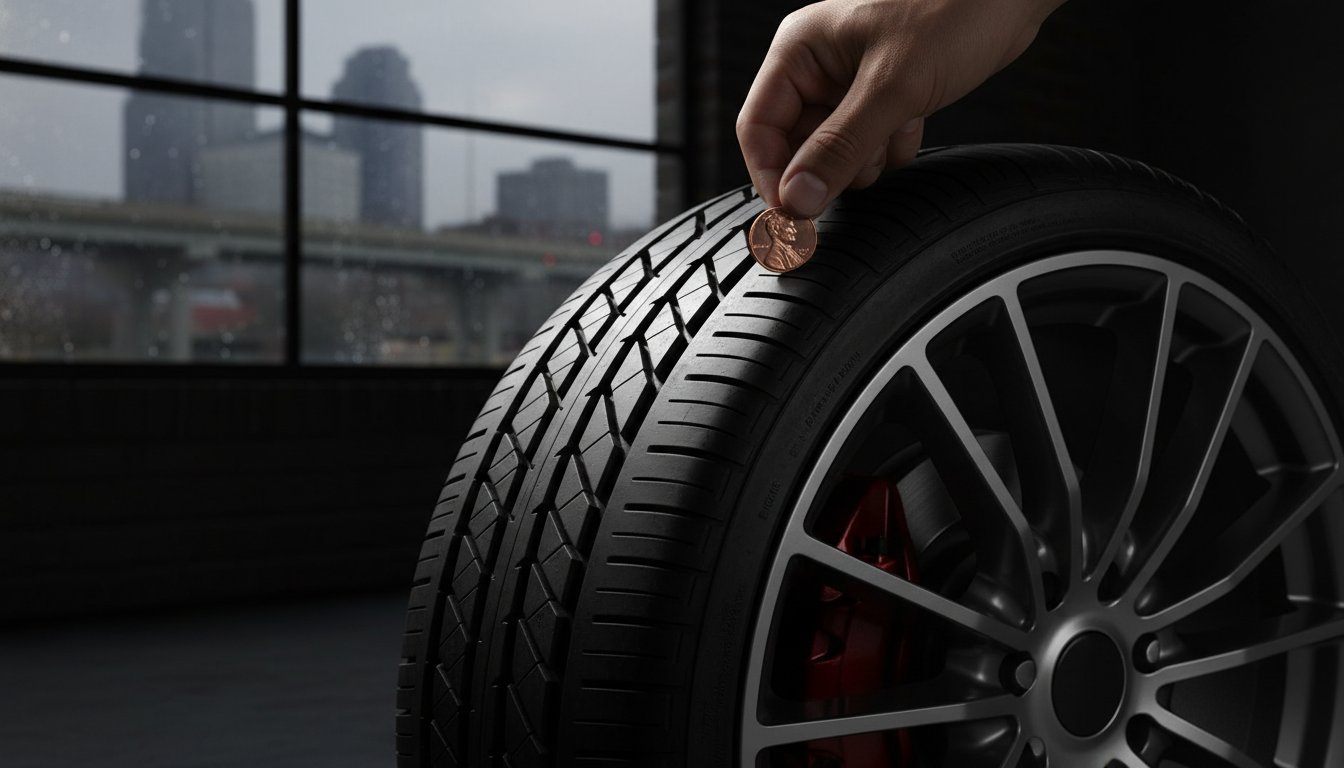
Could a copper penny be the most important safety tool in your Birmingham garage? When a sudden July downpour hits the Red Mountain Expressway, that small coin determines if you maintain grip or begin to hydroplane. Learning how to check tire tread is the fastest way to prevent these risks. Data from the National Highway Traffic Safety Administration shows that tire-related issues contribute to roughly 11,000 crashes every year. You shouldn't have to guess about your family's safety when the clouds turn gray.
We understand that most drivers find technical measurements like 32nds of an inch confusing and time-consuming. You want a clear answer without spending your lunch break waiting at a service center. This guide simplifies the process using items you already own. We'll provide a definitive "safe" or "unsafe" verdict so you can stay mobile and secure on Alabama roads. You'll master the penny test, learn why the quarter test offers more protection, and see how our Birmingham team provides the wholesale power and local touch your vehicle needs to stay driven by service.
Key Takeaways
- Navigate Birmingham’s heavy rains safely by understanding how tread depth maintains grip on I-65 and I-20.
- Discover how to check tire tread in seconds using simple household tools like a penny or a quarter for reliable results.
- Learn to interpret depth measurements from 10/32" to 2/32" to stay ahead of the dangerous "caution zone."
- Identify uneven wear patterns early to diagnose alignment issues caused by Birmingham’s notorious potholes and rough roads.
- Find out how mobile installation services in Hoover and Pelham provide a fast, professional solution for your tire needs.
Why Tire Tread Depth Matters for Birmingham Drivers
Safe driving in Alabama starts where the rubber meets the road. To understand your vehicle's safety, you must first ask: What is tire tread? Simply put, it is the pattern of rubber grooves on the exterior of your tire. These grooves serve a critical purpose by providing grip and channeling water away from the tire's contact patch. For Birmingham drivers navigating heavy rain on I-65 or I-20, these channels are the only thing preventing a dangerous loss of control.
Alabama summers present unique challenges for your tires. Birmingham often sees over 50 days a year with temperatures exceeding 90 degrees. This intense heat accelerates rubber degradation, causing the tire compound to harden and wear down faster than in cooler climates. When your tread depth drops, your stopping distances increase significantly. This is especially dangerous on Birmingham’s hilly terrain. Navigating steep inclines in areas like Mountain Brook requires maximum friction, which only healthy tread can provide. Learning how to check tire tread is a vital skill for every local motorist.
The Risk of Hydroplaning in Alabama
Flash floods are a common reality in Central Alabama. When heavy rain hits, worn tread fails to disperse the water pooling on the asphalt. This creates a barrier between your car and the road. Hydroplaning is the loss of steering due to water buildup between the tire and the road surface. Without deep grooves to pump water out of the way, your car begins to float. This loss of traction makes braking and steering impossible. Maintaining proper tread depth prevents these accidents by ensuring your tires stay firmly planted on the pavement during a storm.
Tread Depth and Your Vehicle’s Performance
Tire health directly impacts your daily commute and your wallet. Healthy tread improves fuel efficiency by maintaining optimal rolling resistance in heavy city traffic. You will notice smoother handling and more responsive steering when your tires are in peak condition. This performance is vital near high-traffic hubs like Hoover, where sudden stops are frequent. If your inspection reveals it is time for a new set, decoding tire size meaning helps you identify the exact replacement needed for your specific vehicle.
Regular maintenance ensures your vehicle remains reliable. We are driven by service and committed to keeping local drivers safe. Use these guidelines on how to check tire tread to monitor your equipment before the next Alabama thunderstorm arrives. Consistent checks protect your safety and your vehicle's long-term performance.
3 Simple Ways to Check Your Tire Tread at Home
Safety on Alabama roads depends on the small patch of rubber connecting your vehicle to the asphalt. Understanding how to check tire tread is a vital skill for every driver in the Birmingham metro area. Proper tread depth ensures your vehicle can channel water away, maintaining grip during sudden afternoon thunderstorms. Use these three reliable methods to verify your tires are ready for the road.
The Penny Test: A Birmingham Classic
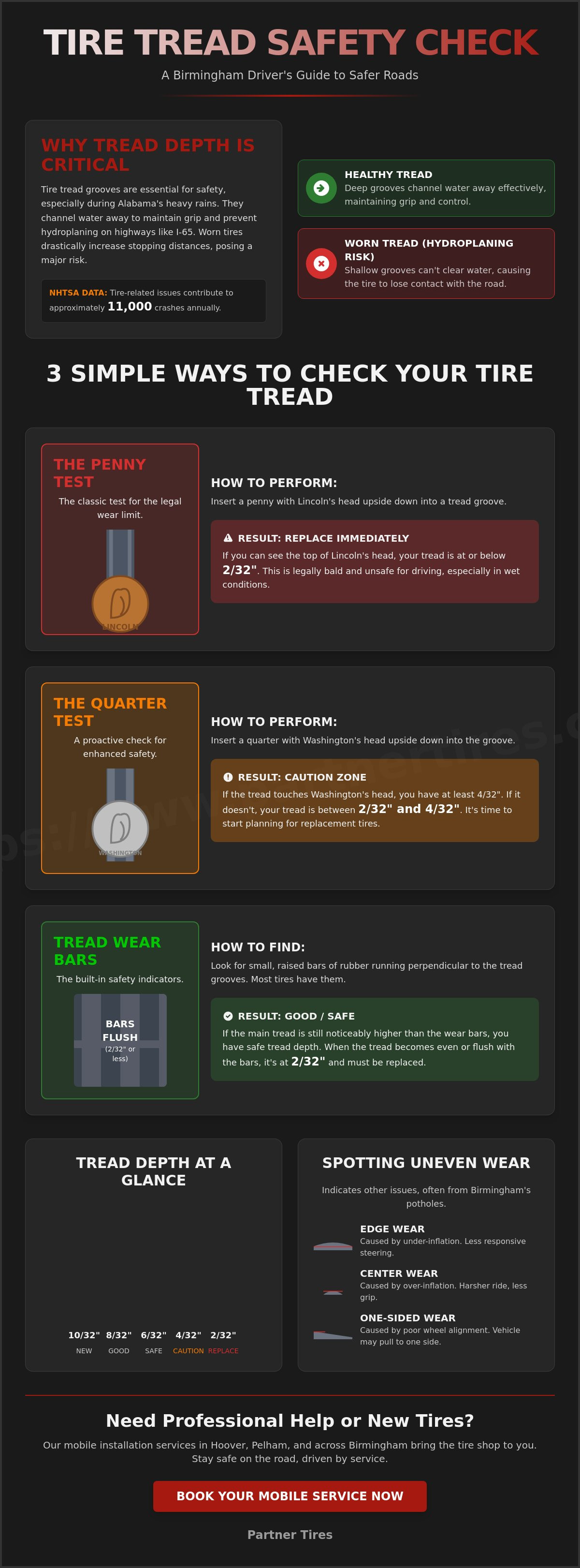
The penny test remains the most accessible DIY method for a quick safety check. It identifies when a tire has reached the legal limit of wear. Follow these steps to get an accurate reading:
- Take a standard copper penny and hold it between your thumb and forefinger.
- Insert the penny into a tread groove with Abraham Lincoln’s head facing down.
- Observe how much of the head is covered by the rubber.
If you can see the very top of Lincoln’s head, your tread depth is less than 2/32 of an inch. This measurement is the industry standard for a "bald" tire. At this level, your vehicle lacks the necessary traction for safe operation. Immediate replacement is required to maintain legal compliance and road safety. Don't risk a blowout on I-65; check your depth monthly.
The Quarter Test for Enhanced Safety
While 2/32 of an inch is the legal minimum, it isn't always the safest margin for heavy rain. Many safety experts recommend a 4/32-inch threshold for better performance on wet surfaces. Following NHTSA tire safety guidelines helps drivers understand that stopping distances increase significantly as tread wears down. Use a quarter to check for this higher safety standard.
Insert the quarter into the groove with George Washington’s head facing down. If the tread covers part of his head, you have at least 4/32 of an inch of depth. If the top of his head is visible, your tires are entering a "caution" zone. This is the ideal time to start browsing for a reliable local tire solution before your grip reaches dangerous levels.
Using Tread Wear Indicator Bars
You don't always need spare change to evaluate your tires. Manufacturers build safety features directly into the rubber. Look closely at the grooves of your tires to find tread wear indicator bars. These are small bridges of raised rubber that run perpendicular to the tread ribs. They sit exactly 2/32 of an inch above the base of the groove.
When the surrounding tread wears down until it's flush with these bars, the tire is finished. It's a visual "stop" sign from the manufacturer. We recommend checking these indicators before any long trips to Cullman or Leeds. It's a fast, effective way to ensure your vehicle is driven by service and safety.
Always check multiple spots across the width of the tire. If the outside is worn but the inside looks deep, you likely have an alignment issue. Consistent monitoring keeps your costs low and your safety high. At Partner Tires, we believe in wholesale power with a local touch, ensuring every driver has access to the information they need to stay on the move.
Understanding the Numbers: When to Replace Your Tires
Tire safety is a matter of precise measurement. Most new passenger tires arrive from the manufacturer with a tread depth of 10/32" or 11/32". This depth provides the necessary channels to move water away from the contact patch. As you accumulate miles on Birmingham roads, this rubber wears down. Understanding how to check tire tread involves knowing exactly what these fractions mean for your stopping distance and control.
The transition from 10/32" to 2/32" isn't just a loss of rubber; it is a loss of safety. Birmingham receives roughly 56 inches of rain annually, which is significantly higher than the national average. This local weather makes 4/32" the functional safety limit for Alabama drivers. When your tread hits 4/32", your vehicle's ability to resist hydroplaning on I-65 or Highway 280 drops sharply. Research shows that stopping distances on wet pavement can increase by over 80 feet when tires wear from 10/32" down to 4/32".
Safety is a logistical priority. You should learn how to check your tire tread using a dedicated gauge for the most accurate results. Consistent monitoring ensures you aren't caught off guard by sudden traction loss during a summer thunderstorm. Driven by service, we recommend replacing tires before they reach the absolute legal limit to maintain peak performance.
Tread Depth Measurement Chart
Use this scale to evaluate your current inventory of rubber. Efficiency and safety go hand in hand.
- 6/32" (Great): Your tires have ample rubber remaining. Traction is high.
- 4/32" (Caution): This is the "Plan for Replacement" zone. Grip in wet weather is compromised.
- 2/32" (Dangerous): Tires are legally bald. Replace them immediately to avoid failure.
Always replace tires in pairs or full sets. Mixing tires with different tread depths creates an imbalance in traction that can lead to unpredictable handling. If a full set of new tires isn't in the budget, used tires in Birmingham, AL are a reliable option if they pass a professional depth inspection and show at least 6/32" of remaining tread.
Legal Requirements in Alabama
Alabama state law mandates a minimum tread depth of 2/32". Driving on tires below this limit is illegal and dangerous. Beyond the risk of a citation, bald tires carry heavy liability. If you're involved in an accident, insurance adjusters look for poor maintenance as a sign of negligence. While Alabama doesn't require universal annual safety inspections, local law enforcement can pull you over for visible tire wear. Keep your vehicle compliant to protect your business and your passengers.
Spotting Uneven Wear and Alignment Issues
Birmingham roads test the limits of your vehicle every day. Between the expansion joints on I-65 and the notorious potholes scattered throughout the Southside, your tires endure significant impact. Knowing how to check tire tread involves more than just measuring depth at a single point. You must inspect the entire surface for uneven patterns. If the inside edge is bald while the outside looks new, your vehicle is fighting against itself. This friction wastes fuel and shortens the lifespan of your rubber.
Rough road surfaces in Alabama accelerate mechanical wear. A single deep pothole can knock your wheels out of alignment instantly. This misalignment causes the tire to drag rather than roll smoothly. Improper inflation also dictates how your tires age. When you maintain the correct PSI, you ensure an even footprint. Partner Tires is driven by service, and we know that consistent maintenance is the only way to protect your bottom line and stay safe on the road.
Common Wear Patterns and Their Causes
Center wear typically indicates over-inflation. The tire bulges in the middle, causing the center ribs to vanish while the edges remain thick. Conversely, edge wear on both sides signals under-inflation. This creates excessive heat and stresses the sidewalls. If you notice cupping, which feels like scalloped dips in the rubber, your suspension or shocks are likely worn out. One-sided wear is a definitive red flag for alignment issues. These patterns are early warning signs that require immediate action to prevent a blowout.
The Role of Alignment and Balancing
Computerized balancing is a critical logistical step in tire maintenance. It ensures weight is distributed perfectly around the axle. If you feel a steady vibration while driving 55 mph on Highway 280, your wheels are likely out of balance. This vibration creates uneven centrifugal force, leading to premature tread loss. We recommend a professional diagnostic every 6,000 miles or whenever you hit a significant road hazard. Local experts can identify these issues before they become expensive failures. Consult these tire dealers in Birmingham, AL for a precision alignment check.
Regular rotation is your best defense against uneven wear. Front tires handle the heavy lifting of steering and braking, causing them to wear faster than the rear set. Swapping their positions every 5,000 to 8,000 miles balances this workload. It extends the life of your investment and keeps your vehicle handling predictably. At Partner Tires, we provide the wholesale power and local touch needed to keep your fleet or personal vehicle moving efficiently. Don't wait for a flat to address your tread health.
Maximize your vehicle's performance and safety. Partner with the tire experts today for reliable service and expert advice.
Fast Tire Solutions in Birmingham: Partner Tires Is Your Ally
Knowing how to check tire tread is a vital skill for every driver in the Magic City. It keeps your family safe on the I-65 and ensures your vehicle handles the unpredictable Alabama rain. Partner Tires acts as your reliable ally across Birmingham, Hoover, and Pelham. We don't just sell rubber; we provide stability for your daily commute. Our business model combines wholesale power with a local touch. This unique approach allows us to offer competitive pricing that rivals national chains while maintaining the personalized service of a neighborhood shop.
We understand that a flat tire or worn tread isn't just an inconvenience. It's a disruption to your livelihood. That's why we prioritize speed. Our delivery and on-site repair services operate with a sense of urgency. We aim to get you back on the road within hours, not days. We've built our reputation on being the backbone of local transportation, ensuring that every driver has access to high-quality inventory exactly when they need it.
Mobile Service: We Come to You
Professional life in Birmingham moves fast. If you're managing a busy schedule in Mountain Brook or heading to meetings in Vestavia, you don't have three hours to spend in a tire shop waiting room. Our at home tire installation service changes the game. We bring high-grade equipment and expert technicians directly to your driveway or office parking lot.
This mobile operation is the heartbeat of our "Driven by Service" philosophy. We handle the logistical heavy lifting while you stay productive. Whether it's a full set of new tires or a critical repair, we arrive on time and finish the job with precision. We've optimized our routes to ensure our mobile units are stocked and ready for any Birmingham zip code, providing a seamless experience that respects your time.
Your Local Tire Partner in Birmingham
Partner Tires is deeply rooted in the local community. We support drivers from Bessemer to Trussville with an unwavering commitment to reliability. For those looking for specific shop information, our Avondale neighborhood guide offers a detailed look at how we serve the local area. We aren't just a vendor; we're a teammate in your vehicle's long-term maintenance.
Now that you've learned how to check tire tread, don't wait for a blowout to take action. If your tread depth is below 2/32 of an inch, your safety is at risk. We provide the expert eyes and the inventory needed to fix the problem immediately. Schedule a professional tread assessment or a mobile installation today. We drive your success by keeping your tires in peak condition.
Secure Your Safety on Birmingham Roads
Your safety on Alabama highways depends on the 2/32-inch of rubber between your vehicle and the pavement. Knowing how to check tire tread prevents hydroplaning during heavy summer rainstorms. Use a tread depth gauge or the simple penny test to identify wear before it becomes a hazard. If your tires show uneven wear or reach the 4/32-inch warning level, don't wait for a failure. Partner Tires brings wholesale power and a local touch directly to your driveway.
We're locally owned and operated right here in Birmingham. Our mobile units serve Hoover, Vestavia, and the surrounding communities with professional efficiency. Every mobile installation includes expert computerized balancing and alignment to ensure your new tires last. We're driven by service and dedicated to keeping your schedule on track. Get New Tires Delivered and Installed at Your Home or Office and experience a smarter way to maintain your vehicle. Trust the partner that prioritizes your family's safety on every mile.
Frequently Asked Questions
Is the penny test for tires still accurate in 2026?
The penny test remains a baseline indicator in 2026, though safety experts recommend the quarter test for better wet-weather performance. If you see the top of Lincoln's head, your tread is at or below 2/32 of an inch. While this meets legal requirements in 42 states, stopping distances on wet Birmingham roads increase by 40% compared to tires with 4/32" of tread. Using a quarter provides a safer 4/32" margin for local rainstorms.
How often should I check my tire tread depth?
You should check your tire tread depth at least once every 30 days. Regular monthly inspections allow you to catch uneven wear patterns caused by alignment issues before they ruin the tire. We recommend checking every 3,000 miles if you drive more than the national average of 13,500 miles per year. Learning how to check tire tread monthly keeps your vehicle safe and your maintenance costs low.
Can I check tire tread with a digital depth gauge?
Digital depth gauges provide the most accurate measurements; they often read in increments of 1/128 of an inch or 0.01mm. These tools remove the guesswork associated with coins or manual slides. Simply zero the gauge on a flat surface, insert the probe into the deepest groove, and press down. Professional shops use these devices to ensure inventory meets strict safety standards before delivery. This precision is why we're driven by service in every technical recommendation.
What happens if only one of my tires has low tread?
Single-tire wear usually signals a mechanical problem like poor wheel alignment or a worn suspension component. If one tire hits 2/32" while others remain at 6/32", your car will pull to one side and lose traction during emergency braking. Replace the worn tire and schedule an alignment immediately to protect your remaining investment. We provide the wholesale power to help local dealers source matching replacements fast to keep you on the road.
Do new tires always start at 10/32 of an inch?
Most passenger car tires start with 10/32" or 11/32" of tread, but depths vary by category. High-performance summer tires often begin at 8/32" to improve stability; dedicated off-road truck tires can feature depths of 15/32" or more. Always check the manufacturer specifications for your specific model to establish an accurate baseline for wear tracking. Knowing your starting point helps you calculate the remaining lifespan and your eventual replacement date.
Why does my tread wear down faster in the Birmingham summer?
Birmingham's average July high of 91 degrees Fahrenheit significantly accelerates rubber degradation. High ambient temperatures combined with friction from the asphalt cause tire compounds to soften and wear away faster than in cooler climates. Maintaining proper inflation is critical during Alabama summers, as under-inflated tires generate even more internal heat, leading to 15% faster tread loss. Our local touch ensures we understand these regional challenges and provide tires built for the heat.
Can low tire tread cause my TPMS light to come on?
Low tread depth won't trigger the Tire Pressure Monitoring System (TPMS) directly, as these sensors only measure air pressure. However, thin tread is 25% more likely to suffer punctures from road debris, which leads to the pressure drops that activate the light. If your light stays on, it's time to learn how to check tire tread and inspect for embedded nails or slow leaks. Proper tread depth is your first line of defense against pressure loss.
Is it safe to buy used tires with 6/32" of tread remaining?
A tire with 6/32" of tread has roughly 50% of its useful life remaining, but safety depends on the tire's age. Check the DOT code on the sidewall; any tire older than 6 years poses a risk of dry rot regardless of tread depth. We prioritize reliability by supplying dealers with fresh, new inventory because used tires lack the verified history needed for total driving confidence. Investing in new rubber is a proven strategy for long-term profitability and safety.


