Your tires are a significant financial asset. Letting them wear down prematurely due to poor maintenance is a direct hit to your bottom line. Many drivers ignore subtle changes in handling, but recognizing the early signs of a bad wheel alignment is the difference between a simple adjustment and an expensive tire replacement. If you feel your car pulling to one side or notice your steering wheel isn't centered, your vehicle is already working against you.
We know that unpredictable handling and highway vibrations create unnecessary stress during your daily commute. You deserve a vehicle that tracks straight and handles with precision. This guide will help you diagnose alignment issues before they lead to premature tire failure or safety risks on the road. We will break down exactly what to look for, from rapid tread wear to steering feedback, so you can find a reliable shop in Birmingham and get back to business with confidence. Protecting your safety starts with understanding how your vehicle communicates its needs.
Key Takeaways
- Identify the critical signs of a bad wheel alignment, including off-center steering and vehicle pulling, to address issues before they escalate.
- Protect your tire ROI by understanding how misalignment accelerates tread wear and increases fuel consumption.
- Learn the distinction between alignment and computerized wheel balancing to ensure your vehicle receives the precise service it requires.
- Discover how Birmingham’s road conditions and suspension wear impact your vehicle’s stability and operational safety.
- Evaluate the benefits of a professional four-wheel alignment in restoring manufacturer specifications and maximizing the lifespan of your tires.
Identifying the 5 Most Common Signs of a Bad Wheel Alignment
Your vehicle's suspension system is a complex network of components designed to work in perfect harmony. When that harmony breaks, your tires pay the price. Recognizing the signs of a bad wheel alignment early allows you to intervene before small vibrations turn into major mechanical failures. It's about protecting your equipment and your safety.
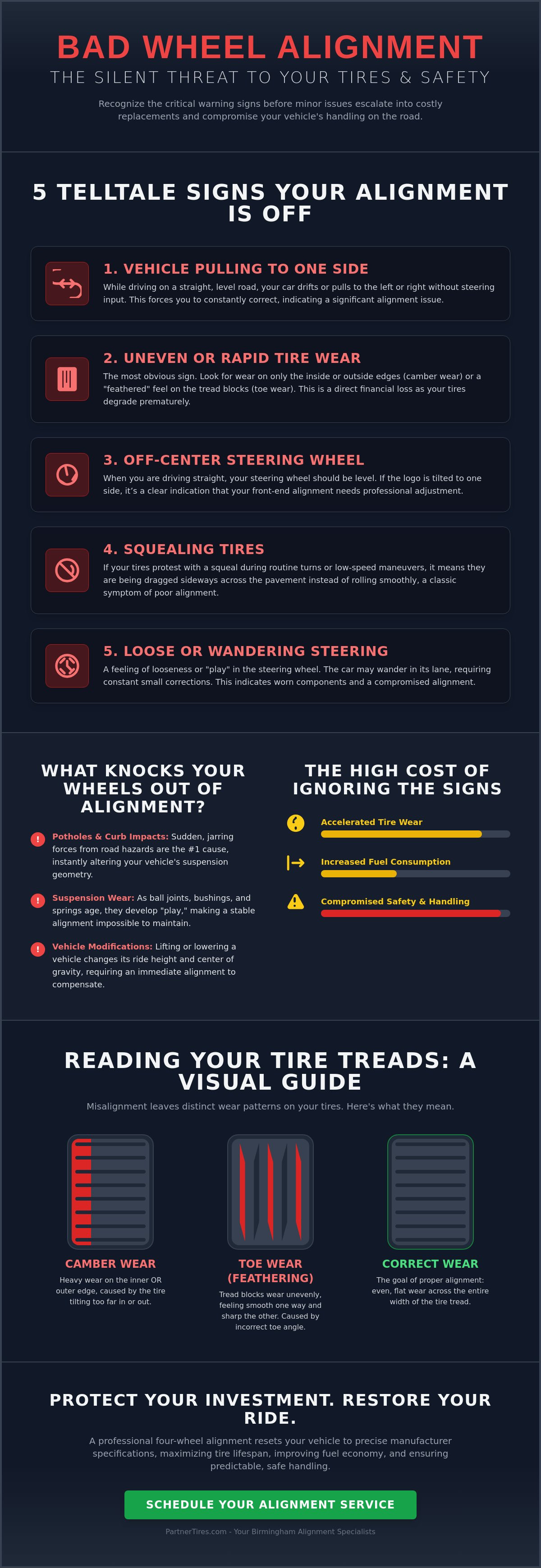
There are five primary indicators that your vehicle needs professional attention. First, watch for a vehicle that pulls to the left or right while you're driving on a straight path. Second, look for uneven or rapid tire tread wear, which often appears as feathering or cupping. Third, check your steering wheel; it should stay perfectly centered when the car moves straight. Fourth, listen for squealing tires during sharp turns or low-speed maneuvers. Finally, pay attention to a loose or wandering sensation in the steering wheel. These symptoms signal that your wheels are no longer perpendicular to the road or parallel to each other.
The 'Pulling' Test: Passive vs. Active Resistance
Determining if your car is truly misaligned requires understanding the difference between a slight drift and a hard pull. A hard pull feels like an active struggle against the steering wheel to keep the car in its lane. A passive drift might just be the result of the road crown. Most roads are built with a slight slope toward the shoulder to manage water drainage. This slope can mimic a minor alignment issue. To test your vehicle safely, find a flat, level surface. If the vehicle still veers off-course without steering input, your alignment is likely the culprit. This isn't just a nuisance; it's a constant strain on your steering components.
Visual Cues: Reading Your Tire Tread Like a Pro
Your tires are the most honest diagnostic tool you own. You can read the tread like a map of your vehicle's health. Feathering occurs when the tread blocks feel smooth when you rub your hand one way but rough in the other direction. This is a classic sign of improper toe settings. Camber wear presents as heavy balding on either the inside or outside edge of the tire. This usually indicates a suspension issue or a significant tilt in the wheel's vertical angle. Regular inspections are far more cost-effective than investing in a full set of new tires every few months. Catching these visual cues early protects your financial health and ensures your vehicle remains a reliable asset on the road.
Why Your Alignment Shifts: Common Causes on Birmingham Roads
Your vehicle's alignment isn't a static setting. It's a precise calibration that faces constant threats from the environment. While you might already recognize the signs of a bad wheel alignment, understanding what causes the shift is key to preventing recurring issues. Birmingham's unique infrastructure and climate create a challenging landscape for even the most robust suspension systems. Every mile driven on local roads introduces variables that can slowly or suddenly nudge your wheels out of spec.
Impacts are the most common culprits. Whether it's a deep pothole or a sharp curb, a single jarring event can bend a tie rod or shift a control arm. Gradual wear also plays a significant role. As your vehicle ages, springs sag and bushings lose their elasticity. These changes alter the ride height and suspension geometry. Modifications like lifting a truck or lowering a car without a follow-up alignment will also lead to immediate handling problems. Even a minor fender bender can jar components enough to compromise your tire's contact with the road.
Local Hazards: Birmingham Potholes and Infrastructure
Alabama's weather patterns take a heavy toll on our road surfaces. The freeze-thaw cycle creates cracks and expands existing fissures, leading to deep potholes that are often hard to spot during a rainy Birmingham commute. Hitting one of these at highway speeds causes an immediate impact that can knock your steering components out of their factory settings. Drivers in Hoover and Vestavia frequently encounter rough road conditions due to heavy traffic and ongoing construction projects. These areas are notorious for hidden dips and uneven pavement that challenge your vehicle's stability. Navigating a construction zone downtown also introduces debris that can lead to sudden steering corrections, further stressing your alignment.
Suspension Fatigue and Component Failure
Alignment depends on the health of your entire suspension system. Components like ball joints and tie rod ends are the pivot points that maintain precise wheel angles. When these parts wear out, they create "play" in the system, making it impossible to hold a true alignment. Worn shocks and struts also contribute to camber issues, causing your tires to tilt inward or outward. According to the NHTSA TireWise program, maintaining proper alignment is a critical factor in vehicle safety and performance. If your handling feels unpredictable, a comprehensive diagnostic scan can help determine if a failing electronic sensor or a mechanical part is causing the issue. Addressing these mechanical failures early is the only way to ensure your tires track straight. If you've recently hit a curb or noticed a change in steering feel, it's a good idea to consult a professional technician to verify your suspension health.
Alignment vs. Balancing: How to Tell Which Service You Need
Understanding the distinction between wheel alignment and wheel balancing is essential for maintaining your vehicle's operational efficiency. While both services contribute to a smoother ride, they solve different mechanical problems. Alignment is a geometric adjustment. It focuses on the angles at which your tires contact the road and each other. Balancing is a matter of physics; it corrects the weight distribution within the tire and wheel assembly to ensure it spins without wobbling. Confusing these two services often leads to incomplete repairs, leaving your vehicle's performance compromised.
You might address a vibration only to find your tires are still wearing unevenly. Identifying the signs of a bad wheel alignment alongside balancing issues ensures your vehicle stays on the road longer. For the best results, performing these services together is a proactive financial strategy. It prevents the rolling resistance caused by misalignment from fighting against the precision of a balanced wheel. When your wheels are out of balance, the centrifugal force creates a heavy spot that slams against the pavement hundreds of times per minute. This doesn't just cause discomfort; it hammers your suspension components, eventually leading to further alignment shifts. By investing in both services, you ensure that your tires spin truly and track straight, maximizing every dollar spent on your rubber.
Diagnosing Vibrations: Steering Wheel vs. Seat
Vibrations are the primary indicator of an unbalanced tire, but where you feel that vibration tells a specific story. If the steering wheel shakes, the issue usually lies in your front-end balance. If you feel a rhythmic vibration in your seat, the rear wheels are likely the culprit. Alignment issues rarely cause high-speed vibrations on their own. Instead, misalignment manifests as a constant pull or a crooked steering wheel. When you experience both a shake and a pull, your suspension has likely suffered a significant impact that requires a comprehensive service approach. Addressing one without the other is a temporary fix that results in accelerated component wear.
Comparison Table: Alignment vs. Computerized Balancing
This table provides a quick reference to help you communicate effectively with your technician and choose the right service for your vehicle’s symptoms. Accurate diagnosis is the first step toward a reliable repair.
| Symptom | Primary Cause | Recommended Service |
|---|---|---|
| Vehicle Pulling to One Side | Incorrect Wheel Angles | Four-Wheel Alignment |
| Vibration at 55+ MPH | Weight Imbalance | Computerized Wheel Balancing |
| Rapid or Uneven Tread Wear | Misaligned Suspension | Four-Wheel Alignment |
| Shaking Steering Wheel | Front Wheel Imbalance | Computerized Wheel Balancing |
The Financial Impact of Ignoring Misalignment
Ignoring the signs of a bad wheel alignment is a choice that costs you money every time you turn the key. It is not just a matter of driver comfort. It is a direct drain on your operating budget. Misaligned tires do not roll efficiently; they drag. This creates excessive rolling resistance, forcing your engine to work harder and consume more fuel. Industry data suggests that severe misalignment can reduce your fuel economy by as much as 10 percent. For a high-mileage driver in Birmingham, that is a significant annual expense that could be avoided with a simple service.
The impact on tire longevity is even more severe. A tire rated for 50,000 miles can have its lifespan cut in half by poor suspension geometry. You are essentially paying for two sets of tires to get the mileage of one. Beyond the rubber, the constant tugging and vibration put undue stress on your steering rack, ball joints, and suspension bushings. Replacing these mechanical components is far more expensive than a routine alignment check. Protecting your vehicle's financial health requires a proactive approach to maintenance.
Maximizing Your Tire ROI
Think of an alignment as an insurance policy for your tires. Spending a small amount on a professional four-wheel alignment can save you hundreds in premature replacement costs. This logic applies whether you are buying premium rubber or opting for used tires to keep your fleet moving. Even the highest quality used tire will fail quickly if it is fighting against a crooked suspension. Perfect alignment ensures that the tread wears evenly across the entire surface, allowing you to extract every possible mile from your investment. Efficiency is the foundation of a successful operation.
The Safety Factor: Stability and Braking
Alignment directly dictates how much of your tire actually touches the road. This is known as the contact patch. When your wheels are out of spec, that patch is reduced or uneven, which compromises your braking efficiency. In wet Alabama weather, this becomes a critical safety risk. Unevenly worn tires are far more prone to hydroplaning during heavy afternoon thunderstorms. Proper alignment keeps your vehicle stable and predictable during emergency maneuvers. Furthermore, a documented history of regular alignments helps maintain the resale value of your vehicle. It proves to future buyers that the chassis has been cared for properly. If you suspect your vehicle is drifting, you should schedule a four-wheel alignment to restore your safety and performance.
Professional Four-Wheel Alignment Services in Birmingham
Recognizing the signs of a bad wheel alignment is the first step toward restoring your vehicle's performance. The next step is choosing the right technical approach. Many shops offer a basic front-end alignment, but this only addresses half the problem. A true four-wheel alignment ensures that all four wheels are parallel to each other and perpendicular to the ground. If your rear wheels are misaligned, your car will "dog-track," forcing the front wheels to compensate and causing erratic handling. Partner Tires provides the computerized precision necessary to meet strict manufacturer specifications. We focus on getting your vehicle back to its peak operational state without unnecessary delays.
Our commitment to no-nonsense service means we prioritize your time and your safety. We understand that Birmingham drivers face unique challenges, from tight construction zones to sudden highway stops. Your vehicle needs to respond with absolute predictability. We provide reliable automotive support that acts as the backbone of your daily operations. Whether you are managing a personal vehicle or a commercial fleet, our goal is to ensure your tires track straight and your suspension remains stable. We offer convenient options for local drivers, including mobile support to minimize your downtime.
Why Computerized Alignment is Non-Negotiable
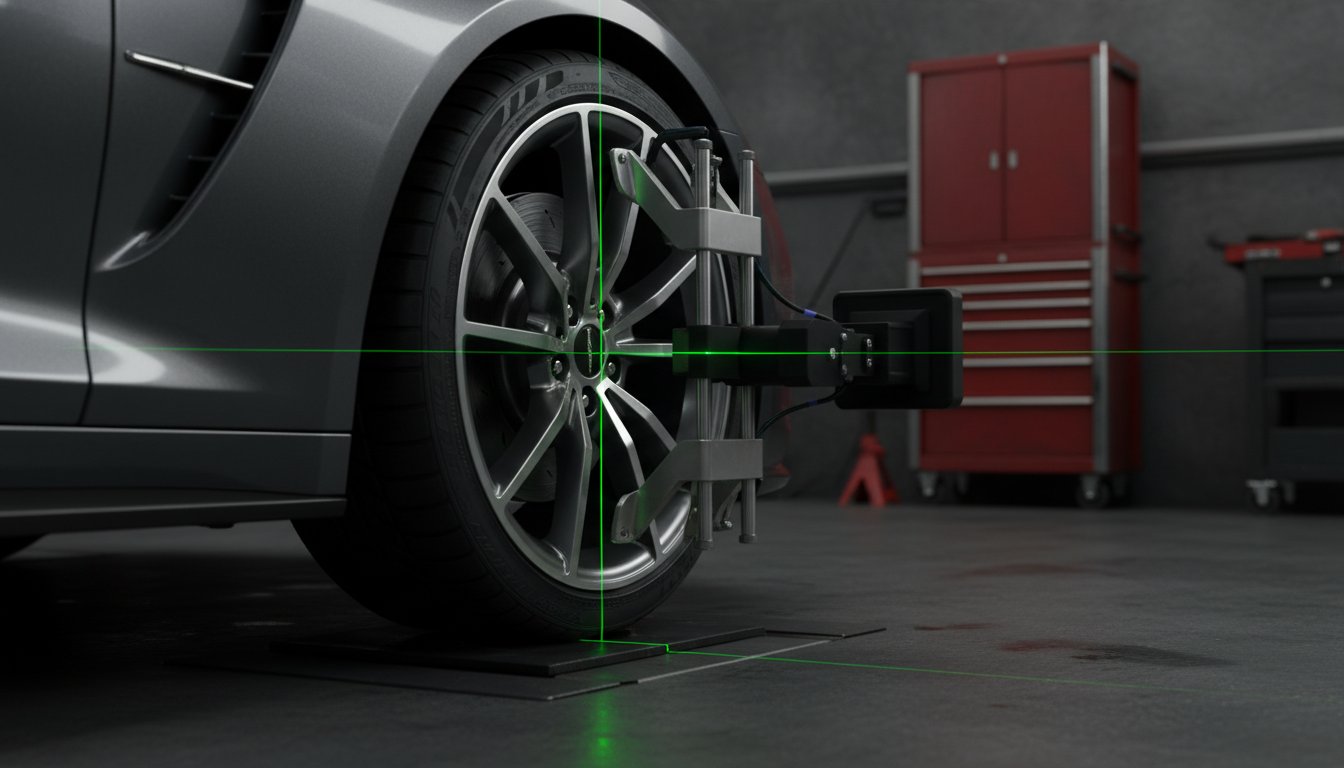
Modern suspension systems are too complex for manual adjustments. Computerized sensors detect misalignments invisible to the human eye, measuring angles down to the hundredth of a degree. We focus on three primary measurements: Toe, Caster, and Camber. Toe refers to whether the wheels are angled inward or outward when viewed from above. Caster affects your steering stability and cornering ability. Camber is the vertical tilt of the wheel. We provide a printed report of your vehicle's before-and-after specs. This transparency ensures you have documented proof that your vehicle is back within factory tolerances. Precision is the only way to maximize your tire ROI.
Comprehensive Care: Beyond the Alignment Rack
Our service doesn't stop at the wheels. We perform a thorough inspection of your brakes and suspension components during every alignment visit. A worn ball joint or a leaking strut can ruin a fresh alignment in a matter of miles. We serve the greater Birmingham area, reaching clients from Bessemer to Trussville with consistent, high-quality care. This regional expertise allows us to understand the specific wear patterns caused by local road conditions. We work behind the scenes to keep your vehicle safe and your costs low. Schedule your four-wheel alignment with Partner Tires today and ensure your vehicle is ready for the road ahead.
Restore Your Vehicle's Precision and Stability
Your vehicle's performance is the foundation of your daily schedule. You now know how to recognize the signs of a bad wheel alignment, from irregular steering feedback to uneven tread wear. These symptoms indicate that your suspension is working against you, draining your fuel budget and shortening the lifespan of your tires. Addressing these issues early isn't just a repair; it's a strategic move to protect your vehicle's long-term value and operational efficiency.
Partner Tires acts as the backbone of your automotive maintenance. We use computerized four-wheel alignment technology to ensure every adjustment meets exact manufacturer standards. Our certified technicians in Birmingham bring regional expertise to every service, ensuring your car handles the local terrain with confidence. For those with busy operations, we offer mobile tire installation and roadside support to keep you on the move. Don't wait for a small pull to become a major safety risk. Take control of your vehicle's health and ensure a smoother, more efficient ride today.
Book Your Professional Alignment in Birmingham Now
Frequently Asked Questions
How often should I get my wheel alignment checked?
You should have your alignment checked every 6,000 to 10,000 miles, or at least once annually. Most manufacturers recommend this interval to ensure your suspension remains within factory specifications. If you drive on rough roads or notice signs of a bad wheel alignment, you should increase the frequency of these checks. Regular inspections prevent minor deviations from turning into major tire expenses and keep your vehicle operating at peak efficiency.
Can a bad alignment cause my steering wheel to shake?
Shaking in the steering wheel is primarily a symptom of unbalanced tires rather than poor alignment. While alignment issues cause pulling or a crooked wheel, high-speed vibrations usually require computerized wheel balancing to correct weight distribution. However, if your suspension components are so worn that they cannot hold an alignment, you might feel a wandering sensation. It is best to have a diagnostic scan to identify the exact cause of the vibration.
Will new tires fix my car's pulling problem?
No, installing new tires will not resolve a pulling issue caused by misaligned suspension. New tires provide better grip, but the underlying geometry remains crooked. If you don't perform a four-wheel alignment with your new purchase, the vehicle will immediately begin wearing down the fresh tread blocks. You risk cutting the lifespan of your investment in half by ignoring the mechanical cause of the pull. Proper alignment is the only way to protect new rubber.
How long does a professional wheel alignment take?
A professional four-wheel alignment typically takes between 60 and 90 minutes to complete. This timeframe allows technicians to set up the computerized sensors, measure the current angles, and make the necessary mechanical adjustments. If your vehicle has advanced driver-assistance systems or significant suspension wear, the process may take slightly longer. It is a precise, efficient service designed to get you back on the road with minimal downtime.
Is it safe to drive with a bad wheel alignment?
Driving with a bad alignment is not safe because it reduces your control over the vehicle. Poor alignment compromises your steering response and braking efficiency, especially in wet conditions. You will find yourself constantly fighting the wheel to stay in your lane, which leads to driver fatigue. Over time, the uneven tire wear creates a higher risk of blowouts or hydroplaning during heavy Alabama rainstorms. Immediate service is required to restore safety.
What is the difference between a 2-wheel and 4-wheel alignment?
A two-wheel alignment only adjusts the front wheels, while a four-wheel alignment calibrates all four wheels to work in unison. Modern vehicles require a four-wheel service to ensure the car tracks straight and the rear wheels follow the front perfectly. If the rear wheels are out of spec, the front wheels will struggle to compensate. This leads to a "dog-tracking" effect that ruins tires and creates unpredictable handling on the highway.
Can hitting a pothole once really ruin my alignment?
Yes, a single impact with a deep pothole can immediately knock your vehicle out of spec. Birmingham construction zones and aging infrastructure present constant risks to your suspension components. A jarring hit can bend a tie rod or shift a control arm, leading to immediate signs of a bad wheel alignment. If you feel a change in steering feel or the car begins to drift after an impact, you should seek a professional inspection immediately.
Does wheel alignment affect my car's gas mileage?
Yes, poor wheel alignment can decrease your fuel efficiency by creating extra rolling resistance. When your tires aren't pointing straight, they drag across the pavement instead of rolling smoothly. This forces your engine to work harder and consume more fuel to maintain speed. Industry professionals report that severe misalignment can reduce your miles per gallon by as much as 10 percent, making regular alignment a critical part of your financial health.


