What if that constant tug on your steering wheel is a warning sign rather than a minor nuisance? Fighting a vehicle that drifts toward the shoulder is physically exhausting and mentally draining during a long commute through Jefferson County. When you are searching for car pulling to the right what to do, you need a clear path to a solution that avoids unnecessary labor costs. Ignoring this subtle drift often leads to rapid tire destruction or, in extreme cases, a total loss of steering control on high-speed Alabama interstates.
We understand that your time is valuable and your safety is the highest priority. This article provides a definitive roadmap to identify why your vehicle drifts right and the exact steps to fix it. You will learn to distinguish between simple tire pressure issues and complex suspension failures before they escalate into major repairs. We will preview a professional diagnostic framework, explore how local road designs impact your handling, and explain how mobile automotive services can restore your vehicle's straight path without disrupting your workday in Birmingham.
Key Takeaways
- Distinguish between natural road slope and mechanical failure to avoid paying for unnecessary professional repairs.
- Identify how a minor 5 PSI difference in tire pressure can mimic a serious alignment issue and learn how to correct it.
- Master a simple two-step diagnostic framework to determine if you need a four-wheel alignment or a mobile tire service.
- Discover exactly why your car pulling to the right what to do begins with a tire inspection rather than an immediate shop visit.
- Recognize the warning signs of worn suspension bushings and tie rods before they lead to a dangerous tire blowout or MOT failure.
Is It the Car or the Road? Understanding the Right-Hand Pull
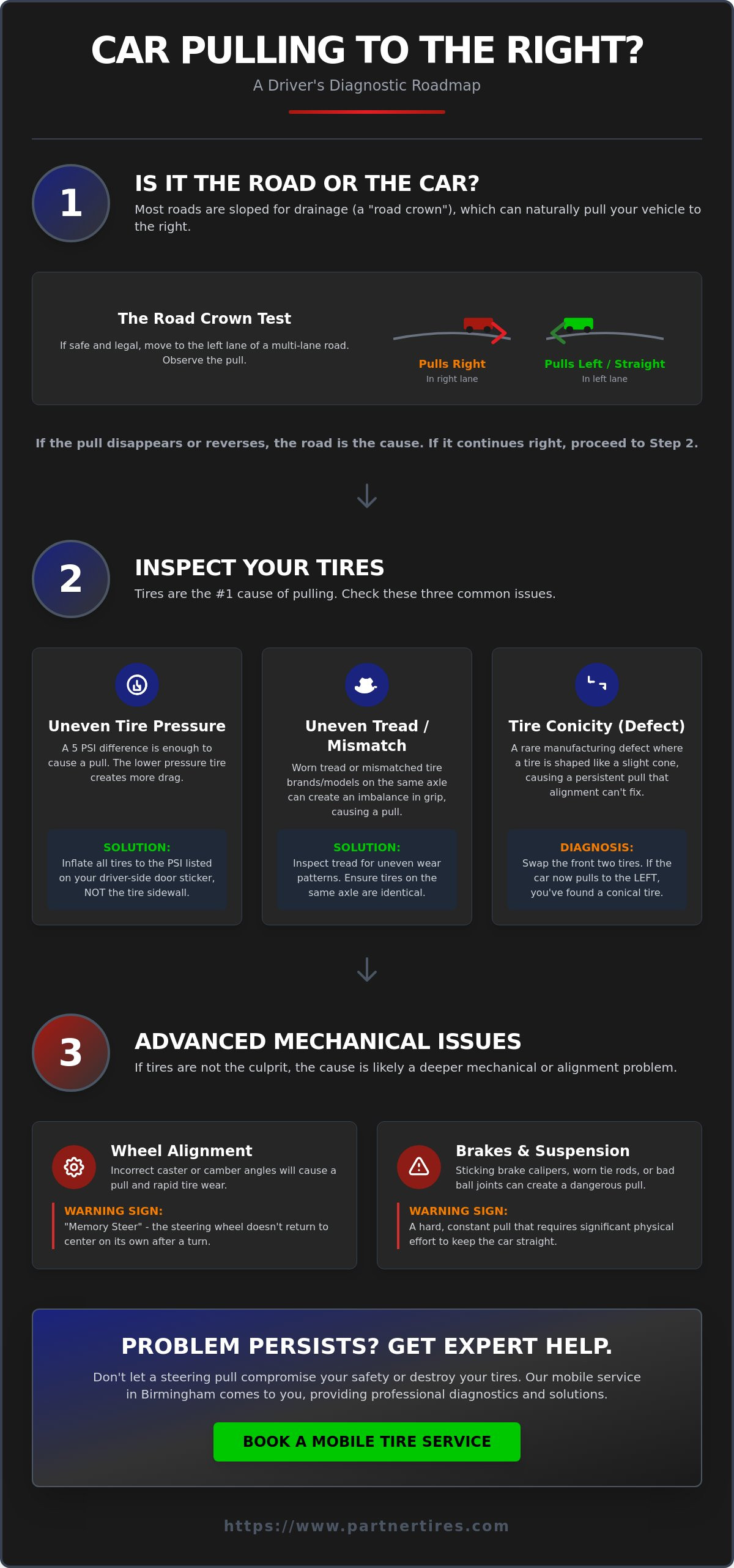
Roads are rarely flat. Engineers design Alabama highways with a specific slope called a road crown to ensure rainwater drains off the surface quickly. This intentional curvature prevents hydroplaning but often creates a subtle drift. If you find yourself wondering about your car pulling to the right what to do, your first step is determining if the pavement is the problem. A standard road crown can mimic a mechanical pull, leading many drivers to seek unnecessary repairs. It's a common issue that confuses even experienced motorists.
To better understand this concept, watch this helpful video:
The Science of Road Crown in Birmingham
In Birmingham, right-hand lanes on major arteries like Highway 280 are typically sloped more aggressively toward the gutter. This helps manage heavy storm runoff during the rainy season. You might notice your vehicle behaves differently on I-20 compared to local surface streets. To test this, safely move your vehicle to the left lane of a divided highway when traffic is clear. If the pull disappears or the car begins to drift slightly left, the road design is the cause. However, if the vehicle continues to fight you toward the right even on a left-sloping surface, you likely have an internal mechanical issue that requires attention.
Immediate Safety Red Flags
While a slight drift is a nuisance, a hard pull is a liability. You should never ignore a steering wheel that requires constant physical effort to keep straight. This often indicates a failure in your braking system or a severe suspension misalignment. Understanding Wheel Alignment is critical here. If your caster or camber angles are off, your tires will wear unevenly and your fuel economy will drop. Watch for "memory steer," where the wheel fails to return to the center after a turn. This is a red flag for binding ball joints or seized steering components. When you experience these symptoms alongside a car pulling to the right what to do is clear: stop driving and seek a professional diagnostic scan immediately to protect your safety and your financial health.
Tire-Related Causes: The Most Common Culprits
Before assuming you have a bent frame or broken suspension, look at your rubber. Tires are the most frequent cause of directional drift. When drivers ask about their car pulling to the right what to do, the answer usually starts with a pressure gauge. Even a minor 5 PSI difference between the left and right tires on the front axle creates a significant imbalance. The tire with lower pressure has a larger contact patch and higher rolling resistance. This drags the vehicle toward that side. Consistent maintenance is the backbone of vehicle safety and prevents these avoidable steering fights.
Pressure and Tread Depth Diagnostics
Check your tire pressure using the manufacturer's recommended PSI found on the driver-side door placard. Never use the "Max PSI" listed on the tire sidewall. That number represents the tire's physical limit, not your car's optimal setting for handling. Beyond pressure, uneven tread wear causes your car to track road grooves aggressively. You can use the "penny test" to measure depth, but looking for diagonal wear patterns provides more insight into your axle health. For a deeper look at identifying quality rubber, see our guide on checking tire tread. If your tires are mismatched by brand or model on the same axle, their different grip levels will inevitably cause a pull.
Understanding Tire Conicity
Tire conicity is a technical manufacturing defect that many general mechanics overlook. It occurs when the internal steel belts are slightly off-center during the molding process. This turns the tire into a cone shape rather than a perfect cylinder. As the cone rolls, it naturally wants to steer in one direction. This creates a permanent pull that alignment settings cannot fix. Following the NHTSA Diagnostic Framework helps isolate this specific issue. To test for conicity, try swapping the two front tires. If the car suddenly pulls to the left instead of the right, you have confirmed a defective tire. Even brand-new tires can suffer from this if they aren't properly mounted and balanced. If you suspect a manufacturing flaw, a professional diagnostic scan can pinpoint the pull source before you waste money on parts you don't need.
Mechanical Issues: Alignment, Suspension, and Brakes
If your tire pressure is accurate and the tread is even, the source of the drift lies deeper in your chassis. Your vehicle's steering geometry depends on precise angles to maintain a straight path. When these angles shift, you lose control and efficiency. Understanding your car pulling to the right what to do requires looking at the mechanical skeleton of your vehicle. Birmingham's road conditions are notoriously harsh on these components. One deep pothole on a rainy night can instantly knock a perfectly tuned system out of specification.
The Role of Wheel Alignment
Alignment involves three primary angles: Toe, Camber, and Caster. Toe is the direction the tires point relative to the vehicle's centerline. Camber is the inward or outward tilt of the wheel when viewed from the front. Caster is the forward or backward tilt of the steering axis. If the right-side caster is more negative than the left, the car will lead toward the right. Modern vehicles feature complex multi-link suspension systems that require a four-wheel alignment to ensure both axles work in harmony. Alignment-based pulls are usually constant. Unlike tire-based issues, they don't change with speed or road surface. They simply require a professional technician to reset the geometry to factory standards.
Suspension and Steering Wear
Suspension components act as the foundation for your alignment. If a control arm bushing is torn or soft, the wheel can shift under the load of acceleration or braking. This creates a dynamic pull that feels unpredictable. Worn tie rod ends are especially dangerous during a Birmingham commute. These parts connect your steering rack to the wheel hubs. If they develop "play," your steering will feel loose and the car will wander across the lane. Ball joints are another common failure point. A seized ball joint prevents the steering from returning to center, a condition often called "memory steer."
Braking systems also contribute to directional issues. A sticking brake caliper creates constant friction on one rotor. This "brake drag" pulls the vehicle toward the side with the malfunctioning part. You can distinguish this from other issues by checking for excessive heat or a burning smell coming from the right front wheel after a drive. If the pull only occurs when you step on the pedal, you likely have a collapsed brake hose or a seized piston. These mechanical failures directly impact your stopping distance and safety. Addressing these issues early prevents a cascading failure that could lead to an expensive roadside emergency.
A Step-by-Step Diagnostic Framework for Drivers
Systematic troubleshooting is the only way to avoid wasting money on parts you don't need. When you are determining your car pulling to the right what to do, you must isolate variables one by one. Many drivers skip straight to a shop, only to find a simple tire pressure adjustment would have solved the problem. Follow this logical progression to identify the root cause of your steering drift before scheduling professional service.
- Step 1: Verify the pull. Find a flat, empty parking lot away from traffic. Accelerate to 20 MPH and gently release the wheel. If the car immediately dives right, you have a mechanical or tire issue. If it drifts slowly after several seconds, it might just be the road surface.
- Step 2: Calibrate tire pressure. Adjust all four tires to the exact PSI listed on your door placard. Underinflated tires increase rolling resistance and force the engine to work harder. Correcting this often eliminates the pull immediately and improves your fuel economy.
- Step 3: Inspect the tread. Look for "feathering" where one side of the tread block is sharper than the other. Check for "cupping," which feels like dips in the rubber. While the US legal limit is 2/32 of an inch, safety experts recommend replacing tires at 4/32 for better wet weather performance.
- Step 4: Perform a rotation test. Move your front tires to the rear axle. If the pull disappears or changes direction, the issue is definitely within the tires themselves. If the pull remains identical, the problem is likely your wheel alignment or suspension components.
- Step 5: Document the symptoms. Note if the pull happens only during braking or at specific highway speeds. This data helps a technician perform a faster diagnostic scan and reduces your overall labor costs.
The "Hands-Off" Test (Done Safely)
The "Hands-Off" test is a diagnostic tool intended only for straight, level roads under clear weather conditions to observe natural vehicle drift. Do not perform this test in heavy Birmingham traffic or on winding roads. Hold the wheel loosely with your palms an inch away. Watch for an immediate "hard pull" where the wheel jerks right. This differs from a "drift," where the car slowly wanders toward the shoulder. An immediate pull usually signals a sticking brake caliper or a severely worn tie rod end that requires urgent intervention.
When to Stop DIY Troubleshooting
Stop troubleshooting if you hear clunking noises or feel heavy vibrations through the floorboard. These are signs of structural suspension failure. Persistent pulling leads to rapid tire destruction, which eventually results in a dangerous blowout. Catching a small leak or an uneven wear pattern early allows for simple tire repair services rather than a full four-tire replacement. If your diagnostic steps don't yield a clear answer, continuing to drive risks your safety. Protect your financial health by choosing a professional solution before a minor drift becomes a major roadside emergency.
Professional Solutions and Mobile Convenience in Birmingham
Driving a vehicle that constantly veers toward the shoulder is more than a nuisance. It is a significant safety hazard. If your car pulls hard, navigating Birmingham's high-speed interchanges becomes a gamble. You risk a sudden blowout or a loss of control that endangers you and other motorists. Most traditional garages require you to bring the problem to them, forcing you to drive an unsafe vehicle across town. We eliminate that risk. When you are stuck wondering about your car pulling to the right what to do, our mobile team brings the solution directly to your location.
Mobile diagnostics allow us to inspect your vehicle in its natural environment. We can identify if the pull stems from tire conicity or uneven tread wear without you ever leaving your driveway. If we find a defective tire, our mobile automotive repairs ensure the issue is resolved on the spot. We combine this with computerized wheel balancing to ensure your new rubber rolls perfectly. This precision complements a fresh four-wheel alignment, creating a stable foundation for your daily commute and protecting your long-term tire investment.
Mobile Tire Services: We Come to You
Our service model respects your busy schedule and prioritizes your safety. Choosing at-home tire installation saves you hours of waiting in a cramped shop lobby. Whether you are at home in Hoover, residing in Vestavia, or working in downtown Birmingham, our technicians arrive fully equipped to handle the job. We don't just swap parts; we diagnose the root cause. By checking your tires right where you park, we can often spot the specific road conditions or parking habits contributing to your alignment issues.
The Partner Tires Commitment to Reliability
We function as the hardworking backbone of your vehicle's operational health. Our approach is straightforward and rooted in grit. Determining your car pulling to the right what to do shouldn't be a guessing game that drains your bank account. We prioritize your financial health by focusing on the most logical, cost-effective fix first. We won't recommend a complex suspension overhaul if a simple tire rotation and computerized wheel balancing will solve the drift. Every interaction is a collaborative effort to keep you safe and your vehicle efficient. This no-nonsense advice ensures you spend money only where it matters. If you are tired of fighting your steering wheel, contact Partner Tires for a professional diagnostic scan today. We will get your vehicle back on a straight path with the speed and precision your schedule demands.
Restore Your Vehicle's Straight Path Today
Ignoring a steering drift leads to rapid tread wear and avoidable safety hazards. You now know how to distinguish between a natural road crown and a structural mechanical failure. Whether the culprit is a minor pressure imbalance or a complex suspension issue, identifying the root cause protects your financial health. Understanding your car pulling to the right what to do starts with a systematic diagnostic approach. Driving a compromised vehicle through Birmingham traffic is a risk you don't need to take.
Partner Tires is your locally owned and operated ally in the community. We specialize in both new and high-quality used tires, bringing professional equipment directly to your location. Our mobile team performs at-home tire installation at your house or office, ensuring your operational needs are met without the shop wait. Schedule your mobile tire inspection or at-home installation with Partner Tires today to secure your safety on the road. We are ready to be the engine that drives your vehicle's reliability. Your straight path is just one mobile visit away.
Frequently Asked Questions
Is it safe to drive a car that pulls to the right?
Driving a vehicle with a directional pull is unsafe because it causes physical fatigue and unpredictable handling during emergency maneuvers. A constant drift requires continuous steering correction that distracts you from the road. If the pull is caused by a failing suspension component, you risk a total loss of steering control at highway speeds.
How much does a wheel alignment cost in Birmingham, AL?
Alignment costs in Birmingham vary based on the vehicle's complexity and whether you require a front-end or four-wheel service. High-performance models and luxury vehicles often carry higher labor rates due to specialized suspension setups and sensor calibration requirements. You should consult a local service provider for a quote that matches your specific make and model.
Can a bad tire cause my car to pull to the right?
A defective tire is a primary cause of steering drift. Internal belt separation or manufacturing flaws like conicity create directional forces that a standard alignment cannot fix. If you aren't sure about your car pulling to the right what to do, swapping the front tires is an effective way to test if the rubber is the culprit.
Why does my car only pull to the right when I hit the brakes?
Pulling that only occurs during deceleration usually points to a "brake pull" caused by a sticking caliper or a collapsed brake hose. This friction creates more drag on one side, forcing the car to pivot toward the right. It is a critical mechanical failure that requires immediate brake replacement to ensure safe stopping distances.
Will a tire rotation fix a car pulling to one side?
Tire rotation can resolve a pull if the drift is caused by uneven wear patterns on the front axle. Moving the front tires to the rear helps determine if the steering issue follows the tire or stays with the suspension. If the pull disappears after the swap, you've confirmed a tire-related problem rather than a mechanical alignment issue.
Can a pothole cause my car to start pulling immediately?
A single deep pothole can instantly bend a tie rod or knock your wheel alignment out of factory specifications. If your car starts pulling immediately after an impact, you likely have structural damage or shifted geometry. This requires a professional diagnostic scan to identify bent components before they cause rapid tire destruction.
How do I know if my pull is caused by the road or my car?
You can identify road-related drift by moving to the left lane of a divided highway when it is safe to do so. If the car pulls right in the right lane but tracks straight in the left lane, the road crown is likely the cause. A mechanical pull will persist regardless of which lane you occupy or the slope of the pavement.


