

What if that glowing orange horseshoe on your dashboard has nothing to do with the air in your tires? It's a common frustration. You pull over, check your pressure, and find everything is fine. Yet, the light stays on. This constant cycle of checking and worrying is a major drain on your time. You're likely dealing with a hardware failure rather than a flat. Recognizing the common signs of a bad TPMS sensor is the first step to regaining your peace of mind on the road.
We know a persistent warning light is more than just an annoyance. It's a distraction that hides real danger. This article identifies the specific red flags that indicate your tire pressure system is failing. You'll learn how to spot battery issues, sensor malfunctions, and erratic readings. We also explore why driving with a faulty sensor isn't worth the risk to your fuel economy or safety. From diagnostic scans to mobile repairs that come to your driveway, we provide the clear path to a permanent fix.
Key Takeaways
- Learn to distinguish between a genuine low-pressure warning and the technical signs of a bad TPMS sensor to avoid unnecessary roadside stress.
- Understand how battery life and local environmental factors cause sensor failure and why individual battery replacement is not an option.
- Master the difference between a simple system reset and a professional relearn process to keep your vehicle's computer data accurate.
- Identify the safety and financial risks of driving with a faulty sensor, including decreased fuel economy and compromised vehicle handling.
- Discover how mobile diagnostic services provide a convenient, on-site solution for sensor replacement at your home or workplace.
Understanding the TPMS Sensor and Why It Matters for Your Safety
A Tire-pressure monitoring system (TPMS) is your vehicle's first line of defense against road hazards. It's an electronic system designed to monitor the air pressure inside your pneumatic tires. While it might seem like a minor convenience, it's a critical safety component. Modern stability control systems rely on accurate PSI data to function correctly. If your sensors fail, your car's computer makes decisions based on bad information.
Ignoring the signs of a bad TPMS sensor creates a dangerous warning fatigue. When you get used to seeing that amber light, you stop checking your tires manually. This leaves you blind to actual punctures or slow leaks. A dead sensor isn't just a nuisance. It's a safety blind spot that puts your vehicle at risk. Relying on a broken system is a gamble you don't need to take.
Direct vs. Indirect TPMS: How Your Car Watches Your Tires
Most vehicles use one of two systems to track pressure. Direct TPMS uses physical hardware sensors mounted inside each wheel. These sensors measure actual air pressure and temperature in real time. Indirect TPMS doesn't use pressure sensors at all. Instead, it uses the Anti-lock Braking System (ABS) wheel speed sensors. It calculates pressure by measuring how fast each tire rotates. If one tire spins faster, the computer assumes it's low on air.
You can usually identify your system by looking at the valve stem. Metal stems or thick plastic bases often indicate a direct sensor. If your dashboard displays specific PSI numbers for each tire, you definitely have a direct system. Knowing your system type helps you understand why signs of a bad TPMS sensor appear differently across various car models. Industry data shows most modern vehicles favor the direct system for its precision.
The Hidden Benefits of a Functional TPMS
Reliable sensors do more than just prevent flats. They protect your financial investment. Proper inflation reduces rolling resistance. This directly improves your fuel economy and keeps more money in your pocket. It also ensures your tires wear evenly. This extends the life of your new tires and prevents early replacement costs.
Stability is another key factor. During emergency maneuvers, your car's computer uses tire data to manage braking and traction. A functional TPMS ensures these systems respond predictably. When tires are underinflated, the sidewalls flex more. This generates excess heat that can break down the tire's internal structure. A working sensor catches this before a blowout occurs. Keeping your sensors in top shape is a standard part of tire maintenance, just like balancing and alignment.
5 Common Signs of a Bad TPMS Sensor You Can’t Ignore
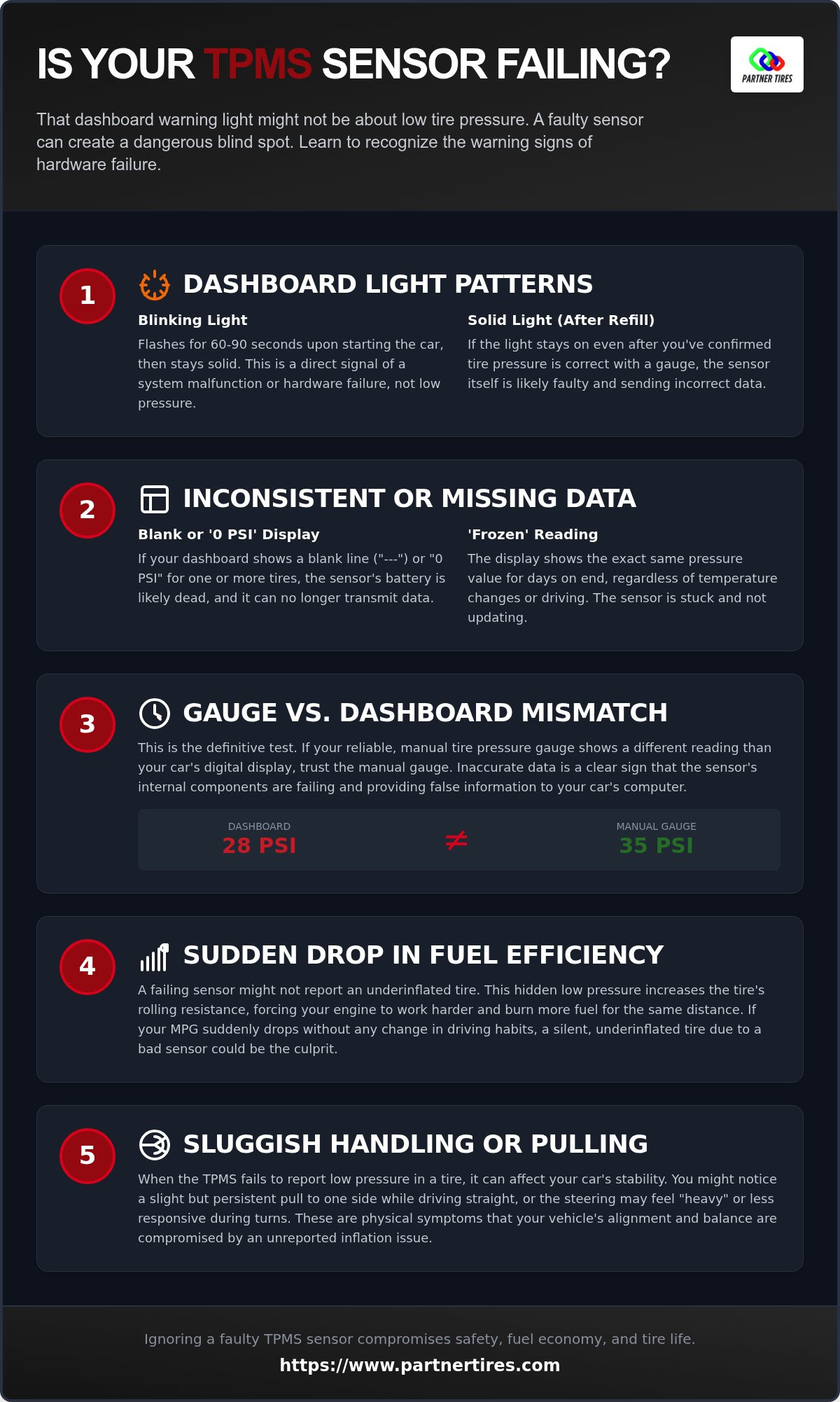
Identifying the signs of a bad TPMS sensor early prevents minor technical glitches from turning into safety hazards. Your vehicle communicates through specific patterns that go beyond just a simple light. If you notice a sudden drop in fuel efficiency, it might be the first clue. An underinflated tire increases rolling resistance, which forces your engine to work harder. You might also feel a slight pull to one side or a sluggish steering response during turns. These are physical indicators that your digital system is failing to report the truth about your tire health.
Dashboard Warning Light Patterns
A solid amber light usually means your pressure is low. However, if it stays on after you've topped off the air and confirmed the pressure with a gauge, the sensor is likely faulty. A blinking TPMS light is a more urgent signal of hardware failure. It typically flashes for 60 to 90 seconds every time you start the car before staying solid. This sequence indicates a system malfunction, often a communication failure between the sensor and the vehicle's computer. Some modern vehicles provide text alerts like 'Service TPMS' or 'Tire Sensor Fault'. These messages remove the guesswork and confirm that the sensor itself is the problem.
Inconsistent and Missing Data
Digital displays provide real-time updates, but they are only as good as the hardware feeding them. If you see a '0 PSI' reading or a blank dash where a number should be, the sensor battery is likely dead. Another red flag is a 'frozen' reading. This happens when the display shows the exact same PSI for days, regardless of temperature changes or driving distance. To understand more about how TPMS sensors work, it helps to know they are active transmitters that eventually wear out. If your manual gauge consistently contradicts your dashboard, trust the gauge. Inaccurate data is a clear sign the internal components are failing.
Don't let a faulty light compromise your safety or your budget. If you're seeing these errors, a professional diagnostic scan can pinpoint the exact sensor causing the issue. This allows you to address the problem quickly and maintain your vehicle's stability without a trip to a traditional shop.
Why Do TPMS Sensors Fail? Batteries, Corrosion, and Road Hazards
Sensors operate in a brutal environment. They face constant vibration, extreme pressure shifts, and fluctuating temperatures every time you drive. Understanding these failure points helps you recognize the signs of a bad TPMS sensor before a warning light becomes a permanent fixture on your dash. Most issues stem from predictable mechanical or chemical decline. By identifying these triggers, you can plan your maintenance more effectively and avoid the logistical headache of a sudden system failure.
The 10-Year Battery Limit
TPMS sensor batteries typically last between 5 and 10 years. These lithium-ion cells are sealed in a hard epoxy to resist moisture and road debris. This design makes the battery non-replaceable. When the power runs out, the whole unit is trash. Birmingham's intense summer heat often speeds up this chemical decline. High temperatures force the battery to drain faster during transmission. If one sensor fails due to age, the other three aren't far behind. Replacing the full set during your next tire service is often the most efficient choice for your vehicle's long-term health.
Corrosion and Physical Damage
Alabama's high humidity creates a perfect environment for galvanic corrosion. This happens when moisture gets trapped between a brass valve stem and a cheap aluminum cap. Over time, these different metals fuse together. If you force a stuck cap, you'll likely snap the stem and destroy the sensor. Road salts from our occasional winter freezes also accelerate this chemical bond. We recommend using plastic or high-quality nickel-plated caps to avoid this specific headache.
Physical trauma from Birmingham's potholes can also crack a sensor housing or dislodge internal components. Improper mounting is another major culprit. Inexperienced technicians often catch the sensor with a tire iron during a standard tire swap. This is why specialized tools and trained hands are essential for every installation. Maintaining a proper wheel alignment reduces the erratic vibrations that stress sensor mounting points. Keeping your suspension calibrated protects your sensors and your tire investment simultaneously.
Troubleshooting vs. Replacement: What Birmingham Drivers Need to Know
A flashing dashboard light demands a logical response. You must decide if you're facing a simple pressure drop or a hardware failure. While a quick adjustment might clear the alert, persistent signs of a bad TPMS sensor usually require specialized intervention. Ignoring the problem leads to uneven tread wear and compromised fuel economy. It's a logistical error to drive on a system you can't trust. Proactive maintenance ensures your vehicle's stability control stays synchronized with real-world road conditions.
Can You Reset a TPMS Light Yourself?
Most modern vehicles include a reset option within the dashboard menu. This is designed for use after you've added air to your tires. It recalibrates the system to the new baseline pressure. However, a reset is not the same as a system relearn. If the light returns immediately or continues to flash, you've identified a hard sensor failure. At this point, no amount of button-pressing will solve the issue. You're likely dealing with a dead battery or a cracked transmitter that can't hold a signal. A reset simply clears the current alert; it doesn't fix broken hardware.
The Professional Diagnostic Process
True resolution requires industrial-grade tools. Professional technicians use a TPMS signal tool to ping each sensor individually. This device reads the internal battery life and signal strength without removing the tire. We also perform a specialized diagnostic scan of the Engine Control Unit (ECU). This reveals specific fault codes, such as C0750 or C0755, which pinpoint the exact wheel location of the failure. This precision prevents the unnecessary cost of replacing healthy sensors. It ensures your maintenance budget is spent only where it's needed.
DIY replacement is nearly impossible for the average owner. You must break the tire bead to access the sensor, which requires a professional mounting machine. Once the new hardware is installed, it must be torqued to exact specifications to prevent slow air leaks. Finally, the vehicle must undergo a relearn process using an OBD-II tool to sync the new sensor ID with the computer. Competitors often overlook this step, but it's essential for system accuracy. Save yourself the frustration of trial and error by scheduling a mobile TPMS diagnostic scan today. We bring the necessary technology directly to your driveway, ensuring your safety systems are fully operational without the shop wait.
Mobile TPMS Sensor Service and Replacement in Birmingham
Traditional tire shops often require you to sacrifice a full morning or afternoon in a waiting room. Partner Tires eliminates this logistical bottleneck by bringing the tire shop directly to your location. If you've identified the signs of a bad TPMS sensor, you don't need to delay the repair due to a busy schedule. Our mobile units are fully equipped to handle complex sensor issues on-site. We specialize in providing efficient, professional service throughout the Birmingham metro area, ensuring your vehicle's safety systems are restored without interrupting your day.
TPMS Service at Your Home or Office
We serve residents and businesses across Birmingham, Hoover, Vestavia, and Mountain Brook. Our mobile service vehicles operate as fully functional automotive bays. We carry specialized diagnostic tools to program new sensors and sync them with your vehicle's computer instantly. Unlike basic roadside assistance that might only offer a spare tire change, we provide a complete technical solution. We perform tire mounting and computerized wheel balancing right in your driveway or office parking lot. This on-site capability ensures that your new hardware is installed correctly and your wheels are perfectly balanced before we leave. Booking a mobile appointment is a straightforward process that prioritizes your operational needs and financial health.
Comprehensive Tire Care
Efficiency is the core of our service model. We often recommend replacing your sensors during a new tire installation. Since the tire is already dismounted, this is the most cost-effective time to address aging batteries or corroded stems. It prevents you from paying for the same labor twice in a few months. We also combine sensor replacement with professional tire repair for those dealing with both a puncture and a system fault. This integrated approach ensures your entire wheel assembly is in peak condition.
We use only high-quality OEM or equivalent sensors to guarantee long-term reliability. Our technicians understand the specific communication protocols for various vehicle makes and models. This expertise prevents the common 'relearn' errors associated with generic, low-quality parts. If you are noticing the signs of a bad TPMS sensor, don't wait for a flat tire to force your hand. Contact Partner Tires today to schedule a mobile diagnostic scan. We provide the expert foundation your vehicle needs to stay safe on Birmingham's roads. Our team is ready to deliver a logistical solution that respects your time and secures your vehicle's performance.
Restore Your Road Confidence Today
A failing tire pressure system is more than a technical glitch. It's a safety blind spot that affects your fuel economy and vehicle handling. By recognizing the signs of a bad TPMS sensor, such as flickering dashboard lights or inconsistent digital readings, you protect your vehicle's stability. You've learned that these sensors have a fixed battery life and are susceptible to Alabama's humidity. Don't let a hardware failure lead to a real roadside emergency.
Partner Tires provides a reliable foundation for your daily commute. Our certified technicians arrive with advanced on-site diagnostic tools to pinpoint faults quickly. We specialize in expert mobile tire repair and high-quality new or used tires throughout the Birmingham area. We work behind the scenes to ensure your operational needs are met without the shop wait. Schedule Your Mobile TPMS Service with Partner Tires to keep your vehicle performing at its peak. Drive with the certainty that your safety systems are fully operational.
Frequently Asked Questions
Can I drive with a bad TPMS sensor?
You can technically drive with a faulty sensor, but it is a significant safety risk. A non-functional system prevents you from receiving real-time alerts about actual tire pressure drops. This makes you more susceptible to blowouts and poor vehicle handling during emergency maneuvers. It also means you lose the automated checks that maintain fuel efficiency. Resolving the issue quickly ensures your stability control systems operate with accurate data.
How much does it cost to replace a TPMS sensor in Birmingham?
Replacement costs vary based on your vehicle's make and model and the type of sensor required. Dealerships often use OEM parts that carry a premium, while independent mobile services utilize high-quality aftermarket equivalents to manage your maintenance budget more effectively. Factors like labor time for mounting and the necessary electronic relearn process influence the final invoice. Contacting a local provider for a specific quote based on your vehicle is the best logistical step.
Do I need to replace all four TPMS sensors at once?
You aren't required to replace all four, but it's a smart logistical move if the sensors are the same age. Since sensor batteries have a lifespan of 5 to 10 years, one failure often indicates the others are close to depletion. Replacing the full set during a single service visit reduces future downtime and ensures consistent system performance. This proactive approach prevents the annoyance of multiple shop visits for the same recurring issue.
Why is my TPMS light on but my tires are full of air?
If your tires are properly inflated but the light persists, you're likely seeing the primary signs of a bad TPMS sensor. This often points to a dead internal battery, a cracked transmitter, or a communication error with the vehicle's computer. Electronic interference or extreme temperature shifts can also trigger false alerts. A professional diagnostic scan is the only way to confirm if the sensor has failed or if the system simply needs a technical relearn.
Will a bad TPMS sensor cause a flat tire?
A faulty sensor cannot physically cause a puncture or a flat tire. However, it creates a dangerous situation by failing to warn you when a real pressure drop occurs. Without a functional alert system, you might drive on an underinflated tire until it suffers structural damage or a blowout. Maintaining your sensors ensures you have the early warning needed to perform a flat tire repair before the situation escalates into a total tire loss.
How long do TPMS sensors typically last?
Most TPMS sensors last between 5 and 10 years. This timeframe is dictated by the sealed lithium-ion battery inside the sensor housing. Factors like high mileage and extreme Alabama heat can shorten this lifespan by forcing the sensor to transmit data more frequently. Because the batteries are not replaceable, the entire unit requires replacement once the power runs out. Tracking the age of your sensors helps you plan for these maintenance cycles.
Can a tire shop fix a broken TPMS sensor without replacing it?
Most sensor failures are internal and cannot be repaired. If the battery is dead or the electronic circuit is damaged, the unit must be replaced. However, if the issue is a slow leak around the base, a technician might replace the service kit, which includes the nut, seal, and valve core. This maintenance doesn't fix the sensor's electronics but can resolve physical leaks. If the transmitter itself is faulty, a full replacement is the only solution.
Does my spare tire have a TPMS sensor?
Some full-size spare tires include a TPMS sensor, while most temporary spares do not. If your vehicle tracks five tires, a low spare can trigger the dashboard light even when your four main tires are perfect. Check your owner's manual or look for a metal valve stem on the spare to confirm. Including the spare in your regular pressure checks prevents confusing alerts and ensures you have a reliable backup during roadside emergencies.


