
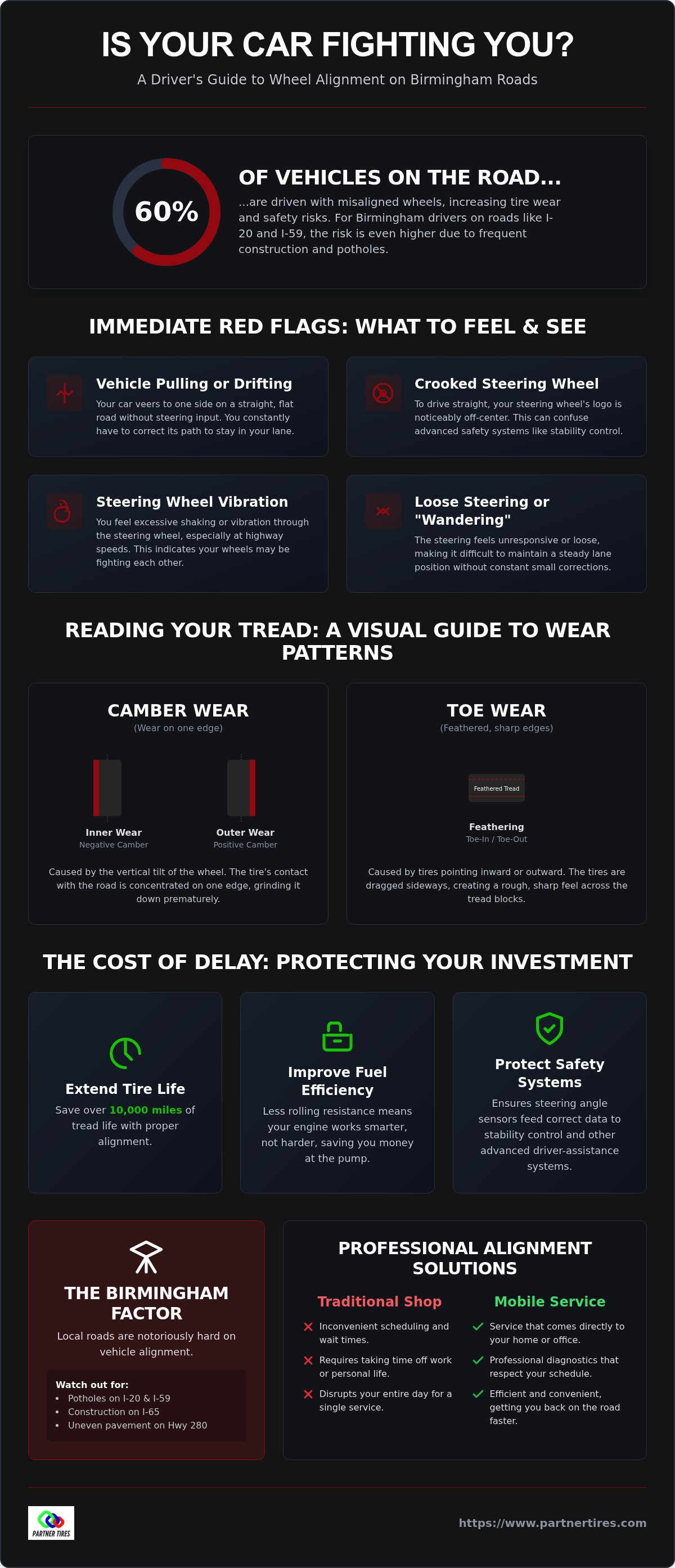
Did you know that 60% of vehicles on the road today are being driven with misaligned wheels, according to 2026 data from Hunter Engineering? For Birmingham drivers, the risk is even higher. Frequent construction and deep potholes on I-20 and I-59 can knock your vehicle out of spec in a single commute. You probably already suspect something is wrong when your car pulls to the left or your steering wheel feels off-center. Recognizing the early signs you need a wheel alignment is the best way to protect your tire investment and ensure your family stays safe on Alabama roads.
It's frustrating to watch your tire tread disappear or feel your car fight you on the highway. You want reliability and safety without losing a whole day at a traditional repair shop. We've built this guide to help you confirm if an alignment is necessary and show you how it protects your financial health. We'll cover the top symptoms of misalignment, the impact on your fuel economy, and how to find convenient, professional service that respects your schedule. Consider this your foundation for a safer, more efficient drive through the Magic City.
Key Takeaways
- Identify common signs you need a wheel alignment, like a crooked steering wheel or vehicle drifting, before they cause permanent damage.
- Learn how proper alignment can save over 10,000 miles of tread life and significantly improve your vehicle's fuel efficiency.
- Understand how specific tire wear patterns like feathering or edge baldness serve as early warnings for suspension issues.
- Discover why local infrastructure like Highway 280 and I-65 construction zones are particularly hard on your vehicle’s wheel angles.
- Compare traditional shop diagnostics with the efficiency of mobile tire services that come directly to your Birmingham home or office.
Immediate Red Flags: Obvious Signs You Need a Wheel Alignment
Precision is the backbone of vehicle safety. When your suspension is out of spec, your car stops working with you and starts working against you. You shouldn't have to wrestle with the steering wheel to maintain a straight line. If you find yourself constantly correcting your path, it's one of the clearest signs you need a wheel alignment. These red flags often start small but quickly escalate into expensive tire replacements and compromised handling. Recognizing these signs you need a wheel alignment early prevents minor issues from becoming major logistical headaches.
A vehicle in proper alignment tracks straight with minimal effort. However, internal components can shift after hitting a Birmingham pothole or a curb. This shift creates a "hard pull" where the car actively veers toward the shoulder or the median. You might also notice a "wandering" sensation. This happens when the steering feels loose or unresponsive, making it difficult to maintain a steady lane position at highway speeds. Vibrations in the steering wheel are another critical indicator. While often linked to balancing, these shakes frequently signal that your wheel angles are fighting each other as you accelerate.
The "Hands-Off" Drift Test
You can perform a simple diagnostic check on a flat, level stretch of road. Safely and briefly relax your grip on the steering wheel while traveling at a steady speed. If the car immediately darts in one direction, your alignment is likely compromised. It's important to distinguish this from "road crown." Most Alabama roads are built with a slight slope toward the shoulder to manage rainwater drainage. A very slow, soft drift to the right is often just the road doing its job. A true alignment issue will cause a consistent pull regardless of the road's slope. If the pulling only occurs when you apply the brakes, the problem is likely a sticking brake caliper or worn pads rather than your wheel angles.
Centering the Steering Wheel
Your steering wheel should be perfectly horizontal when driving on a straight path. If the emblem in the center is tilted while you're moving straight, your alignment is objectively wrong. Modern vehicles rely on steering angle sensors to feed data to advanced safety systems. These sensors expect the wheel to be centered to function correctly. An off-center steering wheel sends incorrect data to the electronic stability control system, potentially causing it to engage unnecessarily or fail to intervene during a real skid. Partner Tires technicians use computerized diagnostics to ensure your steering wheel position matches your wheel angles exactly. This precision protects your safety tech and extends the life of your tire investment.
Reading Your Tread: How Tire Wear Patterns Reveal Alignment Issues
Your tires act as a data log for your vehicle’s suspension health. Every mile you drive on misaligned wheels leaves a permanent mark on the rubber. When the angles are off, the road grinds away your tread unevenly, which is why visual inspections are so effective. Learning to read these patterns helps you catch the signs you need a wheel alignment before you're forced to buy a new set of tires prematurely. These visual cues are definitive signs you need a wheel alignment that no driver should ignore.
You can perform a "Palm Test" to check for feathering. Run your hand across the tire tread from the inside to the outside. If the edges feel sharp in one direction but smooth in the other, your tires are "scuffing" against the pavement. Another common issue is cupping or scalloping. This appears as dipped, wavy patterns around the tire circumference. While cupping often points to worn shocks or struts, it frequently occurs alongside alignment problems. Catching these dips early preserves your ride quality and your budget.
Toe-In vs. Toe-Out Wear
Toe refers to the direction your tires point relative to the vehicle's centerline. Imagine looking down at your feet; toe-in means the front of your tires point toward each other, while toe-out means they point away. When these angles are incorrect, the tires are essentially being dragged sideways as you drive forward. This friction creates "feathered" wear across the entire tread block. You will notice the outer edges wearing down faster if the toe-in is too aggressive. This type of wear happens quickly and can ruin a tire in just a few thousand miles.
Camber: The Vertical Lean
Camber is the vertical tilt of the wheel when viewed from the front of the vehicle. If the top of the tire leans toward the engine, it's negative camber. If it leans outward, it's positive camber. Heavy loads, worn springs, or hitting a Birmingham pothole can pull wheels into a negative camber position. This causes "shouldering," where the inner edge of the tire goes bald while the outer edge remains thick. Protecting your investment in new tires requires a computerized check to ensure these vertical angles meet factory specifications. Correcting camber issues prevents the lopsided wear that forces early replacements.
The Birmingham Factor: Why Local Roads Wreck Your Alignment
Birmingham infrastructure is a constant test for your vehicle’s suspension. Navigating the metro area means dealing with deep potholes and shifting road surfaces daily. These conditions are the primary reason local drivers search for signs you need a wheel alignment more frequently than those in other regions. Your suspension is a precision system. Birmingham roads are the disruptor. From the industrial corridors of I-20 to the commuter lanes of I-65, the environment is hostile to your wheel angles.
Routes like Highway 280 and I-65 are notorious for ongoing construction. Uneven lanes and temporary metal plates create jarring impacts that shift your wheel angles out of factory specifications. Even if you avoid major craters, the constant vibration from milled pavement can loosen suspension fasteners over time. Tight street parking in neighborhoods like Avondale or Homewood also increases the risk of curb strikes. A single impact while parallel parking can knock your toe angle out of spec instantly. Additionally, Alabama's extreme summer heat causes significant fluctuations in tire pressure. While low pressure isn't an alignment issue itself, it can mimic the pulling sensation, making it harder to identify the true signs you need a wheel alignment.
Sudden Impact vs. Gradual Misalignment
A single pothole hit can instantly bend a tie rod or damage a control arm. This is a "hard hit" that results in an immediate, noticeable change in how your car handles. You might see your steering wheel suddenly sit at a 10-degree angle while you're driving straight. However, most alignment issues are a "silent" shift. Daily commuting wears down the rubber bushings and ball joints that hold your wheels in place. This gradual degradation is harder to spot but just as damaging to your tires. If your vehicle feels "darty" or less stable than it did six months ago, your suspension has likely taken enough small hits to require professional recalibration.
Local Maintenance Schedules
We recommend a computerized alignment check every 12,000 miles or at least once a year. For Birmingham professionals who commute daily on high-traffic routes, a check after every major pothole season is a smart financial move. Late winter and early spring are particularly brutal on local asphalt. Checking your alignment after the worst road damage has been patched ensures you aren't grinding away your new tire investment on misaligned wheels. For a list of trusted local providers, see our Expert Wheel Alignment Shops Near Me: Birmingham, AL 2026 Guide. Staying proactive with this schedule protects your vehicle's handling and your bottom line.
The Cost of Delay: How Poor Alignment Destroys Your Investment
Delaying vehicle maintenance is a hidden drain on your bank account. While a slight pull or a crooked wheel might seem like a minor nuisance, these are critical signs you need a wheel alignment. Ignoring them creates a chain reaction of mechanical stress. Every mile driven out of spec forces your vehicle to work harder, burning more resources and wearing down expensive components prematurely. It isn't just a handling issue; it's a financial liability. Spotting the signs you need a wheel alignment early is the first step toward maintaining long-term vehicle health.
Misalignment also compromises your safety during Alabama's unpredictable weather. When tires don't sit flat against the pavement, their ability to channel water away is reduced. This increases your risk of hydroplaning during heavy rainstorms on I-65 or Highway 280. Beyond the rubber, the constant tension of fighting a pull puts immense stress on your steering rack and tie rods. Replacing a rack-and-pinion system is a major repair that far exceeds the cost of routine preventative care. Professional diagnostics protect both your equipment and your family.
Fuel Efficiency and Financial Health
Misaligned wheels create significant rolling resistance. When your tires aren't pointing exactly where the vehicle is traveling, the engine must burn extra fuel to overcome that friction. Misaligned wheels act like dragging a foot while running, forcing the powertrain to work harder just to maintain highway speeds. A 2025 report from the Automotive Service Association states that wheel misalignment can reduce fuel efficiency by as much as 10%. For a Birmingham professional commuting daily, this translates to hundreds of dollars in wasted fuel over a single year.
Protecting Your New Tires
Protecting your tire investment starts the moment you leave the shop. You should always perform a computerized alignment when installing a fresh set of rubber to ensure even wear from day one. If you are currently shopping, consult The Definitive Guide to Choosing Tire Dealers in Birmingham, AL to find a provider that prioritizes precision. Routine tire rotations are necessary, but they cannot fix underlying mechanical angles. Combining regular rotations with annual alignments can save you 10,000 miles or more of tread life. Secure your vehicle's performance by booking a four-wheel alignment today to lock in your savings.
Professional Alignment Solutions: Shop vs. Mobile Diagnostics
Identifying the signs you need a wheel alignment is the first step toward reclaiming your vehicle's performance. The second step is choosing a service model that fits your schedule and technical requirements. You need an ally who understands that your time is as valuable as your equipment. Partner Tires bridges the gap between high-end technical precision and the practical needs of busy Birmingham professionals. We provide the stability your vehicle needs to handle Alabama's demanding road conditions.
Efficiency is the core of our business model. You shouldn't have to sacrifice a workday to sit in a tire shop waiting room. Our mobile service brings professional-grade diagnostic tools and installation equipment directly to your driveway. This approach ensures your vehicle is serviced correctly without the logistical headache of traditional repair shops. We focus on the practicalities of your vehicle's health so you can stay focused on your daily operations.
Computerized Precision
Modern vehicles are complex machines with tight tolerances. Our technicians use advanced 3D imaging and laser sensors to map your vehicle's current geometry. This technology measures caster, camber, and toe with absolute accuracy. Many discount shops offer "front-end only" or "toe-and-go" services. These are rarely enough for modern cars equipped with independent rear suspensions or all-wheel drive. We provide a comprehensive four-wheel alignment that includes:
- 3D imaging sensors for precise angle measurement
- Comprehensive rear-wheel tracking checks
- Electronic steering angle sensor resets for safety systems
- Computerized balancing for total wheel harmony
We pair this precision with computerized wheel balancing to eliminate the micro-vibrations that destroy suspension bushings. This holistic approach is the only way to truly fix the signs you need a wheel alignment and restore a factory-smooth ride. It protects your suspension and ensures your tires wear evenly across every mile.
The Mobile Convenience Advantage
Mobile tire delivery and installation allow us to service your vehicle at your home or office. We bring the shop to you, providing a level of convenience that traditional brick-and-mortar locations cannot match. This service is essential if you've already identified symptoms of misalignment and want to prevent further tire damage immediately. You can read more about our specialized process in our guide to Professional At Home Tire Installation in Birmingham.
We provide expert on-site support throughout Hoover, Vestavia, and Pelham. Our team acts as a hardworking, no-nonsense ally for your automotive needs. Contact Partner Tires today to schedule a diagnostic scan and alignment check. We'll ensure your vehicle is stable, safe, and ready for the road ahead.
Secure Your Vehicle’s Performance on Birmingham Roads
Maintaining proper wheel geometry is a fundamental requirement for vehicle safety and financial efficiency. Birmingham infrastructure won't wait for your schedule; the potholes on I-20 and construction on Highway 280 are constant threats to your suspension. Recognizing the early signs you need a wheel alignment prevents a minor drift from turning into a total tire failure. You've invested in your vehicle, and protecting that investment requires the right technical partner.
Partner Tires serves as the backbone of your automotive maintenance. We combine locally owned reliability with expert four-wheel alignment in Birmingham to keep you moving safely. Our convenient mobile tire installation ensures you don't have to lose a workday to stay on top of your vehicle's health. We are committed to your success on the road through precision and professional support. Protect your tires and schedule your Birmingham alignment today with Partner Tires. It's time to restore the stability and efficiency your drive deserves.
Frequently Asked Questions
Can I drive with a bad wheel alignment?
You can drive with misaligned wheels, but you shouldn't do it for long. Bad alignment forces your vehicle to fight against its own steering geometry. This creates unnecessary stress on your steering rack and suspension bushings. It also increases the risk of hydroplaning during heavy Alabama rainstorms. Addressing the signs you need a wheel alignment immediately protects your safety and prevents your tires from wearing down thousands of miles prematurely.
How much does a wheel alignment cost in Birmingham, AL?
Alignment costs in the Birmingham metro area depend on your vehicle's specific technology. Modern cars with Advanced Driver Assistance Systems (ADAS) often require electronic recalibration alongside physical adjustments. A comprehensive four-wheel alignment is the standard for local SUVs and sedans to ensure total tracking accuracy. While basic front-end services exist, they often fail to address rear-wheel issues that cause uneven tire wear and reduced fuel efficiency for your commute.
How long does a professional wheel alignment take?
A standard computerized four-wheel alignment typically takes between 60 and 90 minutes. This timeframe includes the initial diagnostic scan, physical adjustments to the suspension, and a final verification check. Modern laser-based systems have streamlined this process for maximum precision. We respect your schedule and focus on getting your vehicle back into service as quickly as possible. This efficiency ensures your operational needs are met without sacrificing the technical accuracy your vehicle requires.
Will new tires fix my car’s pulling issue?
New tires won't fix a pulling issue because the problem lies in your suspension angles, not the rubber. In fact, mounting new tires on a misaligned vehicle is a guaranteed way to waste your financial investment. The improper angles will immediately begin scrubbing the tread off your fresh tires. If you notice signs you need a wheel alignment, you must correct the mechanical geometry to ensure your new tires track straight and last for their full rated mileage.
How often should I get my wheels aligned?
Most industry professionals recommend an alignment check every 12,000 miles or at least once per year. However, Birmingham's specific road conditions often dictate a more aggressive schedule. Frequent encounters with construction zones on Highway 280 or deep potholes on I-65 can shift your angles sooner. We suggest a quick check after any major impact or whenever you invest in a new set of tires to maintain peak operational efficiency and safety.
Can hitting a pothole cause immediate misalignment?
A single pothole hit can cause an immediate and severe misalignment. The force of hitting a deep crater at highway speeds is often enough to bend a tie rod or shift a control arm. This results in a hard pull where the car actively veers toward the shoulder. If your steering wheel suddenly sits at an angle after an impact, your suspension requires an immediate computerized diagnostic scan to prevent further damage to your steering components.
What is the difference between wheel balancing and wheel alignment?
Wheel balancing and wheel alignment are two distinct services that work together for a smooth ride. Balancing corrects the weight distribution within the tire and wheel assembly to prevent high-speed vibrations. Alignment adjusts the physical angles of the wheels so they are parallel to each other and perpendicular to the road. While balancing addresses the shake, alignment addresses the pull and ensures your tires wear evenly across their entire surface for maximum tread life.


