Did you know that your tires account for roughly 20% to 30% of your vehicle's total energy consumption? With regular gas prices in Birmingham currently at $3.729 per gallon, that percentage represents a significant portion of your monthly operating budget. It's frustrating to deal with high costs at the pump and the confusion of complex tire specifications. You want a reliable vehicle that doesn't drain your bank account, yet uneven tire wear often leads to expensive, premature replacements.
We understand that efficiency is the backbone of your daily operations. This guide explains exactly how to improve gas mileage with right tires, showing you how proper selection and maintenance can reduce fuel consumption by up to 30%. You'll discover the impact of rolling resistance and learn why precision services like computerized wheel balancing and four-wheel alignments are essential for your financial health. We will preview the best fuel-efficient tires for 2026 and provide a clear roadmap for maintenance that keeps your vehicle on the road longer for less money. Let's get your business moving more efficiently.
Key Takeaways
- Identify how rolling resistance impacts your fuel bill and why specific rubber compounds are critical for your bottom line.
- Discover how to improve gas mileage with right tires by prioritizing lightweight designs and fuel-efficient tread patterns.
- Master essential maintenance habits, from precise pressure management to regular tire rotations, that eliminate unnecessary drag.
- Use a clear ROI framework to justify the cost of fuel-efficient tires against your annual fuel savings in Birmingham.
- Optimize your operational uptime with mobile installation and on-site computerized wheel balancing that brings the shop to your location.
The Science of Rolling Resistance: How Tires Impact Your Fuel Bill
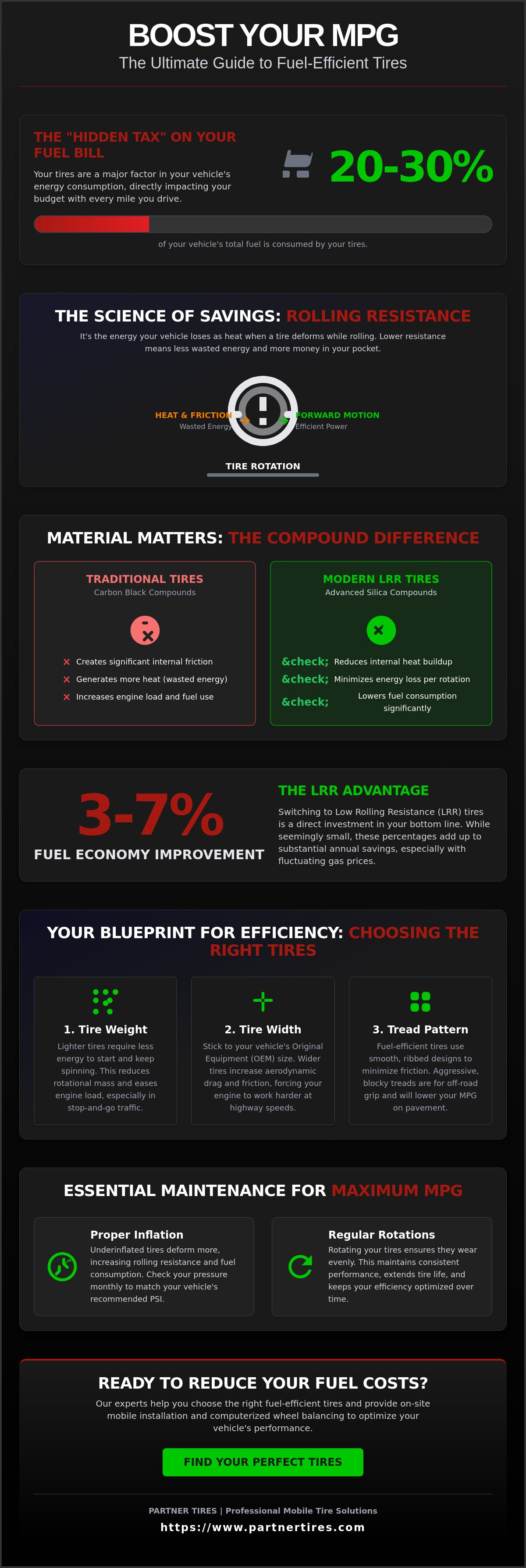
Rolling resistance is the energy your vehicle loses as heat when a tire deforms while rolling. Every time your tire rotates, the weight of your car presses the rubber against the pavement. This constant flexing creates internal friction. That friction generates heat, which is essentially wasted energy. For industry professionals and daily commuters alike, this isn't just a physics lesson. It's a direct drain on your operating budget. Tires account for roughly 20% to 30% of a vehicle's total energy consumption. If your tires aren't optimized for efficiency, you're paying a "hidden tax" on every mile you drive.
Traditional tire manufacturing relies heavily on carbon black to reinforce the rubber. While durable, this material creates significant internal friction. Modern engineering has introduced silica-based compounds as a superior alternative. These advanced materials allow the tire to maintain its structure with less internal heat buildup. By reducing the energy lost during each rotation, these compounds help your engine work less. Learning how to improve gas mileage with right tires begins with understanding these logistical details. Choosing the right material is the first step toward better financial outcomes at the pump.
Why Rolling Resistance Matters for Your Wallet
Your engine must produce enough power to overcome the resistance created by your tires. When rolling resistance is high, the engine load increases. This requires more fuel to maintain the same speed. Low Rolling Resistance (LRR) tires are products designed to minimize energy loss without sacrificing grip. On average, switching to LRR tires can improve your fuel economy by 3% to 7%. While a few percentage points might seem small, the cumulative effect over a year of Birmingham driving is substantial. It's a logical solution for anyone looking to stabilize their monthly fuel expenses.
The Trade-offs: Traction vs. Efficiency
A common misconception suggests that fuel-efficient tires lack the grip necessary for safe driving in wet weather. This is no longer the case in 2026. Modern tire engineering uses sophisticated tread designs to balance safety and savings. High-performance summer tires often use "sticky" compounds that prioritize cornering but create massive drag. In contrast, fuel-saver tires use optimized tread patterns to reduce resistance while maintaining reliable stopping distances. You don't have to choose between a safe commute and a healthy bank account. Partner Tires focuses on providing options that deliver both stability and efficiency for your specific vehicle needs.
Choosing the Right Tires for Maximum Fuel Efficiency
Selecting the correct equipment is a calculated business decision. It's about more than just replacing rubber. Knowing how to improve gas mileage with right tires requires a close look at weight, width, and tread geometry. Every pound of tire weight adds to your vehicle's rotational mass. It takes more energy to start a heavy object spinning than a light one. Heavier tires increase engine load during every stop and go. This directly impacts your fuel expenses over thousands of miles. To maximize your return on investment, you must choose tires that balance durability with a lightweight profile.
Tread patterns also play a vital role in your vehicle's efficiency. Smooth, ribbed designs are engineered to reduce the energy needed to keep the vehicle moving. In contrast, aggressive lug patterns create turbulence and friction. While these are useful for off-road traction, they lower your MPG on paved roads. You should also check the sidewall for the Uniform Tire Quality Grading (UTQG). A high temperature rating often indicates a tire that manages heat effectively. This characteristic usually correlates with lower rolling resistance and better fuel outcomes.
The Impact of Tire Size and Width
Wider tires increase your vehicle's frontal area. This creates more aerodynamic drag, especially at highway speeds. The "plus-sizing" trend might improve aesthetics, but the extra width and weight will hurt your bottom line. Stick to OEM size specs. This maintains the efficiency your vehicle was engineered to achieve. If you aren't sure which size fits your operational goals, you can consult with our tire experts to find the perfect match for your fleet or personal vehicle.
Tread Depth and Pattern Efficiency
Brand-new tires often deliver slightly lower MPG than those with several thousand miles of wear. This happens because of "tread squirm." Deep tread blocks flex more, which generates heat and wastes energy. As tires wear down, they become more aerodynamic and have less mass to spin. This is why high-quality used tires can be a strategic choice for budget-conscious drivers. You can find more details in our Smart Shopper’s Guide to Used Tires in Birmingham, AL (2026). However, even the best tread won't save you money if you aren't running on properly inflated tires. Correct pressure minimizes unnecessary road friction and protects your investment.
For most Birmingham commuters, all-season patterns are the most logical choice. They prioritize a smooth contact patch and consistent efficiency. All-terrain tires use deep voids that trap air and increase resistance. Unless your daily route requires heavy off-road use, the extra fuel cost of aggressive patterns isn't a sound financial trade-off.
Maintenance Habits That Save Gas: A Birmingham Driver’s Checklist
Choosing the right rubber is only half the battle. To truly understand how to improve gas mileage with right tires, you must focus on consistent maintenance. Neglecting your tires creates unnecessary drag that forces your engine to work harder. Recent data shows that professional tire maintenance can improve gas mileage by an average of 4.1%. This isn't just about safety. It's a logistical strategy to protect your financial health and extend the lifespan of your assets.
- Check tire pressure monthly using a reliable gauge.
- Rotate tires every 5,000 to 8,000 miles to ensure even wear.
- Schedule computerized wheel balancing to eliminate energy-wasting vibrations.
- Verify alignment twice a year or after hitting significant road debris.
Regular tire rotation prevents uneven drag by ensuring each tire wears at a similar rate. When one tire wears faster than the others, it can create a slight imbalance in resistance. This forces the vehicle's drivetrain to compensate, which consumes extra fuel. Maintaining a uniform tread depth across all four wheels keeps your vehicle's rolling profile consistent and efficient.
Tire Pressure and the Alabama Heat
Birmingham’s climate presents a unique challenge for tire management. For every 10-degree change in temperature, your tire pressure can shift by approximately 1 PSI. During a typical Alabama summer, morning and afternoon temperature swings cause significant fluctuations. Under-inflated tires increase the contact patch, which creates more friction and lowers MPG. Never use the "Max PSI" listed on the tire sidewall. Instead, follow the specific PSI found on your vehicle's door placard. If your dashboard warning light stays on, our TPMS sensor service can identify the fault and ensure you aren't driving on efficiency-killing low pressure.
The Critical Role of Alignment
Misalignment is a silent thief of fuel. When your wheels are "toed-in" or "toed-out," they don't roll straight. Instead, they "scrub" against the pavement at an angle. This acts like a constant, subtle brake on your vehicle. You'll burn more gas just to maintain speed. Regular four-wheel alignments ensure your tires point exactly where they should. Check out our Expert Wheel Alignment Shops Near Me: Birmingham, AL 2026 Guide to find professional support. Combine this with computerized balancing to ensure smooth, efficient rolling. These steps turn your tires into a high-performance system rather than a logistical burden.
The ROI of Fuel-Efficient Tires: Calculating Your Savings
Investing in fuel-efficient tires is a strategic move for your bottom line. It's about more than the initial purchase price. It's about the total cost of ownership over the entire lifespan of the tire. When you understand how to improve gas mileage with right tires, you move from reactive spending to proactive financial management. For the average Birmingham commuter driving 12,000 to 15,000 miles per year, small gains in efficiency translate into substantial annual savings. We view your tires as a critical component of your vehicle's logistical success.
Consider the current regular gas price in Birmingham of $3.729 per gallon. If you improve your fuel economy by even a small percentage, you're effectively putting money back into your budget every month. Premium efficiency brands also typically offer robust mileage warranties. This longevity ensures that your investment pays dividends for a longer period before you need a replacement. It's a logical progression from identifying a need to implementing a concrete financial solution.
Strategic buyers often consider high-quality used tires to achieve these goals. This approach allows you to access premium, low rolling resistance brands at a lower entry cost. It's a practical way to boost efficiency without the full price tag of brand-new sets. Our commitment to reliability means we only stock used options that meet strict safety and performance standards, ensuring your operational needs are in capable hands.
Doing the Math: Gas Savings Over 50,000 Miles
Let's look at the numbers. A vehicle averaging 25 MPG will consume 2,000 gallons of fuel over 50,000 miles. By switching to tires that provide a 26.5 MPG average (a 6% improvement), that consumption drops to approximately 1,887 gallons. At $3.729 per gallon, you save over $420 in fuel costs alone. If the price premium for the better tires was $100, you've recouped that cost within the first 12,000 miles. Experienced tire dealers in birmingham al can often identify rebates to lower that initial hurdle even further.
When to Replace for Efficiency vs. Safety
Wait until your tires are bald, and you risk more than just poor gas mileage; you risk total operational failure. However, replacing tires too early means you haven't fully realized the efficiency gains of your investment. The "sweet spot" for fuel efficiency often occurs when the tread has worn down slightly, which reduces tread squirm and resistance. Proper alignment and rotation extend this sweet spot by preventing uneven wear. To get a precise evaluation of your current tire health and potential savings, you should schedule a professional tire diagnostic with our team today.
Professional Tire Solutions: Partner Tires Mobile Services
Achieving peak vehicle efficiency requires more than just information. It requires a logistical partner who understands your operational needs. You now know how to improve gas mileage with right tires through selection, math, and maintenance. Partner Tires provides the physical foundation for that success. We bring professional tire solutions directly to your location. This eliminates the need for you to waste fuel and time driving to a traditional brick and mortar shop. By removing that extra trip, you start saving money before your new tires even rotate once.
Our mobile units are equipped with advanced technology. We perform computerized wheel balancing and precision mounting on-site. These services are not "scaled down" versions of shop work. They are the same high-standard operations delivered with greater efficiency. We also provide four-wheel alignment services to ensure your vehicle doesn't scrub away your fuel savings on the road. This direct approach ensures your assets stay in service and your financial health remains a priority. We act as the backbone of your maintenance strategy, handling the technical details so you can focus on your business.
Mobile Service for Busy Birmingham Professionals
Commuters in Hoover and Homewood often struggle to find time for essential maintenance. Our at-work installation process solves this problem. We arrive at your office or job site and complete the service while you remain productive. Precision mounting and computerized balancing are standard with every mobile install. This level of service ensures your vehicle operates at maximum efficiency. Regular mobile check-ups also prevent the emergency flat tire that ruins your day and your MPG. We provide at home tire installation to make fuel-saving maintenance a convenient part of your routine.
Expert Advice and Custom Tire Quotes
Every vehicle has unique requirements. A heavy work truck needs a different efficiency strategy than a compact commuter car. Our technicians offer expert advice on the best low rolling resistance (LRR) tires for your specific application. We maintain an extensive stock of both new and high-quality used tires to fit any operational budget. This flexibility allows us to support your growth without compromising on safety or reliability. We are not just a service provider; we are your ally in the industry. Our regional expertise in Birmingham ensures you get the right product at the right time. Contact Partner Tires for a mobile tire quote today.
Secure Your Long-Term Fuel Savings
Mastering how to improve gas mileage with right tires requires a combination of smart hardware selection and consistent maintenance. You have seen how rolling resistance and tire weight directly impact your fuel bill. You also understand that precision alignment and pressure management are essential to protecting your financial outcomes. These are not just technical details; they are the logistics of a successful operation. Every mile driven on unoptimized rubber is a missed opportunity for efficiency.
Partner Tires stands as your dependable ally in this effort. We provide professional on-site care across Birmingham, Hoover, and Pelham. Every mobile install includes computerized wheel balancing to ensure smooth, efficient travel. Whether you need new tires or high-quality used options for maximum ROI, our experts work behind the scenes to keep your business moving forward. Don't let inefficient tires drain your budget. Take control of your vehicle's performance and start saving at the pump immediately. We are ready to be the engine that drives your growth.
Schedule Your Mobile Tire Installation or Alignment in Birmingham Today
Frequently Asked Questions
Do fuel-efficient tires really work?
Yes, fuel-efficient tires are a proven logistical tool for reducing energy loss. Understanding how to improve gas mileage with right tires involves choosing models that utilize specialized silica-based rubber compounds. These materials minimize the heat generated during rotation, allowing your engine to move the vehicle with significantly less effort. This creates a more reliable and cost-effective foundation for your daily operations while protecting your long-term financial health.
How much gas mileage do you lose with bigger tires?
Bigger tires generally decrease gas mileage because they increase rotational mass and aerodynamic drag. For every 100 pounds of extra weight added to your vehicle, fuel economy can drop by approximately 1-2%. Larger wheels also force the engine to work harder to initiate movement from a complete stop. Sticking to the original equipment manufacturer specifications is the most logical choice for maintaining your vehicle's efficiency and your bottom line.
What tire pressure is best for gas mileage?
The best tire pressure for gas mileage is the exact PSI listed on your vehicle's door placard or owner's manual. Maintaining this proper inflation can improve your fuel economy by up to 3%. Under-inflated tires create a larger contact patch, which leads to increased friction and wasted energy. You shouldn't over-inflate tires as a solution, as it causes uneven wear and reduces your overall traction and safety.
Can bad alignment cause low gas mileage?
Bad alignment is a significant contributor to low gas mileage. When wheels aren't properly aligned, they don't roll straight and instead drag against the road surface at an angle. This creates a constant resistance that your engine must overcome by burning more fuel. Regular four-wheel alignments ensure your vehicle moves with maximum efficiency, minimal friction, and a longer overall tire lifespan, keeping your operational costs predictable and low.
Are Low Rolling Resistance tires noisier than standard tires?
No, modern Low Rolling Resistance (LRR) tires are not inherently noisier than standard options. Tire manufacturers in 2026 use sophisticated tread geometry to dampen road noise while maintaining high efficiency. These designs provide a quiet, professional driving experience without sacrificing your fuel saving goals. You can enjoy a comfortable ride while simultaneously lowering your monthly operating costs through advanced engineering that prioritizes both performance and driver comfort.
How often should I check my tire pressure to maintain MPG?
You should check your tire pressure at least once every month to ensure peak performance. Environmental factors, such as the frequent temperature changes in Alabama, cause air pressure to fluctuate significantly. Checking PSI before long trips is also a critical habit for maintaining peak MPG. Consistent monitoring ensures your tires remain in the "sweet spot" of efficiency, protecting your financial health from sudden and unnecessary spikes in fuel consumption.
Do used tires have worse gas mileage than new ones?
Used tires don't necessarily provide worse gas mileage than new ones. In some cases, the reduced tread depth on a high-quality used tire can actually decrease rolling resistance by minimizing energy-wasting tread squirm. Choosing premium used brands is a strategic way to learn how to improve gas mileage with right tires without the high initial purchase price. It's a practical, no-nonsense solution for budget-conscious industry professionals and service providers.
What are the best tire brands for fuel efficiency in 2026?
Top brands for fuel efficiency in 2026 include Bridgestone, Goodyear, and Continental. Specific models like the Bridgestone Ecopia EP422 Plus and Goodyear Assurance Fuel Max are engineered to reduce energy loss through advanced internal structures. These manufacturers lead the industry in developing sustainable, low-resistance compounds. Partner Tires can help you analyze the ROI of these specific brands based on your vehicle's typical route and load requirements to ensure maximum savings.


