
Nearly 10% of all tires sold in the United States are used tires. For SUV owners in 2026, the financial pressure of maintaining a heavy vehicle is a constant reality. You want to reduce your expenses, but you cannot ignore the potential risks on the road. This leads to a vital question for every driver: are used tires a safe option for SUVs? With nearly 11,000 motor vehicle crashes linked to worn tires annually according to the NHTSA, the stakes are high. You should not have to choose between your budget and your family's safety.
We understand that the high cost of new SUV tires is a significant burden. It is frustrating to deal with conflicting safety information while worrying about the threat of blowouts or hydroplaning. This guide changes that. We will show you exactly how to evaluate used SUV tires for safety, load capacity, and reliability. You will learn to identify internal damage and understand the specific load-rating requirements your vehicle demands. We provide a clear checklist for your next purchase and help you find a reliable local source to keep your SUV performing at its best.
Key Takeaways
- Understand why SUV curb weight requires a more rigorous inspection process than standard passenger vehicles.
- Learn how to use your vehicle's door placard to confirm if specific used tires are a safe option for SUVs.
- Identify the signs of rubber oxidation and dry rot caused by Alabama’s extreme temperature cycles.
- Apply a professional 5-point inspection to verify tread depth and uniform wear before installation.
- Find reliable local inventory in Birmingham and Hoover that balances operational savings with driver safety.
Understanding the Risks and Rewards of Used Tires for SUVs
High-quality used tires are a strategic asset for your vehicle. They are not discarded waste. Most premium used inventory consists of "take-offs" from new vehicles or low-mileage trade-ins. These tires often retain a significant portion of their original tread life. Choosing these options extends the product's lifecycle and reduces the environmental burden on Alabama landfills. It is a logical choice for the environmentally conscious driver who values efficiency. The real question is: are used tires a safe option for SUVs? The answer lies in the rigor of the inspection process.
Safety is our primary commitment. We treat used tires as a reliable foundation for your daily operations. A used tire is only as good as the technician who inspects it. We focus on identifying structural integrity and tread depth to ensure every tire meets our professional standards. This approach turns a potential risk into a calculated, cost-effective solution for your vehicle.
To better understand how used tires can be a smart investment, watch this helpful video:
Why SUVs Demand Higher Tire Standards
SUVs are not standard sedans. Their heavy curb weight and higher center of gravity place immense stress on tire sidewalls. During sharp turns or sudden maneuvers, these tires must withstand forces that would compromise lighter equipment. Understanding Tire construction and safety hazards is vital for every SUV owner. Increased weight also affects braking distances. A tire with reduced tread depth will struggle to stop a three-ton vehicle on wet Alabama roads. If your SUV uses an All-Wheel Drive (AWD) system, matching all four tires is non-negotiable. Mismatched tread depths can cause expensive drivetrain wear and mechanical failure.
The Financial Logic of Used Tires in 2026
New SUV tires are a major financial commitment. They often cost twice as much as standard passenger tires. This price gap makes used options an attractive alternative for maintaining your financial health. Tires depreciate rapidly the moment they leave the showroom, but their utility remains high. You can capitalize on this depreciation to secure premium brands at a fraction of the retail cost. Are used tires a safe option for SUVs? Yes, provided you prioritize load-rating integrity and professional sourcing. For more details on finding the right fit, see the smart shopper’s guide to used tires in Birmingham, AL (2026). We act as the backbone of your vehicle's maintenance, ensuring you get the right product at the right price.
Essential Safety Specs: Load Index and Speed Ratings for SUVs
Are used tires a safe option for SUVs? They are if you respect the technical limits of your vehicle. Every tire has a specific job. For an SUV, that job involves supporting thousands of pounds of steel, passengers, and cargo. You cannot guess this requirement. You must follow the NHTSA tire safety guidelines to ensure your equipment is up to the task.
Check your driver's side door placard. This sticker lists the exact load index and speed rating required by the manufacturer. If you find a used tire that matches the size but has a lower load index, walk away. Installing a 'Passenger' (P) rated tire on a heavy vehicle that requires 'Light Truck' (LT) specifications is dangerous. LT tires have reinforced sidewalls to handle the increased pressure of an SUV. Using a P-rated tire instead invites sidewall flex and heat buildup. This often leads to a blowout at highway speeds.
Speed ratings also matter for Alabama drivers. If you spend time on I-65 or I-20, your tires must handle sustained heat. A lower speed rating means the tire cannot dissipate heat effectively. This is why we prioritize matching the OEM specs for every used tire we stock at Partner Tires. We focus on your financial health by providing parts that actually fit your vehicle's performance needs.
Decoding the SUV Tire Sidewall
Look at the alphanumeric string on the tire. The last two digits before the speed letter represent the load index. The load index number represents the maximum weight a tire can support. Do not confuse this with your Gross Vehicle Weight Rating (GVWR). The GVWR is the total weight of your vehicle when fully loaded. Each tire only supports a portion of that weight. Ensure the combined max load of all four tires exceeds your GVWR by a safe margin. This ensures your used tires remain a dependable foundation for your vehicle.
Why 'Almost Fits' is Never Safe for SUVs
Precision is vital for modern safety systems. Stability control and anti-lock brakes rely on consistent wheel speeds. If you install a tire with a slightly different diameter, these systems may malfunction. This is especially true for AWD vehicles. Mismatched diameters force the differential to work harder, leading to expensive mechanical failure. Every installation requires professional computerized wheel balancing to prevent vibrations that damage your suspension. This is how we ensure that used tires are a safe option for SUVs in our community. We act as the expert who works behind the scenes to keep your operation running smoothly.
The Hidden Dangers: Why SUV Tires Age Differently
Visual inspection is only the first step in determining safety. Are used tires a safe option for SUVs? The answer depends on the chemical health of the rubber. Dry rot is a common phenomenon where tires develop small cracks. These cracks often hide deep within the tread grooves, making them difficult for a consumer to spot. Alabama's extreme heat cycles in Birmingham and Hoover accelerate this process significantly. High temperatures trigger rubber oxidation; this strips the tire of its essential oils and makes it brittle. UV exposure also degrades tires on SUVs that sit in driveways or open lots for extended periods. This chemical breakdown increases the risks of used tires. When these brittle tires face the high-stress loads of a full-sized SUV, the risk of tread separation grows.
The DOT Date Code: Your Most Important Number
Every tire has a birth certificate stamped into the sidewall. You can find the DOT manufacturing date by looking for a four-digit code near the rim. The first two digits represent the week of production. The last two represent the year. Avoid any used tire older than six years, regardless of tread depth. Even "New Old Stock" tires that have never been driven can be dangerous. Rubber compounds lose their elasticity over time through a process called thermo-oxidative degradation. An aged tire may look brand new but can fail catastrophically when it hits highway speeds on I-65 or I-459. We prioritize your financial health by rejecting aged inventory that compromises your safety.
Internal Damage: What You Can't See
Internal belt separation is a silent threat to your vehicle's stability. It often results from a tire being driven with low air pressure, which creates excessive heat. This causes sidewall bruising that is invisible until the tire is dismounted. Heavy SUV loads put immense pressure on these existing internal structural weaknesses. A tire that might survive on a light sedan can fail under the three-ton weight of a modern SUV. We recommend that a professional tire repair birmingham expert inspect the internal liners of any used tire before installation. This secondary check identifies patches or plugs that might be near the sidewall. We serve as the backbone of your maintenance routine, ensuring that every component is reliable and ready for the road.
Your Professional 5-Point Inspection Checklist for SUV Tires
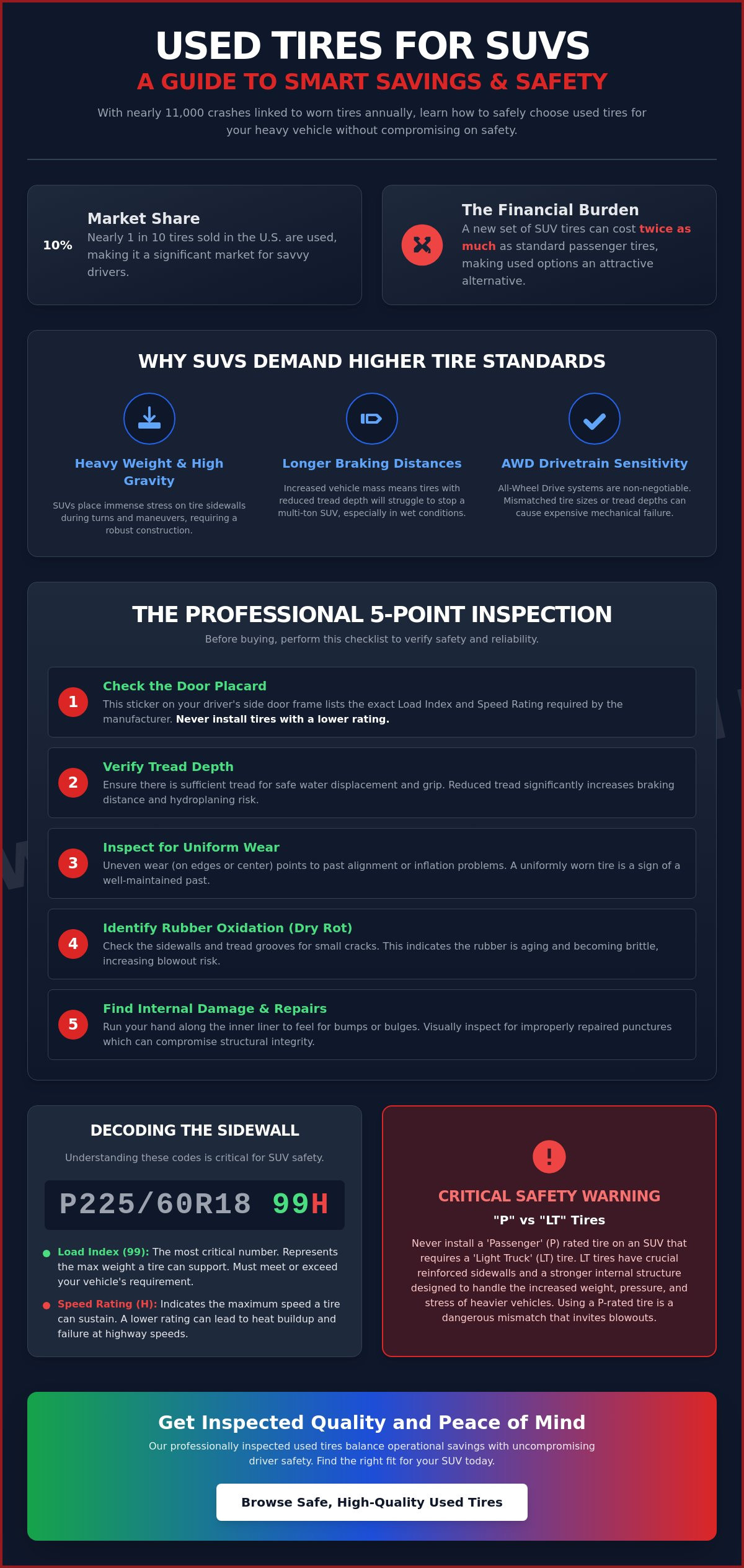
Heavy SUVs demand more than a visual scan. While the U.S. Department of Transportation mandates a minimum tread depth of 2/32 of an inch, this is a bare minimum for light cars. For your safety on wet Alabama roads, we insist on at least 5/32 of an inch for SUV applications. This extra depth is vital for displacing water and preventing hydroplaning. Are used tires a safe option for SUVs? Only if they pass a professional inspection that accounts for the vehicle's weight and performance needs.
Our 5-point checklist provides the reliability you need to make an informed decision. We treat every tire as a critical component of your vehicle's foundation. Follow these steps to ensure your used tires are road-ready:
- Tread Depth: Measure at least 5/32 of an inch to handle heavy SUV braking distances.
- Uniform Wear: Check for even tread across the tire. Uneven wear indicates alignment or suspension issues from the previous vehicle.
- Sidewall Integrity: Look for bubbles, cuts, or evidence of curb scrubbing. These are signs of internal structural failure.
- Repair History: Identify any plugs or patches. Center-tread repairs are acceptable, but shoulder or sidewall repairs are immediate grounds for rejection.
- Bead Condition: Ensure the tire bead is free of tears. A damaged bead will not seat properly on the rim, leading to constant air leaks.
Beyond the Penny Test
Don't rely on the penny test. It is an outdated method that lacks the precision required for heavy-duty vehicles. Use a dedicated tread depth gauge to measure the inner, center, and outer ribs. This process identifies "feathering" or "cupping" that suggests mechanical issues. Hidden wear patterns cause road noise and vibrations that damage your SUV's suspension over time. Precision measurement is the only way to verify if a used tire is a dependable asset.
Vetting the Seller
Your source is as important as the tire itself. Backyard sellers often skip the internal inspection and ignore structural weaknesses. Established shops with professional protocols provide the reliability you need for your daily operations. Ask where the inventory was sourced and if it has been pressure-tested. High-quality shops offer a mounting and balancing guarantee to ensure the tire performs as promised. This no-nonsense approach protects your financial health and keeps your operation moving. Secure your vehicle's performance by choosing from our professionally inspected used tires today.
Sourcing High-Quality Used Tires in Birmingham, AL
Finding a dependable source for SUV equipment is a significant logistical challenge. You need a partner who understands the local terrain and the specific demands of heavy vehicles. Birmingham, Hoover, and Vestavia present unique road conditions that demand high-performance rubber. From the intense heat cycles on I-65 to the uneven surfaces of residential streets, your tires are your vehicle's first line of defense. Are used tires a safe option for SUVs? The answer depends entirely on the expertise and integrity of your supplier. We bridge the gap between used tire savings and new-tire peace of mind.
Purchasing the tire is only half the battle. To maximize your vehicle's performance, we integrate our inventory with professional at home tire installation. This service saves you time and ensures the job is done right. We also emphasize the necessity of a professional four-wheel alignment during installation. An aligned vehicle prevents premature wear on your used tires and protects your SUV's complex suspension. This comprehensive approach ensures that are used tires a safe option for SUVs in our local community. We act as the expert who works behind the scenes to keep your operation running smoothly.
The Partner Tires Inspection Protocol
We don't leave your safety to chance. Our multi-point structural inspection protocol is the backbone of our operation. We verify the load ratings and DOT age codes for every SUV tire before it ever reaches our stock. If a tire shows signs of internal bruising or exceeds our strict age thresholds, we reject it immediately. This focus on detail allows us to provide a reliable product that supports your financial health. We prioritize your operational needs by maintaining a stock that meets high safety standards. Our commitment to quality ensures you receive a product that is ready for the road.
Mobile Convenience for Birmingham Drivers
Your time is a valuable asset. Our mobile service brings a professional tire shop directly to your home or office. We handle tire mounting and computerized balancing on-site, using the same precision equipment found in a traditional bay. This efficiency allows you to focus on your business while we ensure your vehicle is road-ready. It's a supportive partnership designed to drive your growth and maintain your schedule. Contact Partner Tires for a quote on high-quality used SUV tires today and experience the stability of a truly professional tire service. We are ready to serve as the foundation for your vehicle's success.
Secure Your SUV's Performance and Financial Health
Managing the operational costs of a heavy vehicle requires a strategic approach. You now understand that are used tires a safe option for SUVs when you verify load capacities and manufacturing dates. Professional scrutiny is the difference between a risky purchase and a dependable asset. By following our 5-point inspection checklist, you protect your vehicle's stability and your family's safety on the road. We prioritize your success by rejecting any inventory that fails our strict structural standards.
Partner Tires serves as the reliable foundation for drivers throughout Birmingham, Hoover, and Vestavia. We combine locally owned expertise with the convenience of professional mobile installation. Every unit in our stock undergoes a rigorous multi-point safety inspection to ensure it meets your vehicle's high-stress demands. We bring the equipment directly to your home or office, saving you time without compromising on precision. Our team is committed to your financial health and your vehicle's reliability. Browse Our High-Quality Used Tire Inventory in Birmingham to find the right fit for your SUV today. We look forward to being the engine that drives your vehicle's growth and safety.
Frequently Asked Questions
Is it legal to sell used tires in Alabama?
Yes, selling used tires is legal in Alabama. The state mandates a $1.00 environmental fee for every replacement tire sold, including used ones. This fee supports the Alabama Scrap Tire Environmental Quality Act of 2003 to fund cleanup efforts. Alabama will also prohibit the disposal of whole tires in landfills after December 31, 2027. Purchasing high-quality used tires helps keep materials in the supply chain longer while complying with these environmental mandates.
How much tread depth is considered safe for an SUV tire?
A safe SUV tire should have at least 5/32 of an inch of tread depth. While the DOT mandates a minimum of 2/32 of an inch for passenger vehicles, the heavy weight of an SUV requires more grip for braking. Worn tires contribute to almost 11,000 motor vehicle crashes annually according to the NHTSA. Extra depth is vital for maintaining performance and preventing hydroplaning on wet Alabama highways.
What is the 'DOT code' and why does it matter for my SUV?
The DOT code is a four-digit number representing the tire's manufacturing week and year. It is crucial because rubber degrades chemically over time regardless of the remaining tread. For heavy vehicles, rubber integrity is the foundation of road safety. We recommend avoiding any tire older than six years. This ensures the rubber remains flexible enough to handle the high-stress loads and heat cycles typical of SUV operations.
Can I mix used tires and new tires on my AWD vehicle?
Mixing new and used tires on an AWD vehicle is risky. These systems rely on identical wheel speeds to function correctly. If the tread depth difference is significant, the varying diameters can cause mechanical strain on your differentials. This often leads to expensive drivetrain repairs. When asking if are used tires a safe option for SUVs with AWD, the answer is only yes if you match the diameters precisely.
Do used tires come with any kind of warranty or guarantee?
Many professional shops offer tire replacement warranties for their used inventory. We provide specific warranties that cover both products and services to protect your financial health. These guarantees ensure that the tire maintains its structural integrity after installation. Always ask for a written copy of the warranty terms. This documentation confirms that the shop stands behind its inspection protocol and the reliability of its stock.
How can I tell if a used tire has been repaired safely?
Safe repairs are located exclusively in the center tread area of the tire. A professional repair uses a combination plug and patch on the interior liner. You should reject any tire with patches on the shoulder or sidewall. These areas experience the most flex and heat, making repairs prone to failure. Inspect the internal liner during mounting to verify that previous repairs meet these industry safety standards.
Why are load ratings more important for SUVs than for cars?
Load ratings determine the maximum weight a tire can support safely. SUVs have a much higher curb weight and a higher center of gravity than standard sedans. This combination puts extreme pressure on the tire sidewalls during cornering and braking. If the load rating is insufficient, the tire may overheat or suffer a structural blowout. Matching the load index to your vehicle's door placard is a non-negotiable safety requirement.
Can Birmingham heat cause used tires to fail faster?
High temperatures in Birmingham significantly accelerate the oxidation of tire rubber. Heat cycles cause the essential oils in the rubber to evaporate, leading to dry rot and brittleness. This process happens faster in the South than in cooler climates. When considering if are used tires a safe option for SUVs in Alabama, you must prioritize tires with recent DOT codes. This ensures the rubber can still withstand the thermal stress of summer driving.


