

What if your tires are expiring long before the tread wears down? Most drivers in Birmingham look at their wheels and see plenty of rubber, yet they're still driving on a ticking time bomb. It's common to feel anxious about a high-speed blowout or confused by conflicting advice on tread depth versus chronological age. You want your vehicle to be a reliable asset, not a safety risk or a financial burden. Knowing exactly when to replace tires is the difference between a controlled commute and a roadside emergency.
We prioritize reliability over flashy marketing. This 2026 guide provides the precision you need to evaluate vehicle safety at home. You'll learn how the relentless Alabama heat accelerates rubber degradation. We explain why the manufacture date matters as much as the tread depth. This article provides a clear checklist to verify tire health. We also show how mobile installation keeps your workday intact. From computerized balancing to on-site replacement in Hoover or Vestavia, we keep your operation moving. Let's get your vehicle back to peak performance with zero disruption.
Key Takeaways
- Learn how to identify the 2/32-inch legal minimum and why safety experts recommend replacement at 4/32-inch for wet-weather traction.
- Understand how Alabama’s high humidity and UV exposure accelerate rubber decay, making the 6-year age rule more important than tread depth alone.
- Identify structural red flags like sidewall bubbles and learn the technical reasons why you must know when to replace tires in pairs to maintain modern safety systems.
- Discover how mobile at-home or at-work installation services maximize your efficiency and eliminate the traditional tire shop waiting room.
Measuring Tread Depth: The First Line of Defense
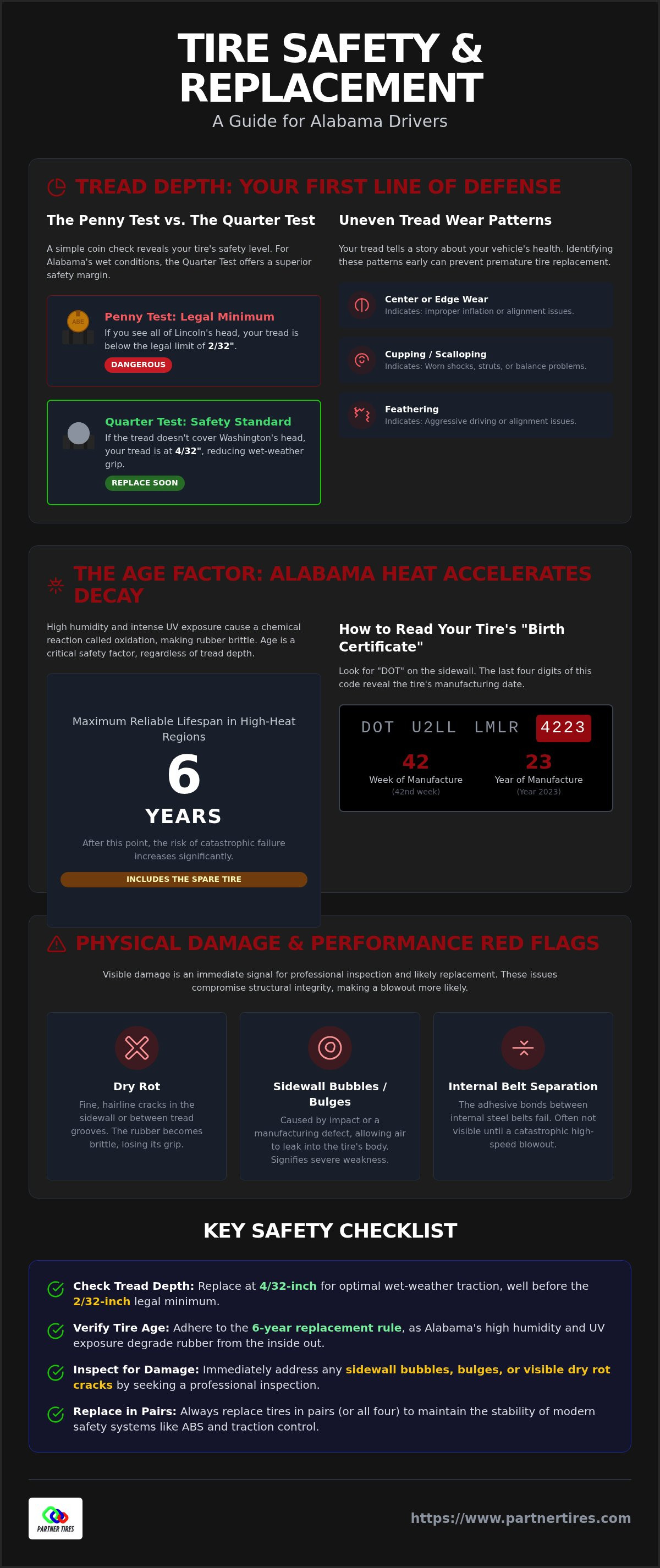
Your safety depends on a few millimeters of rubber. In Alabama, the legal minimum tread depth is 2/32 of an inch. If your tread reaches this level, you're legally required to pull the vehicle off the road. However, performance degrades long before you hit the legal limit. Wet-weather traction drops significantly once you hit 4/32 of an inch. This makes hydroplaning a real risk during Birmingham's heavy afternoon downpours. Understanding Tire construction and safety helps you see why these grooves are vital for clearing water. Determining when to replace tires relies on monitoring these levels closely. Tread wear indicators, also known as wear bars, are the small bridges of rubber between tread ribs that serve as your built-in safety gauge.
The Penny Test vs. The Quarter Test
You don't need expensive tools to check your status. Take a standard penny and place Lincoln’s head upside down into the tread groove. If you can see the top of his head, your tires are below 2/32 of an inch and are dangerous. While the penny test is common, we recommend the Quarter Test for Alabama drivers. Using a quarter provides a safer margin of 4/32 of an inch. Follow these steps for an accurate check:
- Insert the coin at the deepest point of the tread.
- Check the inner, center, and outer grooves of each tire.
- Repeat the process on all four tires to identify discrepancies.
- Look for Washington's head; if the tread doesn't cover it, traction is compromised.
Checking multiple points is critical because wear is rarely perfectly even. If one side of the tire is bald while the other looks new, your safety is still at risk. This simple home diagnostic is your first defense against a highway emergency.
Identifying Uneven Tread Wear Patterns
Your tread tells a story about your vehicle’s mechanical health. Patterns like "cupping" or "feathering" usually signal issues with your shocks or struts. If you notice the inner or outer edges wearing faster than the center, it's a clear sign you need an expert wheel alignment. Ignoring these patterns forces you to buy a new set of tires much sooner than necessary. Regular tire rotation every 5,000 to 7,500 miles balances this wear and extends the life of your investment. We prioritize your financial health by catching these mechanical issues early through our mobile inspection and rotation services.
The Age Factor: Why Alabama Heat Accelerates Tire Decay
Birmingham's climate presents a specialized challenge for vehicle maintenance. High humidity combined with intense UV exposure creates a chemical reaction in tire rubber called oxidation. This process causes the rubber to lose its flexibility over time. Even if your car sits in a garage, the structural integrity of the tire diminishes every day. While tread depth is a visible metric, age is a silent risk factor. Most manufacturers and safety organizations like the NHTSA tire safety standards suggest that six years is the maximum reliable lifespan for a tire in high-heat regions. Beyond this point, the risk of a catastrophic failure increases regardless of how much tread remains. Knowing when to replace tires requires looking past the surface and checking the calendar.
Don't ignore your spare tire during these inspections. Spare tires often live in hot trunks or stay exposed to road debris and heat under the vehicle chassis. They degrade just as fast as active tires but rarely receive the benefit of regular pressure checks or visual reviews. Using a ten-year-old spare during a midnight emergency is a gamble you shouldn't take. If your spare is over six years old, it's effectively a decorative weight rather than a safety tool.
Spotting the Signs of Dry Rot
Dry rot is the physical manifestation of rubber decay. You can identify it by looking for fine, hairline cracks in the sidewall or deep within the tread grooves. As the rubber dries out, it becomes brittle and hard. This loss of elasticity means the tire can no longer grip the road surface effectively during sudden braking or sharp cornering. The most dangerous aspect of dry rot is internal belt separation. The adhesive bonds between the internal steel belts and the rubber can fail. This creates a structural weakness that isn't always visible until a high-speed blowout occurs. If you spot these cracks, a professional tire inspection is the best way to ensure your vehicle remains roadworthy.
How to Read Your Tire’s Birth Certificate
Every tire has a chronological history stamped on its sidewall. Look for the "DOT" symbol followed by a series of characters. The last four digits are the most important for determining when to replace tires. The first two digits represent the week of manufacture, while the last two represent the year. For example, a code ending in "1224" means the tire was produced in the 12th week of 2024. Be cautious when buying from warehouse clearout sales. Tires sold as "new" may have been sitting in a non-climate-controlled environment for three years. This leaves you with only half of the tire's reliable service life before the six-year mark hits. Always verify the manufacture date before installation to maximize your financial investment.
Physical Damage and Performance Red Flags
Birmingham roads are notoriously tough on rubber. Deep potholes on I-65 or local streets in Hoover can cause immediate internal damage that isn't always visible to the untrained eye. Physical trauma is often the primary factor in when to replace tires before the tread naturally wears out. Your Tire Pressure Monitoring System (TPMS) light is your first alert. It often signals more than just a seasonal pressure change. It can indicate a slow leak from a puncture or a structural failure following a heavy impact. We treat every TPMS alert with urgency to prevent a roadside emergency.
Not every nail requires a full set of new tires. If a puncture is located in the center tread area and is smaller than a quarter-inch, a professional plug and patch can often restore the tire. However, if the damage occurs on the shoulder or sidewall, the structural integrity is permanently compromised. In these cases, repair is impossible. You must replace the tire to maintain safe operating standards. We prioritize your safety by providing honest assessments of whether a tire is salvageable or requires replacement.
Sidewall Bulges and Impact Damage
A bulge or "bubble" on the sidewall is a non-negotiable safety hazard. This occurs when an impact, like hitting a deep curb or a jagged pothole, breaks the internal fabric cords. The air pressure then pushes against the outer rubber layer, creating a visible weak spot. It's a ticking time bomb for a high-speed blowout. Sidewall damage can never be safely patched or repaired because this area undergoes the most flex during driving. If you see a bulge, don't drive the vehicle at highway speeds. Immediate replacement is the only logistical solution to protect your safety and your vehicle’s suspension system.
Vibration and Computerized Balancing
Steering wheel vibration is a performance red flag you shouldn't ignore. This often signals that you've lost a wheel weight or developed a flat spot from emergency braking. High-speed shaking typically points to a balance issue. We use computerized wheel balancing to pinpoint these weight discrepancies with extreme precision. This service extends the life of your tires by ensuring even weight distribution across the entire wheel assembly. If the vibration persists after balancing, we investigate for a bent rim or internal belt separation. Catching these issues early prevents secondary damage to your steering components and keeps your operational costs low.
The Replacement Strategy: New vs. High-Quality Used
Deciding when to replace tires involves balancing immediate safety with long-term financial health. You don't always need a full set of four, but you should never replace just one. We follow the "Replace in Pairs" rule to ensure your vehicle maintains consistent handling and braking performance. Mismatched tread depths create uneven grip, which can be dangerous during emergency maneuvers on Birmingham’s busy interchanges. Modern vehicles rely on sophisticated sensors for Anti-lock Braking Systems (ABS) and Traction Control. These systems measure the rotational speed of each wheel. A tire with deep tread has a larger circumference than a worn one. This discrepancy causes the wheels to spin at different rates, potentially confusing your car’s computer and triggering false safety alerts.
For All-Wheel Drive (AWD) vehicles, this diameter difference is even more critical. Mismatched tires can put constant strain on the transfer case, leading to expensive mechanical failure. We prioritize your vehicle’s total health by ensuring your replacement strategy matches your drivetrain’s requirements. Whether you choose new or used, a four-wheel alignment is essential during installation to prevent your suspension from wearing down the fresh rubber prematurely.
Why We Replace Tires in Pairs or Sets
Maintaining balance across the axle is a core safety requirement. If you only purchase two tires, we generally recommend placing the new pair on the rear axle. This configuration provides better stability and prevents the rear of the car from fishtailing in wet conditions. Consistent tread across the same axle ensures that your braking force is distributed evenly, preventing the car from pulling to one side. This logical approach to installation maximizes your control during sudden stops in heavy rain.
Safety Standards for Used Tires
While some national retailers dismiss used options, we recognize that high-quality used tires are a safe, budget-friendly alternative for many drivers. Our multi-point inspection process is rigorous. We verify the DOT age code to ensure the rubber hasn't reached the six-year limit. We also check for internal patches, sidewall integrity, and tread uniformity. Used tires are an ideal solution for lease returns or temporary fixes when a full set of new tires isn't in the current budget. We only stock inventory that meets our professional standards for reliability. If you need an honest assessment of your options, book an on-site consultation with our mobile team to find the best fit for your vehicle.
Convenient Tire Replacement in Birmingham
The traditional tire shop waiting room is a drain on your productivity. We eliminate the logistical bottleneck of vehicle maintenance by bringing the service directly to your location. Once you determine when to replace tires based on the safety metrics we've discussed, the next step shouldn't involve losing half a day in a lobby. We provide a supportive partnership that respects your schedule. At-work installation keeps your day productive in Hoover or Vestavia. You focus on your business while we handle the technical precision of professional mounting and balancing on-site. Partner Tires acts as the backbone of your operation, ensuring your vehicle stays road-ready without disrupting your workflow.
Our commitment to reliability means we don't cut corners just because we're mobile. We arrive with industrial-grade equipment to ensure your vehicle is safe immediately. This efficiency is the core of our service model. It turns a necessary maintenance task into a seamless transition. We prioritize your success by keeping your fleet or personal vehicle in peak condition with zero downtime.
How Mobile Tire Installation Works
The process is designed for speed and clarity. You start by selecting your tires online or by phone. We help you navigate the stock management side of the decision, ensuring you get the right fit for your specific vehicle and tire size. What follows is a highly organized logistical operation. When our mobile service unit arrives at your home or office, we manage the entire lifecycle of the replacement. We don't just swap rubber; we provide a complete technical solution.
We perform professional mobile tire installation including computerized balancing right in your driveway or parking lot. This isn't a simplified version of shop service. It's the exact same high-impact technical work performed with mobile precision. We remove the old tires, mount the new ones, and verify the TPMS sensor status. You receive a logistical solution that matches the speed of modern industry turnover.
Serving the Greater Birmingham Area
Our regional expertise covers the entire metro area. We serve clients in Bessemer, Trussville, Pelham, and Homewood. This community-focused approach ensures that professional help is never far away. Beyond standard installation, we provide emergency roadside assistance for flat tires and TPMS sensor repairs. Supporting a locally owned Birmingham business means you're investing in the regional economy while receiving personalized care. We know the local roads and the specific demands they place on your vehicle.
We want to be the engine that drives your growth. If you've identified that it's time to upgrade, don't let the hassle of a shop visit delay your safety. Knowing when to replace tires is only half the battle; getting them installed correctly is what keeps you moving. Contact Partner Tires today for a free quote tailored to your specific vehicle and tire size. We'll provide the stability and grit needed to keep your vehicle on the road.
Secure Your Vehicle's Performance Today
Maintaining vehicle safety is a continuous process that requires attention to more than just mileage. You now have the technical tools to identify critical warning signs, from the 4/32-inch tread depth threshold to the structural decay caused by Birmingham's intense heat. Deciding when to replace tires is a matter of both safety and logistics. We provide the regional expertise and grit to handle the heavy lifting while you focus on your workday. Our mobile service units bring the shop directly to your home or office in Birmingham, Hoover, and Vestavia. Every installation includes expert computerized balancing to ensure your investment lasts as long as possible. Whether you need a fresh set of four or high-quality used options to fit your budget, we act as the backbone of your operation. Don't let a maintenance delay turn into a roadside emergency. Take the next step toward a more reliable commute and a controlled driving experience. We're ready to be the engine that drives your growth.
Get a Free Quote for New or Used Tires in Birmingham
Frequently Asked Questions
How many years should tires last before they need to be replaced?
Knowing when to replace tires involves checking more than just the tread. Most safety experts recommend a maximum lifespan of six years for tires operating in high-heat environments like Alabama. While some manufacturers suggest a ten-year limit, internal rubber degradation often makes tires unsafe before that point. You should check the DOT date code on your sidewall to verify the manufacturing week and year. If your tires exceed six years, schedule a professional inspection.
Can I replace just two tires instead of all four?
You can replace just two tires, but you must install them as a matching pair on the same axle. We strongly recommend placing the new pair on the rear axle to maintain stability in wet conditions and prevent fishtailing. Mixing old and new tires across the same axle disrupts braking balance and handling. For all-wheel drive vehicles, verify your manufacturer's requirements, as mismatched diameters can cause significant damage to the drivetrain.
What happens if I drive on tires with low tread?
Driving on low tread significantly increases your risk of hydroplaning during heavy rain. As the grooves shallow, they lose the ability to channel water away from the contact patch. This leads to a loss of steering control and extended braking distances. Beyond safety risks, driving on tires below the 2/32-inch legal limit can result in traffic citations and failed vehicle inspections. Maintaining adequate tread is a fundamental requirement for consistent road safety.
Is it safe to buy used tires for my car?
Buying used tires is safe when you source them from a provider that performs rigorous multi-point inspections. We examine every used tire for internal patches, sidewall bulges, and age-related dry rot. High-quality used inventory offers a practical logistical solution for budget-conscious drivers or those returning a leased vehicle. It's a reliable way to manage your operational costs without compromising on the structural integrity or performance of your vehicle's wheels.
How do I know if my vibration is a tire issue or an alignment problem?
A vibration felt through the steering wheel at high speeds usually indicates a tire balance issue or a flat spot. If your vehicle pulls to one side on a straight road, the problem is likely a wheel alignment discrepancy. We use computerized balancing to resolve vibrations and four-wheel alignment services to fix pulling issues. Identifying these symptoms early prevents secondary wear on your steering components and ensures your tires wear down evenly over time.
Does the Alabama heat really make tires wear out faster?
Alabama's intense heat and high UV exposure accelerate the oxidation process in tire rubber. This chemical reaction causes the rubber to become brittle and lose its essential grip. While the tread might not disappear faster, the structural integrity of the tire decays more rapidly than in cooler climates. This environmental factor is a primary reason why knowing when to replace tires in the South depends heavily on the tire's chronological age.
What is the minimum legal tread depth in Alabama?
The legal minimum tread depth in Alabama is 2/32 of an inch. This matches federal safety standards for passenger vehicles. If your tread reaches this level, the built-in wear bars will be flush with the tread ribs, indicating an immediate need for replacement. We advise planning for new tires once you reach 4/32 of an inch. This proactive approach ensures you maintain sufficient wet-weather traction before the tires become legally non-compliant.
How long does a mobile tire installation take at my home?
A standard mobile tire installation for a full set of four tires typically takes between 60 and 90 minutes. Our technicians arrive with all the necessary equipment to perform mounting and computerized balancing on-site. This efficient process allows you to continue your workday or household tasks without interruption. We prioritize a fast-paced rhythm that respects your schedule while ensuring every safety check, including TPMS sensor verification, is completed with professional precision.


