

A flat tire on the shoulder of I-65 isn't just a mechanical failure; it's a high-stakes safety emergency. With traffic moving at 70 mph or faster, knowing exactly what to do with a flat tire on I-65 can mean the difference between a quick fix and a dangerous collision. You likely feel the pressure of high-speed vehicles rushing past your door while you struggle to identify your exact mile marker. It's a stressful situation that demands immediate, logical action to protect your vehicle and your life.
We agree that your primary goal is to get off the pavement and back to your schedule without the uncertainty of high towing costs. This guide provides the definitive protocol for handling roadside tire emergencies in Alabama, from navigating the state's Move Over law to choosing between mobile repair and traditional shops. You'll learn how to leverage local resources like ALDOT's ASAP service and why mobile tire installation is often the most efficient choice for your bottom line. We'll cover essential safety steps, legal requirements, and the fastest ways to secure a professional repair so you can move forward with confidence.
Key Takeaways
- Prioritize immediate extraction by pulling as far right as possible and using mile markers to pinpoint your location for responders.
- Master exactly what to do with a flat tire on I-65 by choosing professional mobile tire repair over life-threatening DIY changes in high-speed traffic.
- Comply with Alabama's Move Over law to avoid steep fines and ensure the safety of both your vehicle and emergency service providers.
- Leverage local Alabama roadside resources like the ALDOT ASAP program for free initial assistance in major metropolitan corridors.
- Secure your long-term financial health by scheduling computerized wheel balancing and alignment after any high-speed tire failure.
Immediate Safety Protocol for a Flat Tire on I-65
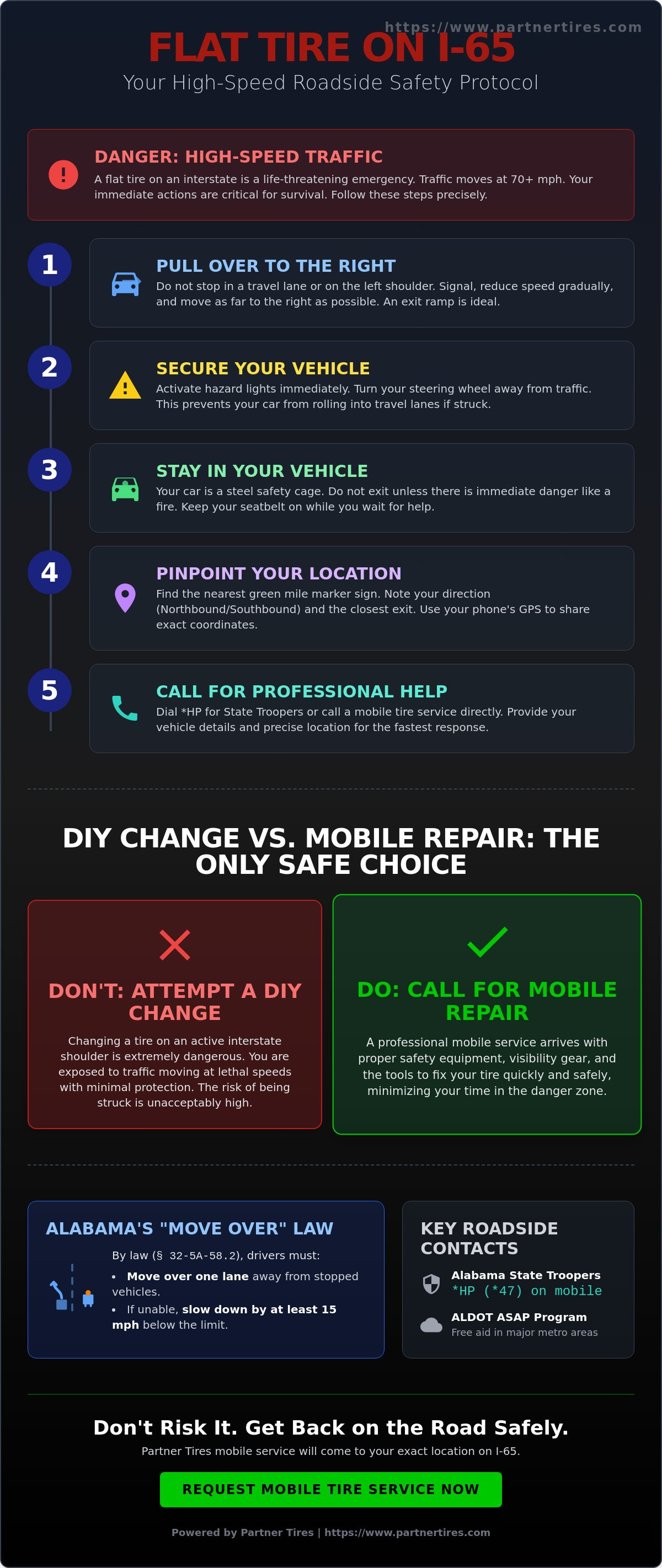
When your tire fails on I-65, your first five seconds determine your safety. High-speed corridors like the stretch between Birmingham and Montgomery leave zero room for error. The most critical step in knowing what to do with a flat tire on I-65 is to resist the urge to stop immediately on the left shoulder. Always aim for the right side of the highway. If you can reach an exit ramp, take it. A wider shoulder or a paved off-ramp provides a necessary buffer between your vehicle and passing semi-trucks.
Once stopped, turn your steering wheel away from the traffic lanes. This ensures that if another vehicle strikes yours, the impact pushes your car into the ditch rather than back into the flow of traffic. Activate your hazard lights immediately. If you carry reflective triangles or flares, deploy them only if you can do so without stepping into a travel lane. Stay inside your vehicle with your seatbelt fastened. Modern safety cabins are designed to withstand impacts; your body is not. Call for professional roadside assistance before you even think about stepping out to inspect the damage. The dangers of changing a flat tire on a busy interstate are often underestimated, leading to preventable tragedies every year.
The 'Move Over' Law in Alabama
Alabama Code § 32-5A-58.2 protects you and service providers. This law requires drivers to move over one lane or slow down at least 15 mph below the limit when they see flashing lights. Don't rely solely on other drivers' compliance. The left shoulder on I-65 is a trap. High-speed traffic often hugs the left line, making that side of your car a danger zone. If you're stuck, signal your distress by hanging a white cloth from the window or popping the hood from the inside. This alerts state troopers and service vehicles without requiring you to leave the safety of your seat.
When to Exit the Vehicle Safely
Staying in the car is usually the safest option unless you smell smoke or see fire. If you must exit because the vehicle is in a precarious position, never use the driver-side door. Slide across the console and exit through the passenger side. Move quickly to a spot at least 50 feet behind a guardrail or up a steep embankment. Never stand directly in front of or behind your vehicle. Position yourself so you can see oncoming traffic while remaining well off the paved surface. This protocol is the foundation of knowing what to do with a flat tire on I-65 safely.
Pinpointing Your Location on the Alabama I-65 Corridor
Precision is your lifeline when you're stranded. On the Alabama I-65 corridor, dispatchers and service providers require specific data to reach you quickly. Alabama's stretch of I-65 spans from mile 0 at the Gulf to mile 366 at the Tennessee line. Look for the small green mile marker signs located every tenth of a mile. These numbers are the most accurate way to communicate your position. If you can't see a sign, identify the nearest exit name or number. For instance, being two miles south of Exit 250 is far more useful than saying you're near Hoover. This level of detail is the first step in knowing what to do with a flat tire on I-65 effectively.
Digital tools provide an added layer of certainty. Use your smartphone's "Share My Location" feature to send your GPS coordinates directly to emergency dispatchers or family members. While you wait, review the NHTSA tire safety guidelines to understand the mechanics of your failure and prevent future blowouts. Knowing exactly where you are reduces your time in the danger zone. If you need a professional to reach you at your specific mile marker, reliable roadside assistance ensures you aren't left waiting in high-traffic areas.
Key Exit Landmarks Near Birmingham
The Birmingham metro area presents unique navigational challenges. If you are near the I-20/I-59 interchange, you are at "Malfunction Junction," one of the busiest segments of the state. In the southern suburbs, identify whether you are between the high-traffic zones of Hoover, Pelham, or Alabaster. For those traveling north of the city, the stretch from North Birmingham toward Gardendale is characterized by steep grades and frequent bridges. Mentioning these landmarks helps responders visualize your surroundings and improves the speed of your recovery.
Communicating with Alabama State Troopers
Dial *HP (*47) from your mobile device to connect with the Alabama Law Enforcement Agency (ALEA). Be prepared to provide the dispatcher with your vehicle color, make, and the number of passengers on board. Clearly state your direction of travel. Southbound traffic is heading toward Mobile, while Northbound traffic moves toward Huntsville. This distinction is critical on I-65, where medians often prevent responders from simply "flipping around" to reach you. Providing these facts clearly is a core part of what to do with a flat tire on I-65 to ensure a safe extraction.
DIY Spare Change vs. Professional Mobile Tire Repair
Deciding between a DIY fix and calling for professional support is the most critical choice you'll make after pulling over. On the high-speed stretches of I-65, the driver-side of your vehicle is often referred to as the "Death Zone." Attempting to change a tire while traffic rushes past at 70 mph or more is a life-threatening risk. Professional mobile tire repair eliminates this danger by placing a high-visibility service vehicle between you and the flow of traffic. This logistical shield is a core part of what to do with a flat tire on I-65 when safety is your top priority.
Efficiency is another major factor. A manual tire change on a highway shoulder is a slow, grueling process. Professional technicians use specialized equipment to complete the task in minutes. This speed reduces your exposure to the risks of the roadway. Furthermore, mobile tire installation provides a permanent solution rather than a temporary fix. Instead of limping home on a "donut" spare, you can have a full-sized tire mounted and balanced right where you sit. This approach protects your vehicle's mechanical integrity and gets you back to your schedule without a secondary trip to a shop.
Risks of Using a Scissor Jack on Highway Shoulders
Interstate shoulders in Alabama are rarely perfectly level or solid. Many sections of I-65 feature soft soil, gravel, or degraded asphalt that can shift under the concentrated weight of a jack. Constant vibrations from passing semi-trucks create a harmonic resonance that can easily cause a standard scissor jack to slip or collapse. This instability risks crushing the vehicle's rotor or, worse, the person working near the wheel. Additionally, donut spares are restricted to 50 mph because their smaller diameter and narrower tread lack the heat dissipation and structural integrity of a full-sized tire.
Benefits of Professional Roadside Assistance
Professional technicians bring industrial-grade equipment directly to your mile marker. High-output impact wrenches and hydraulic floor jacks handle the heavy lifting in a fraction of the time it takes for a manual change. If you are near the metro area, accessing expert tire repair Birmingham services ensures your rim is protected from damage during the process. Lighting is also a factor. Service trucks carry high-intensity LED arrays that illuminate the work area, making night-time repairs significantly safer. When considering what to do with a flat tire on I-65, shifting the physical risk to a professional partner is the most logical operational decision.
Local Roadside Resources and Mobile Support
Success on the interstate depends on your support network. Knowing exactly what to do with a flat tire on I-65 involves identifying the right logistical partners before panic sets in. You have two primary paths: public safety assistance for immediate extraction and private mobile services for full mechanical recovery. Mobile tire delivery is a superior alternative to traditional towing. It keeps your vehicle on the ground and avoids the high costs of hook-up fees and storage. This approach ensures your operational downtime is measured in minutes rather than hours.
Mobile units bridge the gap between being stranded and being road-ready. Instead of moving your vehicle to a shop, the shop moves to you. This is especially critical on the I-65 corridor where towing companies often face long backlogs during peak traffic hours. By choosing a mobile service, you maintain control over your vehicle and your schedule. It is a no-nonsense solution for a high-pressure situation.
ALDOT HERO Program Details
The Alabama Department of Transportation operates the Highway Emergency Response Operators (HERO) program within the Birmingham metropolitan area. These units focus on traffic management and motorist safety. HERO operators provide free initial assistance, such as changing a tire with your own spare or providing a jump-start. They operate primarily during high-volume hours to clear the roadway quickly. While they offer a vital safety buffer, they do not sell new tires or perform complex repairs. If you see a HERO vehicle, signal by staying in your car with your hazard lights active. They are the first line of defense in the Birmingham corridor.
Partner Tires Mobile Tire Installation
When you need a permanent fix rather than a temporary spare, mobile tire installation is the most efficient choice. This service brings a fully equipped tire shop directly to your location. If you can reach a nearby parking lot or exit, you can request at home tire installation or on-site replacement. Technicians perform mounting and computerized wheel balancing right on the shoulder or in a lot. This eliminates the need for a secondary trip to a garage. Coverage extends across the central Alabama corridor, supporting drivers from Cullman through Hoover and down to Alabaster. Understanding what to do with a flat tire on I-65 requires a balance between public safety and professional mechanical support.
Don't let a tire failure derail your entire operation. Secure fast, professional roadside assistance to restore your vehicle's performance and protect your schedule.
Post-Emergency: Ensuring Your Tires Are Road-Ready
Your recovery process isn't finished just because you've reached a safe parking lot. Success requires more than a quick fix; you must verify that your vehicle's structural and electronic systems survived the incident intact. Knowing what to do with a flat tire on I-65 means looking beyond the immediate repair to prevent a repeat performance. Highway failures often stem from road debris that may have impacted your other three tires. Conduct a thorough visual inspection for cuts, bulges, or embedded metal. Debris fields on the interstate are rarely limited to a single hazard. If one tire failed, the others were likely exposed to the same logistical risks.
Modern vehicle safety depends on precision electronics. A sudden blowout at high speed can damage your TPMS sensors, leading to incorrect pressure readings that invite a second failure. Check your dashboard for alerts immediately after the repair is complete. If the sensor was damaged during the blowout or the subsequent rim strike, it requires professional recalibration or replacement. Addressing these technical details protects both your safety and your long-term financial investment. Upgrading to higher-quality tires with reinforced sidewalls can also provide the extra layer of protection needed for frequent interstate travel.
Professional Alignment and Balancing
A high-speed blowout delivers a violent shock to your suspension system. This impact often knocks your vehicle out of its factory specifications, leading to uneven tread wear and poor handling. Scheduling a four-wheel alignment is the only way to ensure your new tire doesn't wear out prematurely. Computerized wheel balancing is equally vital. It eliminates the minute weight discrepancies that cause highway-speed vibrations. These services aren't optional extras. They are the foundation of a reliable repair that keeps your vehicle operational and efficient.
Choosing the Right Replacement
Selecting the correct replacement tire requires a logical balance of budget and performance requirements. For those managing immediate costs, high-quality used tires Birmingham AL offer a reliable alternative to premium new stock. Regardless of your choice, you must verify that the tire's speed rating meets the demands of interstate travel. Standard I-65 speeds generate significant heat, and an under-rated tire is a liability. Partner Tires remains committed to providing Birmingham drivers with the grit and expertise needed to stay on the move. We don't just fix tires; we secure your operation's future. Knowing what to do with a flat tire on I-65 is about making the right choice for your vehicle's next 50,000 miles.
Secure Your Highway Recovery Today
Navigating a tire failure on a high-speed interstate requires a logical, safety-first approach. You now understand the critical steps of what to do with a flat tire on I-65, from pinpointing your exact mile marker to choosing professional extraction over a risky roadside change. Prioritizing the right shoulder and staying inside your vehicle protects your life. Utilizing mobile tire installation ensures your vehicle returns to service with minimal downtime and maximum mechanical integrity. These protocols are the backbone of a successful recovery in the Alabama corridor.
Don't let a mechanical failure compromise your safety or your schedule. Our team provides the regional expertise and grit required to handle highway emergencies with precision. We bring the tire shop directly to your location, eliminating the need for expensive towing and secondary garage visits. Our expert Birmingham technicians focus on efficiency, reliability, and your long-term financial health. We're here to be the engine that drives your growth, even when the road gets tough.
Stuck on I-65? Call Partner Tires for Mobile Roadside Assistance and Tire Repair! Our team provides 24/7 roadside assistance and mobile tire installation at your location to get you moving again. Stay safe and trust the experts to handle the heavy lifting.
Frequently Asked Questions
Is it illegal to change a tire on the shoulder of I-65 in Alabama?
It is not strictly illegal if your vehicle is truly disabled, but Alabama law requires you to pull as far off the roadway as possible. Alabama Code § 32-5A-136 prohibits stopping on the highway when it's possible to pull off. Safety protocols often dictate that you shouldn't attempt a DIY change on a high-speed shoulder. Law enforcement may require you to move the vehicle or call a professional to clear the lane quickly for traffic safety.
How do I call for the ALDOT HERO truck on I-65?
You can reach ALDOT assistance by dialing *HP (*47) on your mobile phone to connect with the Alabama Law Enforcement Agency. HERO units monitor the Birmingham metro area to assist with traffic management and basic motorist needs like flat tires. State troopers coordinate these units to ensure stranded vehicles don't create secondary accidents in high-traffic zones. This service is a vital resource for initial safety and extraction.
Can I drive on a flat tire to reach the next exit on I-65?
You can drive slowly on a flat tire if the alternative is stopping in a dangerous area with no shoulder. This will likely destroy the tire and potentially damage your wheel rim. However, reaching a wide exit ramp or a lighted parking lot is often the safer logistical choice. Weigh the cost of a replacement wheel against the safety risks of the I-65 mainline when deciding your next move.
What is the fastest way to get a new tire delivered to me on the highway?
Requesting mobile tire delivery from a specialized provider is the most efficient solution available. This service bypasses the need for a tow truck and a trip to a physical garage. Technicians arrive at your mile marker with the specific tire you need for your vehicle. They perform mounting and balancing on-site, which is the fastest way to handle what to do with a flat tire on I-65 without leaving your location.
How much does roadside assistance cost on I-65?
Fees for roadside assistance vary based on the specific service required and your exact location on the Alabama corridor. Factors include whether you need a simple flat repair or a full-sized new tire replacement. Most private providers charge a service call fee plus the cost of parts and labor. Contact your service provider directly to get an accurate quote for your specific situation before they dispatch a technician.
What should I do if my tire blows out in the middle of a construction zone?
Construction zones on I-65 often have narrow shoulders or concrete barriers that prevent you from pulling over safely. If you can't find a clear spot, continue driving slowly to the end of the work zone or the next exit. Stopping in a travel lane within a construction zone creates an immediate hazard for you and other drivers. Alert authorities by dialing *HP (*47) immediately if your vehicle is blocking a lane.
Does Partner Tires offer mobile repair at night on I-65?
Partner Tires provides roadside assistance and mobile tire installation to support drivers during emergency situations at all hours. Our technicians are equipped with high-intensity lighting to handle night-time repairs safely on the interstate shoulder. This service ensures that professional help is available when traditional tire shops are closed. It's a reliable way to manage what to do with a flat tire on I-65 after dark without waiting until morning.
How can I tell if my flat tire is repairable or needs replacement?
A tire is generally repairable if the puncture is in the tread area and is less than a quarter-inch in diameter. If the damage is on the sidewall or the tire has been shredded from being driven while flat, it must be replaced. Professional technicians use visual inspections to determine the safest course of action. They ensure your replacement tire is mounted correctly so your vehicle remains road-ready and safe for highway speeds.


