

Imagine standing on a scorching Birmingham parking lot, staring at a worn tread while the Alabama humidity settles in. You look at the sidewall and see a confusing string of numbers like 225/50R17. It's natural to feel overwhelmed and ask, "what kind of tires do I need for my car?" You want safety and reliability, not a high-pressure sales pitch for expensive features that don't fit your daily commute. We know the frustration of trying to balance a budget against the fear of a highway blowout.
Choosing the right tire is a logistical decision that impacts your vehicle's performance and your financial health. This 2026 buyer's guide cuts through the industry jargon to give you total clarity. You will learn how to decode every symbol on your tire and select a compound built to withstand intense Southern heat. We also preview how mobile installation services can save your Saturday by bringing the shop directly to your driveway or office. From understanding load indexes to picking the right tread for rainy seasons, this is your roadmap to a smarter, safer purchase.
Key Takeaways
- Decode the alphanumeric strings on your sidewall to identify the precise size and load capacity your vehicle requires.
- Select tire compounds specifically engineered to withstand Alabama’s intense summer road temperatures and high-speed highway commutes.
- Use our expert checklist to determine what kind of tires do I need for my car based on your specific Birmingham driving patterns.
- Compare all-season and performance categories to find the optimal balance between year-round versatility and precision handling.
- Learn how mobile installation services eliminate downtime by providing professional mounting and computerized balancing at your home or office.
Decoding Your Sidewall: How to Read Tire Sizes
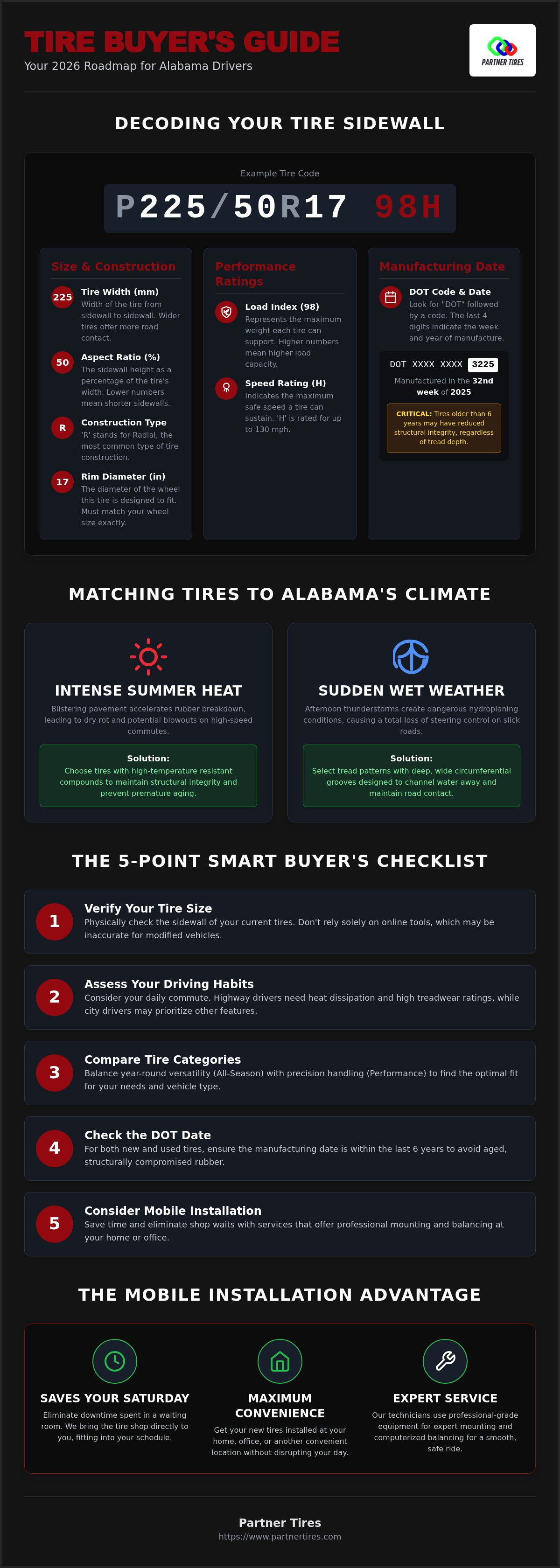
Look at the outer edge of your tire. You will find a raised string of alphanumeric characters like P215/65R15. This sequence is the blueprint for your vehicle's safety and operational efficiency. Many drivers rely on online license plate search tools, but these databases often fail if your car has aftermarket rims or custom modifications. To determine exactly what kind of tires do I need for my car, you must look directly at the rubber currently installed. This physical verification ensures you order the correct stock for your specific setup without wasting time on returns.
Breaking Down the Tire Code
The first three digits in the sequence represent the tire width in millimeters. A wider tire provides more contact with the pavement, which is vital for maintaining traction on hot Alabama roads. Following the slash, the two-digit aspect ratio indicates the height of the sidewall as a percentage of the width. A lower number means a shorter sidewall and generally offers more responsive steering. The final number identifies the rim diameter. This measurement must match your wheel size exactly to ensure a secure fit during mounting and computerized balancing. If you are just understanding tire basics, remember that these dimensions dictate your vehicle's stance and speedometer accuracy.
Why Speed Ratings and Load Indexes Matter
Safety compliance depends on two critical markers found immediately after the size code. The load index is a numerical value that represents the maximum weight each tire can support when fully inflated. Exceeding this limit risks a structural failure, especially when hauling heavy loads or passengers through Birmingham traffic. The speed rating is a letter that follows the load index. A speed rating is the maximum safe speed a tire can maintain. Matching these specifications to your manufacturer's requirements protects your vehicle's suspension and your financial health by preventing premature tread wear.
Every tire also features a birth date stamped near the rim. Look for the letters DOT followed by a four-digit code. The first two digits indicate the week of manufacture, while the last two show the year. Tires older than six years require frequent inspections regardless of tread depth. This is a non-negotiable step when you ask what kind of tires do I need for my car, particularly if you are considering used tires. Knowing this date helps you avoid purchasing aged inventory that has lost its structural integrity due to heat and time.
Matching Tires to Your Alabama Driving Habits
Alabama drivers face unique challenges that generic national guides often ignore. While Northern states focus on snow, our primary concerns are blistering pavement and sudden tropical downpours. When you ask, "what kind of tires do I need for my car," the answer depends heavily on your specific commute. If you spend your mornings on I-65 or circling I-459, you need a tire that prioritizes heat dissipation and low road noise. Long highway stretches at high speeds generate significant internal friction. A tire with a high temperature rating ensures the rubber stays stable and safe during your daily trek between Birmingham and Hoover.
Birmingham's Climate and Tire Longevity
Intense Southern heat accelerates the chemical breakdown of tire rubber. This leads to premature aging, commonly known as dry rot, which creates small cracks in the sidewall. Pavement temperatures in Hoover can climb significantly higher than the ambient air temperature during July and August. You should look for tire compounds specifically engineered with high-temperature resistance. High-quality compounds help maintain structural integrity even when you're parked outdoors under the relentless Alabama sun. Citing expert advice on choosing the right tires reinforces that regional climate is just as important as vehicle type for long-term reliability.
Wet Weather Safety on Alabama Roads
Birmingham's sudden afternoon thunderstorms create a massive risk for hydroplaning. This occurs when a layer of water builds up between your tire and the road surface, causing a total loss of steering control. To combat this, select tread patterns with deep circumferential grooves designed to channel water away from the contact patch. Deep tread is your best defense against the heavy rain common throughout Central Alabama. Maintaining this safety feature requires regular inspections and timely maintenance. If you notice uneven wear or decreased grip during a storm, seeking professional tire repair Birmingham services can prevent a dangerous highway incident before it happens.
Daily mileage also dictates your logistical choice. High-mileage commuters need a higher treadwear rating to ensure their investment lasts more than a single season. Conversely, city drivers in downtown Birmingham might prioritize stopping power and maneuverability over long-term tread life. Balancing these factors ensures you don't overpay for features that don't match your lifestyle. If you're ready to upgrade your vehicle's performance, you can view our current tire inventory to find a set built for the Deep South. We focus on providing the right product for your specific operational needs without the unnecessary fluff.
Tire Categories: All-Season vs. Performance vs. Used
Selecting the right category is a strategic decision that affects your vehicle's operational costs and road safety. Most drivers start by asking what kind of tires do I need for my car based on their specific vehicle class. Touring tires are the standard choice for sedans and crossovers, focusing on a quiet ride and extended tread life. If you operate a sports car or a luxury sedan, ultra-high-performance (UHP) models offer the stiff sidewalls and sticky compounds required for precision handling. Identifying your performance priorities helps you avoid overpaying for specialized features you won't use during a standard Birmingham commute.
The All-Season Advantage for Alabama
Alabama's mild winters mean most local drivers can bypass the expense of dedicated summer and winter sets. All-season tires serve as a reliable foundation for year-round driving. These models balance wet-weather traction with a rubber compound that remains stable during July heat waves. You get a predictable lifespan and a comfortable ride quality that absorbs the imperfections of local city streets. When you work with established tire dealers in birmingham al, you can find all-season options that maximize your vehicle's fuel efficiency. This category is the most efficient logistical choice for the average commuter in Hoover or Vestavia.
When to Consider High-Quality Used Tires
Buying new isn't always the most logical financial outcome, especially for older vehicles or drivers with low annual mileage. High-quality used tires represent a cost-effective alternative that keeps your car on the road without a massive upfront investment. We understand that safety is your primary concern. At Partner Tires, every used unit undergoes a rigorous inspection process to verify tread depth and structural integrity. This ensures you receive a dependable product that meets Alabama safety regulations.
If you're looking for a smart budget choice and ask what kind of tires do I need for my car, don't overlook the value of a high-quality used set. Exploring used tires birmingham al allows you to maintain your vehicle's safety while protecting your bottom line. We prioritize transparency in our stock management so you know exactly what you're putting on your vehicle. This no-nonsense approach to tire replacement ensures your operational needs are in capable hands without unnecessary fluff.
The 5-Point Checklist for Choosing New Tires
You don't need a complex algorithm to decide what kind of tires do I need for my car. You need a logical framework that protects your vehicle and your budget. Start with your owner's manual. This document contains the engineering specifications for your specific trim level. While the sidewall provides data on what is currently installed, the manual confirms the original design intent. Follow this five-point checklist to ensure your next set meets every operational requirement.
- Verify Manufacturer Recommendations: Cross-reference your manual with the tire placard inside the driver's side door jamb.
- Analyze UTQG Ratings: Look for the Uniform Tire Quality Grading to compare treadwear and traction across different brands.
- Match Warranty to Mileage: Confirm the mileage guarantee aligns with your annual driving frequency to maximize your investment.
- Confirm TPMS Compatibility: Ensure the new tires work seamlessly with your vehicle's pressure monitoring system to avoid dashboard warnings.
- Calculate Total Investment: Factor in the complete cost, including professional mounting and computerized wheel balancing.
Understanding Treadwear Ratings
The numbers 300, 400, or 600+ on your sidewall represent the tire's expected longevity. A higher number typically indicates a longer-lasting rubber compound. This is a critical metric for Birmingham commuters who rack up high mileage on I-65. Treadwear ratings are relative to the manufacturer's base tire. Choosing a higher rating can lower your long-term operational costs by extending the interval between replacements. We prioritize stock with competitive ratings to ensure our clients receive the best possible value for their specific driving habits.
TPMS and Sensor Health
Your Tire Pressure Monitoring System (TPMS) is a vital safety component. It's best practice to service these sensors whenever you install a new set of tires. Over time, sensor batteries fail or seals degrade, leading to inaccurate dashboard alerts. Distinguishing between a genuine flat tire and a faulty sensor requires professional diagnostic equipment. Our TPMS Sensor Service ensures your system remains accurate and reliable. We handle the technical details behind the scenes so you can drive with confidence. If you're ready to upgrade, schedule your professional tire installation with our mobile team today. We bring the shop to your location for maximum efficiency.
Expert Installation: Why Mobile Tire Service Wins
Traditional tire shops in Birmingham often require a two-hour wait in a cramped lobby. This is a significant drain on your productivity and your weekend. Once you determine what kind of tires do I need for my car, the next logistical hurdle is getting them onto your vehicle. Mobile tire service eliminates this bottleneck by bringing the entire shop to your location. You receive professional mounting and computerized balancing without leaving your property. This approach ensures your vehicle is handled by local experts who understand the specific stresses of Alabama road conditions. We focus on speed and precision to keep your schedule intact.
At-Home vs. At-Work Tire Installation
Time is your most valuable asset. For busy professionals in downtown Birmingham or Hoover, driving to a service center is often impossible during business hours. Our mobile units provide a seamless solution with at home tire installation and at-work services. We offer safe, contactless options for residential driveways and office parking lots. This flexibility allows you to focus on your operation while we handle the technical execution. We combine tire delivery with professional installation to create a truly integrated supply chain for your vehicle maintenance. Whether you're managing a single car or a small fleet, our logistical strength supports your success.
The Partner Tires Reliability Guarantee
Stability and safety are the foundations of our service mission. We don't just drop off rubber; we perform full computerized wheel balancing on-site to ensure a smooth ride. This precision prevents vibration and protects your suspension from unnecessary wear. Our commitment extends beyond the initial install. We provide roadside assistance and flat tire repair support to keep our local customers moving. This comprehensive care model positions Partner Tires as the backbone of your automotive safety. We work behind the scenes to ensure the right product is installed at the right time. Our regional expertise in Birmingham, Hoover, and Vestavia ensures we meet the highest standards of service.
Choosing the right tire is only half the battle. The quality of the installation determines the longevity of your investment and the safety of your passengers. When you finally decide what kind of tires do I need for my car, the installation process should be the easiest part of the journey. By opting for a mobile solution, you choose efficiency over frustration. You avoid the hidden costs of downtime and the hassle of traditional retail environments. We treat every vehicle with the grit and focus it deserves. Get your free tire quote from Partner Tires today! and experience the efficiency of a mobile partnership.
Secure Your Vehicle's Performance Today
Choosing the right rubber is a vital decision for your safety and your budget. You now have the tools to decode complex sidewall markings and select compounds built specifically for Alabama's intense road heat. Following a logical checklist ensures you don't overpay for features that don't match your specific driving habits. We focus on providing the facts so you can make a strategic choice for your vehicle's longevity.
When you determine what kind of tires do I need for my car, the final step is a professional installation that fits your life. Partner Tires eliminates the downtime of traditional shops by bringing the equipment to your driveway or office. We serve Birmingham, Hoover, and Pelham with a focus on speed and reliability. This mobile approach ensures your operational needs are handled without disrupting your schedule.
Our mobile service includes computerized balancing to guarantee a smooth ride from the moment we finish the job. You can maintain your vehicle's health and safety without losing a single hour of your productive day. Schedule Your Mobile Tire Installation with Partner Tires to get the expert support you deserve. We're proud to be the backbone of your automotive safety and look forward to getting you back on the road with confidence.
Frequently Asked Questions
Where can I find my car's recommended tire size?
You can find the manufacturer's recommended tire size on the placard located inside the driver's side door jamb. This sticker provides the specific dimensions, load index, and inflation pressures required for your vehicle's safety. If the placard is missing, consult your owner's manual for the original engineering specifications. Birmingham drivers should verify this data before asking what kind of tires do I need for my car to ensure a precise fit during mobile installation.
Is it okay to mix different tire brands on the same car?
Mixing tire brands is not recommended because different manufacturers use unique rubber compounds and tread patterns. This variation can lead to unpredictable handling, especially during sudden maneuvers on I-65 or I-459. If you must replace only one tire, try to match the brand and model of the existing tires on that axle. Maintaining uniform traction across all four wheels is a critical logistical step for vehicle stability and long-term suspension health.
Should I replace all four tires at once or just two?
Replacing all four tires simultaneously is the safest choice for maintaining balanced handling and traction. If your budget requires replacing only two, always install the new pair on the rear axle regardless of whether your car is front-wheel or rear-wheel drive. This configuration helps prevent fishtailing and hydroplaning during heavy Alabama thunderstorms. Consistent tread depth across all wheels simplifies your tire rotation schedule and protects your computerized wheel balancing investment.
What is the difference between a speed rating of H and V?
The primary difference lies in the maximum sustained speed each tire can safely handle. An H rating indicates the tire is tested for speeds up to 130 mph, while a V rating supports up to 149 mph. Higher speed ratings often feature stiffer sidewalls that improve cornering and heat dissipation. For daily commutes in Birmingham, matching the rating specified in your manual ensures your tires can withstand the thermal stresses of high-speed highway driving.
Do I really need an alignment when I get new tires?
A four-wheel alignment is essential whenever you install a new set of tires to protect your financial investment. Proper alignment ensures the tires meet the road at the correct angle, which prevents uneven treadwear and pulling. Birmingham's potholes and uneven pavement can easily knock your suspension out of spec. Combining a professional alignment with your new tire installation maximizes the lifespan of the rubber and ensures your vehicle tracks straight on the highway.
How often should I check my tire pressure in Alabama's heat?
You should check your tire pressure at least once a month and before any long road trips. Alabama's extreme summer temperatures cause air to expand, which can lead to over-inflation and increased center-tread wear. Conversely, sudden cold snaps in the fall can drop your pressure and trigger TPMS alerts. Regular monitoring prevents blowouts and optimizes fuel efficiency. Always measure the pressure when the tires are cold for the most accurate results.
Are used tires safe for highway driving on I-65?
High-quality used tires are safe for highway use provided they pass a rigorous inspection. At Partner Tires, we verify tread depth and check for structural defects like sidewall bulges or internal cord damage. This professional vetting process ensures the rubber can handle the high speeds and heat of I-65. When you ask what kind of tires do I need for my car on a budget, used tires offer a reliable, cost-effective alternative for local commuters.
How does mobile tire installation work at my office?
Mobile installation is a straightforward logistical solution for busy professionals in Hoover or downtown Birmingham. Our specialized service van arrives at your parking lot equipped with tire mounting and computerized balancing machinery. You simply provide access to the vehicle, and our technicians handle the entire replacement process while you stay at your desk. This eliminates the need to wait in a shop lobby and ensures your vehicle is ready for the drive home.


