

The most expensive tire on the rack isn't always the smartest investment for your vehicle's specific mission. Birmingham drivers often feel trapped between the rising costs of premium brands and the fear of buying a "plugged" or unsafe used tire. When weighing used vs new tires, the decision involves more than just the sticker price; it's about matching rubber to your actual road usage. We know you need a reliable vehicle without overpaying for tread you'll never use. Efficiency and trust are the foundations of a solid commute, and your safety shouldn't be a budget compromise.
This guide helps you master the technical and financial differences of your options so you can make the most cost-effective choice for your vehicle. You'll learn the exact legal safety standards in Alabama, including how to spot a dangerous defect like a bulge or sidewall crack before it's mounted. We provide a clear framework for deciding based on your annual mileage and explain how mobile installation eliminates the inconvenience of waiting at a traditional shop. By the end, you'll have the knowledge to protect your wallet and your passengers with absolute confidence.
Key Takeaways
- Understand Alabama safety laws and how regional heat impacts the structural integrity of your tire sidewalls.
- Master the financial logic of used vs new tires by focusing on the total cost of ownership rather than the sticker price.
- Identify critical tire defects using a professional field-inspection checklist designed for used inventory.
- Eliminate shop downtime by utilizing mobile installation services that bring professional mounting and balancing to your location.
- Ensure vehicle stability by pairing every tire replacement with computerized wheel balancing and a four-wheel alignment.
Understanding the Choice: New vs. Used Tires for Your Vehicle
Selecting the right rubber for your vehicle requires a cold, hard look at your driving habits. The debate over used vs new tires often misses the critical distinction between a tire's manufactured lifespan and its remaining utility. New tires provide the full spectrum of their engineered life from day one. Used tires, however, offer a focused window of service that can match specific needs without the premium price tag. Understanding Tire construction and basics is the first step in recognizing that a tire isn't just a commodity; it's a safety component with a finite cycle of performance.
To better understand the practical trade-offs between these options, watch this helpful comparison guide:
The Immediate Benefits of New Tires
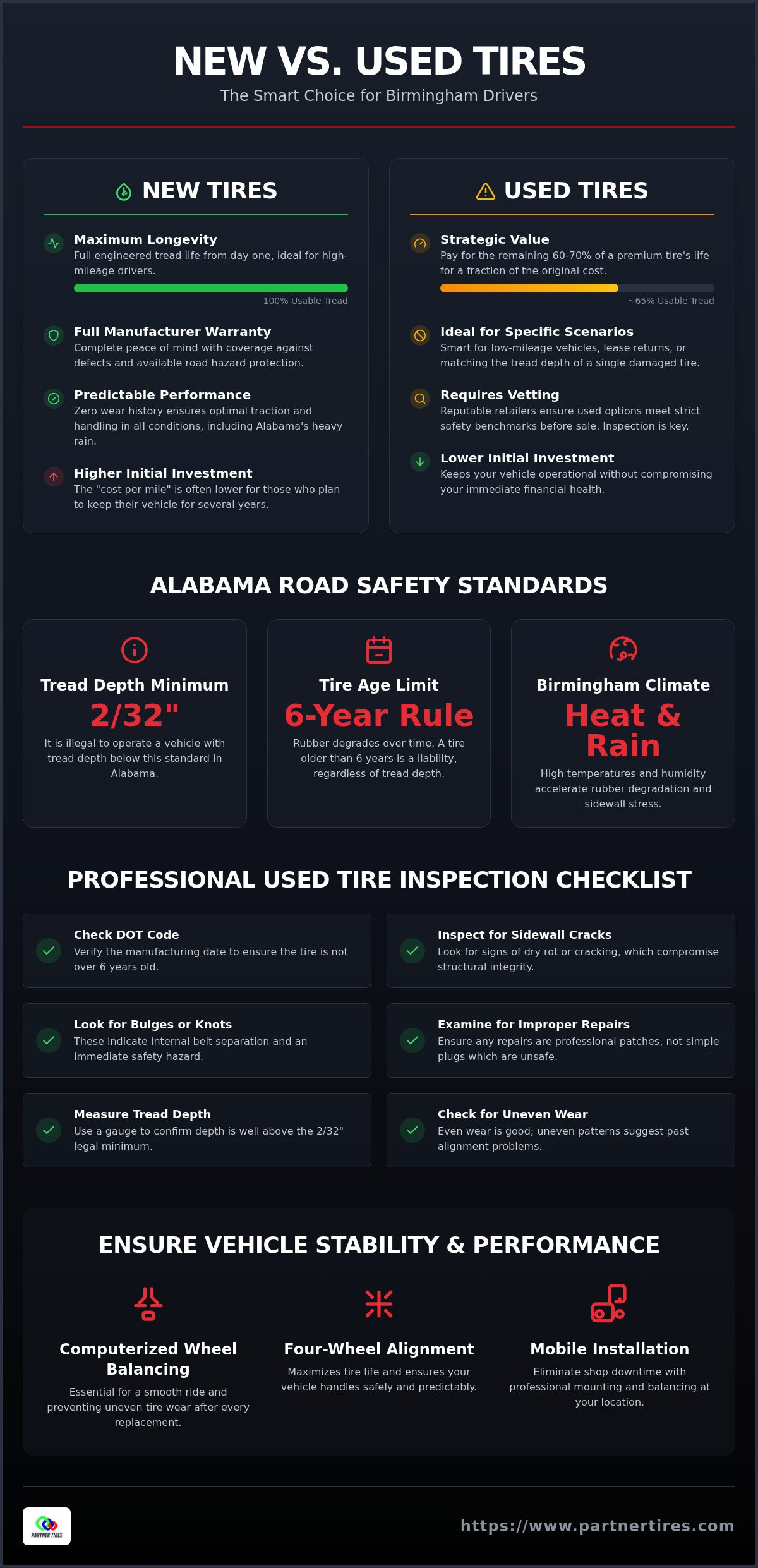
New tires represent the gold standard for drivers who prioritize maximum longevity and total peace of mind. When you buy new, you secure a full manufacturer warranty and the availability of road hazard protection. This is vital for high-mileage commuters traveling between Hoover and Vestavia every day. You start with zero wear history. There are no hidden structural issues, previous improper repairs, or heat-stressed sidewalls. You get predictable performance in Alabama's heavy rain and summer heat. While the initial investment is higher, the "cost per mile" is often lower for those who plan to keep their vehicle for several years.
When Used Tires Make Strategic Sense
The "all or nothing" mentality regarding used tires often leads to wasted capital. Used inventory makes strategic sense in several scenarios. If you drive a secondary vehicle with low annual mileage, paying for 60,000 miles of tread is inefficient. Additionally, if you damage one tire on a set that is half-worn, a high-quality used tire can match the tread depth of the remaining three. This maintains your vehicle's handling balance without forcing an unnecessary full set replacement. Birmingham professionals also use this option to meet lease return requirements or prepare a vehicle for sale.
When weighing used vs new tires, remember that reputable retailers ensure used options meet strict safety benchmarks before they touch your rims. This vetting process is the backbone of a reliable used tire market. It transforms a gamble into a calculated business decision. You aren't just buying "old" rubber; you're buying the remaining 60% or 70% of a premium tire's life for a fraction of the original cost. This approach keeps your fleet or family vehicle operational without compromising your financial health.
Safety and Performance Standards on Alabama Roads
Safety on the road depends on more than just the amount of "meat" left on the tire. Rubber is a complex chemical compound that degrades over time; even if a tire looks deep and rugged, its structural integrity might be compromised. When evaluating used vs new tires, you must account for the specific environmental stressors of the Birmingham metro area. High humidity and asphalt temperatures that frequently exceed 100 degrees create a volatile environment for aged rubber. Reliability isn't just a marketing term. It's a technical requirement for every mile you drive.
Why Tread Depth and Rubber Age Matter
Alabama law is clear: it is illegal to operate a vehicle with a tread depth less than 2/32 of an inch. While many drivers use the "Penny Test" to check depth, professional tread depth gauges provide the precision needed for high-speed commuting. However, tread depth is only half the story. Industry standards, including NHTSA tire safety standards, emphasize the "6-year rule." Rubber begins to oxidize the moment it leaves the factory. This oxidation leads to dry rot, especially in tires stored improperly in unconditioned warehouses. A used tire with 80% tread but a seven-year-old DOT code is a liability, not an asset. It lacks the flexibility required to grip the road during emergency maneuvers.
Handling Birmingham’s Heat and Heavy Rain
Heat is the primary enemy of tire sidewall integrity. In Birmingham, the combination of heavy vehicle loads and summer road heat causes internal components to expand and contract. This stress can reveal hidden defects in used tires, such as internal belt separation or small snags that eventually lead to a blowout. Wet-weather traction is equally critical for I-65 and I-459 commuters who face sudden afternoon deluges. Hydroplaning is the loss of steering due to water buildup between the tire and road. Without deep, clear channels to evacuate water, your vehicle becomes a passenger to its own momentum.
Maximizing the lifespan of your investment requires more than just a purchase. Computerized wheel balancing is a non-negotiable step that prevents premature wear and protects your suspension system. This process ensures that weight is distributed evenly around the wheel assembly, eliminating the vibrations that shake your steering wheel at highway speeds. For drivers seeking a balance of safety and value, choosing a professional tire partner ensures every tire is vetted for age and structural soundess before installation. Whether you choose new or high-quality used options, precision mounting is the foundation of your operational success.
The Financial Reality: Price vs. Value Over Time
Smart financial management requires looking past the immediate transaction. When comparing used vs new tires, the upfront savings of a used set often mask the long-term value of a new one. Your goal is to minimize the cost per mile while maintaining operational safety. A lower initial price doesn't always equal a better deal if the replacement cycle is three times as frequent. You must account for the full lifecycle of the rubber to protect your bottom line.
Comparing Initial Costs and Price-Per-Mile
A typical new tire provides roughly 60,000 miles of service. In contrast, a high-quality used tire might offer 20,000 miles of utility. While the used option costs significantly less, you'll visit a shop three times to match the lifespan of one new set. However, a premium used tire from a top-tier manufacturer often outperforms a brand-new budget tire in terms of grip and road noise. This makes used inventory a strategic choice for secondary vehicles or short-term needs. For more details on sourcing the right rubber, see The Smart Shopper’s Guide to Used Tires in Birmingham, AL (2026).
Factoring in Professional Mounting and Balancing
The cost of labor remains constant regardless of the tire's age. Every installation requires professional mounting and computerized wheel balancing to ensure a smooth ride. Attempting DIY mounting is a safety risk and a false economy that can lead to catastrophic failure. The U.S. Tire Manufacturers Association highlights the dangers of used tires when they aren't properly inspected or installed. Protecting your investment also requires a four-wheel alignment. Misaligned wheels scrub away tread prematurely, effectively throwing money out the window. Check out our Expert Wheel Alignment Shops Near Me: Birmingham, AL 2026 Guide to learn more about preserving your tread.
Efficiency is the engine of your success. Mobile tire delivery and installation save Birmingham professionals hours of billable time. You avoid the waste of fuel and staff resources required to visit a traditional shop. Don't overlook hidden costs like increased fuel consumption. Worn or low-quality tires increase rolling resistance, forcing your engine to work harder and burn more fuel. A poor ride quality also leads to driver fatigue and increased wear on suspension components. Balancing these factors ensures that your choice of used vs new tires supports your long-term financial health.
A Professional Checklist for Evaluating Used Tires
Evaluating used vs new tires requires a technical eye and the right tools. You shouldn't rely on a visual "glance" to determine if a tire is safe for Alabama highways. A professional inspection involves a tread depth gauge for precision and a high-lumen flashlight to reveal internal defects. Without these, you're guessing with your safety and your vehicle's performance.
- Tread Depth: Any tire with less than 4/32 of an inch of tread is nearing the end of its useful life for wet-weather traction.
- Structural Defects: Immediately disqualify any tire with exposed ply, metal cords, or visible bumps and bulges in the sidewall.
- Surface Damage: Look for cuts or snags over one inch long that are deep enough to expose the internal body cords.
- Wear Patterns: Avoid tires with "cupping" or one-sided wear, as these signal previous mechanical issues that will cause vibrations on your vehicle.
Reading the DOT Date Code and Sidewall Markings
The manufacture date is a critical data point for safety. Every tire has a four-digit DOT code stamped into the sidewall that tells you exactly when it was produced. The first two digits indicate the week, and the last two digits of a DOT code represent the year of production. If a tire was manufactured more than six years ago, the rubber has likely begun to oxidize and lose its structural flexibility. Watch for "weather checking," which appears as tiny cracks in the sidewall or between tread blocks. This is a clear sign of rubber degradation that leads to catastrophic failure in Birmingham's summer heat.
Identifying Hidden Damage and Improper Repairs
Internal inspections are the only way to find previous flat tire repairs that might fail under pressure. A simple "plug" is a temporary fix often performed on the side of the road; a professional "patch-plug" is a permanent, internal repair that seals the puncture and the inner liner. If you see a plug without a corresponding internal patch, the tire's integrity is compromised. Also, check the bead—the inner circle that meets the rim. If the bead is torn or "chunked" from previous mounting attempts, it won't seal properly against your wheel. For a deeper look at what constitutes a safe fix, read our Expert Tire Repair in Birmingham, AL: The 2026 Professional Guide.
Reliability is built on rigorous standards, not luck. We eliminate the guesswork by performing a comprehensive vetting process on every used unit we stock. If you want the security of a professional inspection without the hassle of visiting a shop, schedule a mobile tire installation and let our technicians bring the expertise to your driveway. Choosing between used vs new tires becomes a simple business decision when you have a partner who prioritizes your operational success.
Partner Tires: Reliable Tire Solutions in Birmingham
Reliability is the foundation of every successful operation. At Partner Tires, we don't just sell rubber; we provide a logistical solution that keeps Birmingham moving. Our team performs a rigorous professional vetting of every used tire in our stock to ensure it meets our strict safety benchmarks. Whether you are weighing used vs new tires for a single vehicle or a commercial fleet, our goal is to deliver the right product at the right time. We act as the engine that drives your growth by prioritizing trust and efficiency over flashy marketing.
Why Professional Balancing and Alignment Are Non-Negotiable
Precision is non-negotiable for vehicle safety and longevity. Professional mounting and computerized wheel balancing are essential to ensure your new or used tires don't vibrate at highway speeds. This isn't just about comfort; it's about protecting your vehicle’s suspension and steering components from premature wear. We utilize advanced computerized equipment for every installation, ensuring your investment is balanced to factory specifications. Pairing your install with a precision four-wheel alignment further secures your financial health by preventing the uneven tread wear that forces early replacements.
The Convenience of Mobile Tire Service at Home or Work
Time is your most valuable asset. Our mobile tire service allows you to skip the waiting room entirely. We bring professional installation directly to your driveway or office lot, providing a seamless experience that respects your busy schedule. We serve the entire metro area, including Birmingham, Pelham, Hoover, and Bessemer, with efficient mobile tire delivery and on-site mounting. For a deeper look at how we transform this process, see our Professional At Home Tire Installation in Birmingham, AL: The Complete Guide.
From specialized TPMS sensor service to expert flat tire repairs, we offer comprehensive support designed for the hardworking professional. We understand the grit required to maintain a vehicle in Alabama’s climate. Partner Tires stands as a dependable foundation for our community, prioritizing your operational needs through a supportive partnership. Deciding between used vs new tires is a simple business calculation when you have a local ally focused on your long-term success.
Secure Your Vehicle’s Performance with Expert Tire Support
Choosing between used vs new tires shouldn't be a gamble with your safety or your budget. You now have the technical framework to evaluate tread depth, decode DOT manufacture dates, and calculate the true cost of ownership. Reliability on Alabama roads requires more than just a purchase; it demands precision mounting and expert computerized balancing to protect your suspension and steering components. Whether you prioritize the maximum lifespan of a new set or the strategic value of a vetted used tire, the focus remains on your vehicle's operational success.
Partner Tires serves the Birmingham metro area as a locally owned and operated partner dedicated to your convenience. Our mobile service at home or work eliminates the downtime of traditional shop visits, bringing the expertise directly to your driveway. We handle the logistical details so you can stay focused on your business and family. Get a Professional Tire Quote from Partner Tires Today and experience a higher standard of service. Your road safety is our priority.
Frequently Asked Questions
Is it safe to buy used tires for highway driving?
Yes, provided the tires have been professionally vetted for structural integrity. High-speed driving on I-65 or I-459 requires rubber without internal belt separation or hidden sidewall snags. When weighing used vs new tires, the safety of the used option depends entirely on a rigorous inspection process. Reputable retailers check for previous improper repairs and heat damage to ensure the tire can handle the extreme temperatures generated by Alabama highway speeds.
How old is too old for a used tire even if it has tread?
Six years is the industry standard limit for tire safety regardless of remaining tread depth. Rubber is a complex chemical compound that oxidizes and hardens over time, a process accelerated by Birmingham's high humidity and road heat. You can identify the age using the four-digit DOT code on the sidewall. If the last two digits indicate the tire was manufactured over six years ago, it's too old for reliable service.
Will used tires affect my car’s fuel economy?
Used tires can impact fuel economy if they have uneven wear patterns or high rolling resistance. A tire with "cupping" or feathered edges creates more friction against the road, forcing your engine to work harder and burn more fuel. To mitigate this, ensure every installation is paired with computerized wheel balancing and a four-wheel alignment. This keeps your vehicle running efficiently and protects your financial health from unnecessary fuel expenses.
Do used tires come with any kind of warranty?
While used tires don't carry manufacturer treadwear warranties, we offer Tire Replacement Warranties for our vetted inventory. This provides a layer of protection that "as-is" private sellers cannot match. It is a core part of our supportive partnership with Birmingham drivers. Always verify the specific terms of your warranty before installation to understand your coverage in the event of a road hazard or a discovered structural defect.
Can I mix new and used tires on the same vehicle?
You can mix new and used tires, but they should be installed in pairs on the same axle to maintain balanced handling. Ideally, the two tires with the deepest tread should be placed on the rear axle to prevent fishtailing during heavy Birmingham rainstorms. Mixing used vs new tires is a strategic way to replace a single damaged tire while matching the tread depth of the remaining three units.
What is the minimum legal tread depth for tires in Alabama?
The minimum legal tread depth in Alabama is 2/32 of an inch. Operating a vehicle below this limit is illegal and significantly increases your risk of hydroplaning on wet roads. We recommend replacing tires before they reach this legal minimum. Most safety experts suggest a 4/32-inch threshold for maintaining adequate traction during the frequent afternoon deluges that are common across Hoover, Pelham, and the surrounding Birmingham metro area.
How much can I save by choosing used tires over new ones?
Choosing used tires provides significant upfront savings, often costing a fraction of the price of premium new brands. This makes them a cost-effective choice for secondary vehicles, lease returns, or drivers with low annual mileage. The financial benefit is found in matching the tire's remaining utility to your specific driving mission. This prevents you from paying for thousands of miles of tread life that your vehicle may never actually use.
Does Partner Tires offer mobile installation for used tires?
Yes, Partner Tires provides professional mobile installation for both new and used tires throughout the Birmingham metro area. Our technicians arrive at your home or work with the equipment necessary for mounting and computerized wheel balancing. This service covers Hoover, Pelham, Bessemer, and surrounding communities. We eliminate the inconvenience of the traditional tire shop waiting room, allowing you to stay productive while we handle your vehicle's maintenance.


