Your tires aren't wearing out prematurely because of bad luck. Birmingham's roads are doing it. Between the frost heaves on I-65, the pothole-riddled side streets, and Alabama's relentless heat cycles, your vehicle's alignment takes a beating that quietly drains your wallet one uneven tread at a time. If you've been searching for reliable wheel alignment in Birmingham, AL, you already know the frustration: shops that move slowly, technicians who upsell without explaining, and tires that wear out faster than they should.
You're right to take this seriously. Misalignment isn't just a handling issue; it's a financial one. Every mile driven on a misaligned vehicle shortens tire life and forces your engine to work harder, cutting into your fuel economy in the process. The good news is that precision alignment is one of the most cost-effective maintenance decisions you can make.
This article breaks down why Birmingham's road conditions make alignment a priority, what computerized four-wheel alignment actually does for your vehicle, and how Partner Tires delivers the kind of efficient, trustworthy service that keeps your tires lasting longer and your ride feeling safer on Alabama roads.
Key Takeaways
- Birmingham's potholes, road construction, and heat cycles are active threats to your alignment — and your wallet — making routine checks a financial necessity, not an optional extra.
- Computerized four-wheel alignment uses precision sensors to detect microscopic angle deviations in camber, caster, and toe that a visual inspection would never catch.
- Alignment and balancing solve different problems: knowing which issue your vehicle has saves you time, money, and unnecessary service visits.
- Specific warning signs — including pulling to one side and uneven tread wear patterns — tell you exactly when to schedule wheel alignment in Birmingham, AL before the damage compounds.
- Partner Tires pairs local Birmingham expertise with computerized alignment technology, inspecting your suspension and steering components first to ensure every adjustment actually holds.
Dealing with Birmingham Roads: Why Your Wheel Alignment Matters
Wheel alignment is the process of adjusting your vehicle's suspension angles so that each tire makes optimal contact with the road, matching the specifications your manufacturer engineered into the vehicle. It's precision work. And Birmingham's roads make that precision harder to maintain than almost anywhere else in the region.
Road construction is a near-constant reality across the metro area. Add in Alabama's heat cycles, which expand and contract asphalt repeatedly through the year, and you get a road surface that's actively hostile to your suspension geometry. Drivers in Hoover and Vestavia Hills face an additional challenge: the rolling terrain and curved roadways in those communities place lateral stress on steering components that flat-road driving simply doesn't. If you're logging regular commutes through these areas, routine wheel alignment in Birmingham, AL isn't optional maintenance. It's financial protection.
The Impact of Potholes and Curb Strikes
A single hard pothole hit can shift your camber or toe settings enough to start wearing your tires unevenly within days. Camber is the vertical tilt of your tire; toe is the direction each tire points relative to the vehicle's centerline. Both are measured in fractions of a degree. A sharp impact doesn't need to damage visible components to knock those angles out of spec.
Think about what a typical Birmingham commute actually involves: construction zone transitions, uneven lane patches, and the occasional unavoidable pothole. Each one sends a shockwave through your suspension. That stress accumulates. A subtle pull to one side while driving might feel minor, but it signals that your vehicle is constantly fighting its own geometry just to travel in a straight line. That's wear you're paying for with every mile.
Alignment and Your Vehicle's Financial Health
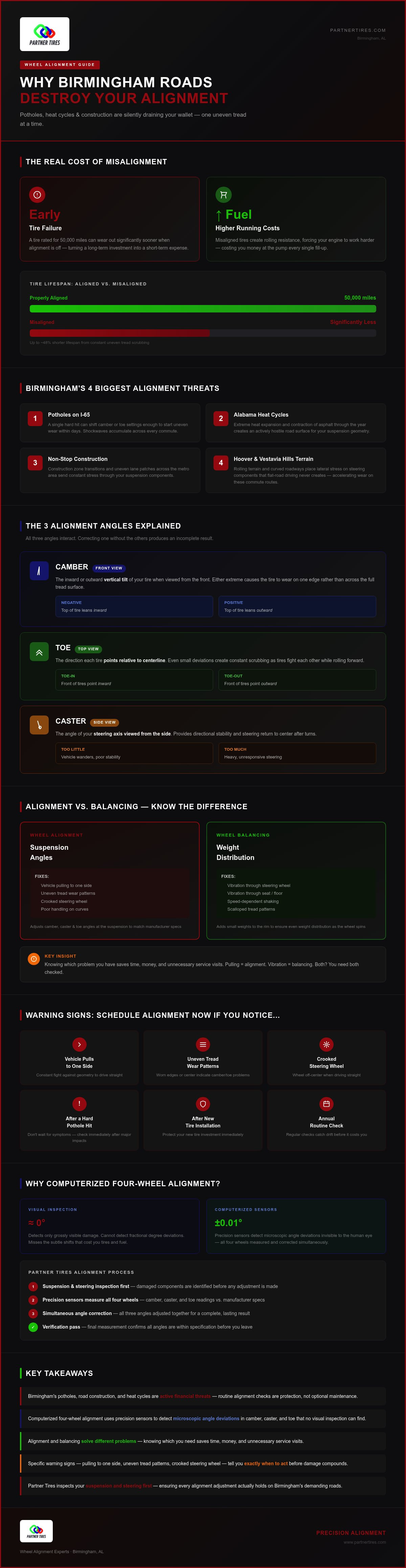
Misalignment costs you money in two direct ways. First, uneven tread wear destroys tires faster than almost any other factor. A tire that should last 50,000 miles can wear out significantly sooner when your alignment is off, turning a long-term investment into a short-term expense.
Second, there's rolling resistance. When your tires aren't pointed where they should be, your engine works harder to push the vehicle forward. That translates directly into reduced fuel economy, a cost you absorb every time you fill up.
If you've invested in quality new or used tires from Partner Tires, proper alignment is what protects that investment. Without it, even the best tires wear unevenly and fail early. Alignment and tires work together. One without the other is money left on the table.
The Science of Precision: How Computerized Four-Wheel Alignment Works
Alignment isn't guesswork. It's geometry. Your vehicle's suspension was engineered to precise angular specifications, and when those angles drift even slightly, the consequences show up in your tires, your fuel costs, and your steering feel. Computerized four-wheel alignment technology makes the invisible visible, detecting deviations that no visual inspection could ever catch.
Camber, Caster, and Toe Explained
Three angles define your alignment. Understanding what each one does helps you recognize why all three need to be correct simultaneously:
- Camber is the inward or outward tilt of your tire when viewed from the front of the vehicle. Negative camber means the top of the tire leans inward; positive camber means it leans outward. Either extreme causes the tire to wear on one edge rather than across the full tread surface.
- Toe describes the direction each tire points relative to the vehicle's centerline. Toes pointing inward is called toe-in; toes pointing outward is toe-out. Even a small deviation creates constant scrubbing as your tires fight each other while rolling forward.
- Caster is the angle of your steering axis viewed from the side. It's what gives your vehicle directional stability and steering return. Too little caster and the vehicle wanders; too much and steering becomes heavy and unresponsive.
All three angles interact. Correcting one without addressing the others produces an incomplete result. That's why a full four-wheel alignment is the only service that accounts for every variable at once.
Why Computerized Accuracy is Non-Negotiable
Computerized alignment systems mount precision sensors to each wheel and feed real-time angle data into diagnostic software. That software cross-references your vehicle's specific year, make, and model against the manufacturer's exact specifications. There's no estimating, no eyeballing, and no human error in the measurement phase.
The difference between front-end-only alignment and a full four-wheel service matters significantly on modern vehicles. Most cars and SUVs have adjustable rear suspension. If the rear angles are off, correcting only the front axle simply masks the underlying problem. Your vehicle will still track incorrectly, and your tires will still wear unevenly.
One detail drivers often overlook: a properly completed alignment always leaves your steering wheel perfectly centered. If you walk away from a service and your wheel sits slightly off-center at straight-ahead driving, the job wasn't finished correctly.
At Partner Tires, computerized four-wheel alignment is the standard, not an upgrade. Every adjustment is matched to your vehicle's factory specs, protecting the tires you've invested in and ensuring your ride performs the way it was designed to. For drivers dealing with Birmingham's demanding road conditions, that level of precision is exactly what wheel alignment in Birmingham, AL should deliver. Learn more about Partner Tires' alignment services and what a precision adjustment can do for your vehicle's long-term health.
Alignment vs. Balancing: Knowing the Difference for Better Vehicle Health
Two services. Two completely different problems. Confusing them costs you time and money. Alignment and balancing are both essential to tire health, but they address separate mechanical issues, and treating one when you need the other won't fix what's wrong with your vehicle.
Here's the clearest way to separate them:
- Alignment adjusts the angles at which your tires contact the road. It's a suspension geometry correction, not a tire correction.
- Balancing corrects uneven weight distribution around the wheel and tire assembly. It's about rotation, not angles.
The symptoms each service addresses are distinct. If your vehicle pulls to one side or your steering wheel sits off-center while driving straight, that's an alignment issue. Your suspension angles are out of spec, and the vehicle is fighting its own geometry. If you feel a vibration in the steering wheel that intensifies at highway speeds, that's a balance issue. One section of the wheel is heavier than the rest, creating a rhythmic wobble as it spins.
Misreading those symptoms leads drivers to pay for the wrong service. Knowing the difference is how you make a smarter decision before you ever pull into a shop.
What is Computerized Wheel Balancing?
Balancing works by mounting your wheel and tire assembly on a specialized machine that spins it and measures where weight is unevenly distributed. Small counterweights are then attached to the rim at precise points to achieve even rotation. That correction eliminates the vibration and reduces the stress placed on your wheel bearings, suspension components, and steering linkage over time. Without it, that repetitive imbalance gradually wears down parts that are far more expensive to replace than a balancing service. Read more about computerized wheel balancing and how it fits into a complete tire maintenance plan.
When to Get Both Services Done
Installing new tires is the standard trigger for getting both services completed together. New tires bring fresh tread depth and different weight characteristics than the worn tires they replace. Balancing ensures they rotate smoothly. Alignment ensures they wear evenly. Skipping either one undermines the investment you just made.
The same logic applies to used tires in Birmingham, AL. Quality used tires can deliver real value, but only if they're set up correctly from the start. Pairing them with both balancing and alignment gives them the best possible chance of reaching their full remaining tread life.
Partner Tires routinely recommends both services together because they solve different problems that often exist simultaneously, especially after Birmingham's roads have had their way with your suspension. For drivers looking for complete wheel alignment in Birmingham, AL, combining it with balancing isn't upselling. It's just good math.
Warning Signs: When to Schedule a Wheel Alignment in Birmingham
Your vehicle communicates alignment problems clearly. The challenge is knowing how to read the signals before they become expensive repairs. Birmingham drivers who commute through Trussville, Bessemer, or anywhere along I-459 face these symptoms regularly, often dismissing them as minor quirks rather than recognizing them as the financial warnings they actually are.
Watch for these specific indicators:
- Pulling or drifting to one side while holding the wheel straight on a level road
- Uneven tread wear across the tire shoulder, with one edge wearing faster than the other
- A steering wheel that sits tilted even when you're driving in a straight line
- Squealing tires during turns or light acceleration on Birmingham streets, which signals tires scrubbing sideways instead of rolling cleanly
- A sudden change in handling after hitting a pothole hard in Trussville or dropping into a construction zone gap in Bessemer
That last one matters. A single hard impact can shift your suspension angles enough to start causing problems immediately. Don't wait for symptoms to compound. Schedule wheel alignment in Birmingham, AL promptly after any significant road impact.
The 'Pull Test' and Steering Feel
On a flat, straight, low-traffic road, relax your grip slightly and observe whether your vehicle drifts left or right without steering input. That's your pull test. A properly aligned vehicle tracks straight with minimal correction needed. A heavy or loose steering feel tells a different story: heavy steering often points to caster issues, while a vague, wandering feel suggests the front angles aren't holding the vehicle on its intended path. Ignoring even a slight pull forces your tires into constant lateral scrubbing, accelerating wear on the edges and adding stress to your steering linkage with every mile.
Reading Your Tire Tread Like a Pro
Tread wear patterns are diagnostic tools. Wear concentrated on one shoulder indicates a camber problem; the tire is tilting and loading unevenly. A feathered or saw-tooth pattern across the tread surface, where one edge of each tread block wears sharper than the other, signals a toe problem. Regular tire rotation is one of the most practical ways to catch these patterns early, because rotating tires moves them to different positions where wear differences become visible before they become irreversible.
For checking tread depth at home, the penny test remains a reliable baseline: insert a penny into the tread groove with Lincoln's head facing down. If you can see the top of his head, you're below safe tread depth. A quarter gives you an earlier warning at roughly 4/32 of an inch remaining, which is the smarter threshold for Birmingham's rain-prone driving conditions.
Catching these signs early is what separates a routine alignment adjustment from a full suspension repair bill. Schedule your alignment check with Partner Tires before uneven wear costs you a set of tires you weren't ready to replace.
Professional Alignment Services at Partner Tires: Reliable Local Expertise
Partner Tires isn't a national chain running cookie-cutter service protocols. It's a locally owned Birmingham operation built around one straightforward goal: keeping your vehicle performing the way it should on the roads you actually drive every day. That focus shapes everything about how alignment work gets done here.
The process starts before any adjustment is made. Partner Tires technicians inspect your suspension and steering components first. That step matters more than most drivers realize. Adjusting alignment angles on worn ball joints, damaged tie rod ends, or compromised control arm bushings produces results that won't hold. The geometry drifts back out of spec quickly because the components meant to maintain it can't do their job. Identifying those issues upfront means the alignment you leave with is one that actually lasts.
Transparency is built into the service. You see the before-and-after alignment specs on a printed report, not just a verbal summary. Those numbers show exactly where your vehicle's angles were sitting when it came in and where they sit after the adjustment. That's accountability you can take home with you.
For drivers who need even more flexibility, Partner Tires integrates alignment with its mobile tire services. New tires installed at your home or workplace can be paired with a shop alignment appointment to complete the setup correctly. Both services working together is what protects your tire investment from day one.
Why Birmingham Drivers Trust Partner Tires
Local knowledge isn't a marketing phrase here. It's operational. Partner Tires understands the specific toll that Birmingham's road network takes on suspension geometry, from the construction corridor transitions on I-65 to the rolling terrain through Hoover and Vestavia Hills. That context informs every recommendation made. No upselling without explanation. No services pushed that don't solve a real problem on your specific vehicle.
National chains offer standardized processes. Partner Tires offers regional expertise backed by computerized precision. That combination is what fills the gap between generic service and alignment that actually holds up against Birmingham's roads.
Ready for a Smoother Ride?
Booking is straightforward. Contact Partner Tires to schedule your four-wheel alignment, and expect a thorough suspension inspection, a computerized adjustment matched to your vehicle's factory specs, and a clear before-and-after report when the work is complete. Whether you're protecting a new set of tires or addressing a pull you've been ignoring for too long, this is how wheel alignment in Birmingham, AL should work.
Schedule your wheel alignment with Partner Tires now and put precision back under every mile you drive.
Put Precision Back Under Every Mile You Drive
Birmingham's roads don't give your suspension a break. Potholes, heat cycles, and constant construction zone transitions work against your alignment every single day. The cost shows up in your tires, your fuel bill, and eventually your suspension components if the problem goes unaddressed long enough.
Three things protect you from that cycle: knowing when your vehicle is showing alignment symptoms, understanding the difference between alignment and balancing so you get the right service, and working with a locally owned shop that uses computerized technology to deliver adjustments that actually hold.
That's exactly what Partner Tires brings to every appointment. Computerized four-wheel alignment matched to your factory specs. A suspension inspection before any adjustment is made. Local Birmingham expertise that understands what these roads do to your vehicle. And mobile tire service integration when you need it.
Don't let misalignment quietly drain your tire investment mile by mile. Get your precision wheel alignment at Partner Tires Birmingham and drive with the confidence that your vehicle is set up exactly the way it should be.
Frequently Asked Questions About Wheel Alignment in Birmingham, AL
How much does a wheel alignment cost in Birmingham, AL?
Alignment pricing varies based on vehicle type and whether you need a two-wheel or four-wheel service. Rather than quoting figures that may not reflect current rates, contact Partner Tires directly for accurate pricing on your specific vehicle. What's worth knowing: the cost of a professional alignment is consistently lower than replacing a set of tires prematurely because misalignment went unaddressed.
How long does a professional four-wheel alignment take?
A computerized four-wheel alignment typically takes between 45 minutes and an hour for most passenger vehicles. If the technician identifies worn suspension or steering components during the pre-alignment inspection, additional time may be needed to address those issues first. Skipping that inspection saves time upfront but often means the alignment doesn't hold, which costs you another visit.
Can poor alignment cause my car to shake at high speeds?
Alignment problems don't usually cause high-speed shaking on their own. That symptom points more directly to a wheel balance issue, where uneven weight distribution creates a rhythmic vibration as the tire spins faster. Misalignment causes pulling, drifting, and uneven tread wear rather than vibration. If you're experiencing both symptoms, you likely need both services addressed.
Do I need an alignment every time I buy new tires?
Yes, and it's one of the smartest moves you can make for your tire investment. New tires have fresh tread depth and different wear characteristics than the tires they replace. Installing them on a misaligned vehicle starts the uneven wear process immediately. Pairing new tires with a four-wheel alignment from day one protects the purchase and maximizes how long that tread lasts.
Is a front-end alignment enough for my SUV or truck?
For most modern SUVs and trucks, a front-end-only alignment isn't sufficient. These vehicles typically have adjustable rear suspension, meaning rear angles can drift out of spec just like front angles can. Correcting only the front axle while leaving rear misalignment unaddressed masks the problem rather than solving it. A full four-wheel alignment is the correct service for virtually any current SUV or truck on Birmingham roads.
What happens if I ignore my car's alignment issues?
The damage compounds in layers. Tires wear unevenly and fail earlier than they should. Your engine works harder against rolling resistance, reducing fuel economy with every fill-up. Over time, the stress placed on steering linkage, ball joints, and tie rod ends accelerates wear on components that are far more expensive to replace than a routine alignment service. Ignoring the problem doesn't make it cheaper; it makes it costlier.
Can Partner Tires perform alignments on all vehicle makes and models?
Partner Tires uses computerized alignment technology that cross-references manufacturer specifications for your vehicle's specific year, make, and model. This covers a broad range of domestic and import vehicles, including cars, SUVs, and trucks. Contact Partner Tires with your vehicle details if you have questions about a specific make or model before scheduling your wheel alignment in Birmingham, AL.
How often should I have my wheel alignment checked in Alabama?
A general guideline is to have alignment checked every 12 months or 12,000 miles, whichever comes first. Alabama's road conditions make a strong case for checking more frequently, particularly after any significant pothole impact, after hitting a curb hard, or any time you notice pulling, drifting, or uneven tread wear developing. Catching drift early keeps a routine adjustment from turning into a suspension repair bill.


