

You are cruising through Birmingham city centre when that amber horseshoe symbol suddenly glows on your dashboard. It is rarely just a light. It is an immediate spike in stress. You might wonder if you have a hidden flat or if you are about to waste an hour at a petrol station air pump. Learning how to reset TPMS light indicators is a vital skill for any driver, but the process involves more than just pushing a button. You need to know if your vehicle is truly safe or if a sensor is reaching the end of its five to ten year lifespan.
We understand that dashboard warnings cause genuine anxiety for busy professionals. You want your car to work without unnecessary shop visits or expensive diagnostic fees. This 2026 guide promises to show you exactly how to clear your tire pressure warning light and identify when professional sensor service is required. We will preview the critical differences between a solid and flashing light, explain why a faulty system now triggers a major MOT failure, and help you get back on the road with total confidence.
Key Takeaways
- Distinguish between a solid light for low pressure and a flashing light that signals a system fault and an MOT failure.
- Master 4 proven DIY methods on how to reset TPMS light indicators to clear your dashboard safely.
- Identify the signs of a dying sensor battery, typically lasting five to ten years, to avoid operational downtime.
- Learn when to use mobile TPMS sensor service for efficient repairs at your Birmingham home or workplace.
- Save money by diagnosing persistent warnings before they escalate into roadside emergencies or failed inspections.
Understanding the Tire Pressure Monitoring System (TPMS)
The Tire-pressure monitoring system (TPMS) is an essential electronic safety feature designed to alert you before a tire failure occurs. Since 2007, every passenger vehicle sold in the United States has included this technology as standard equipment. It tracks the internal air pressure or rotational speed of your tires to ensure you aren't driving on dangerously underinflated rubber. When the light activates, it indicates that at least one tire is 25% or more below the recommended manufacturer specifications. Understanding the hardware behind the dash symbol is the first step in learning how to reset TPMS light warnings effectively.
Direct vs. Indirect TPMS: Why It Matters
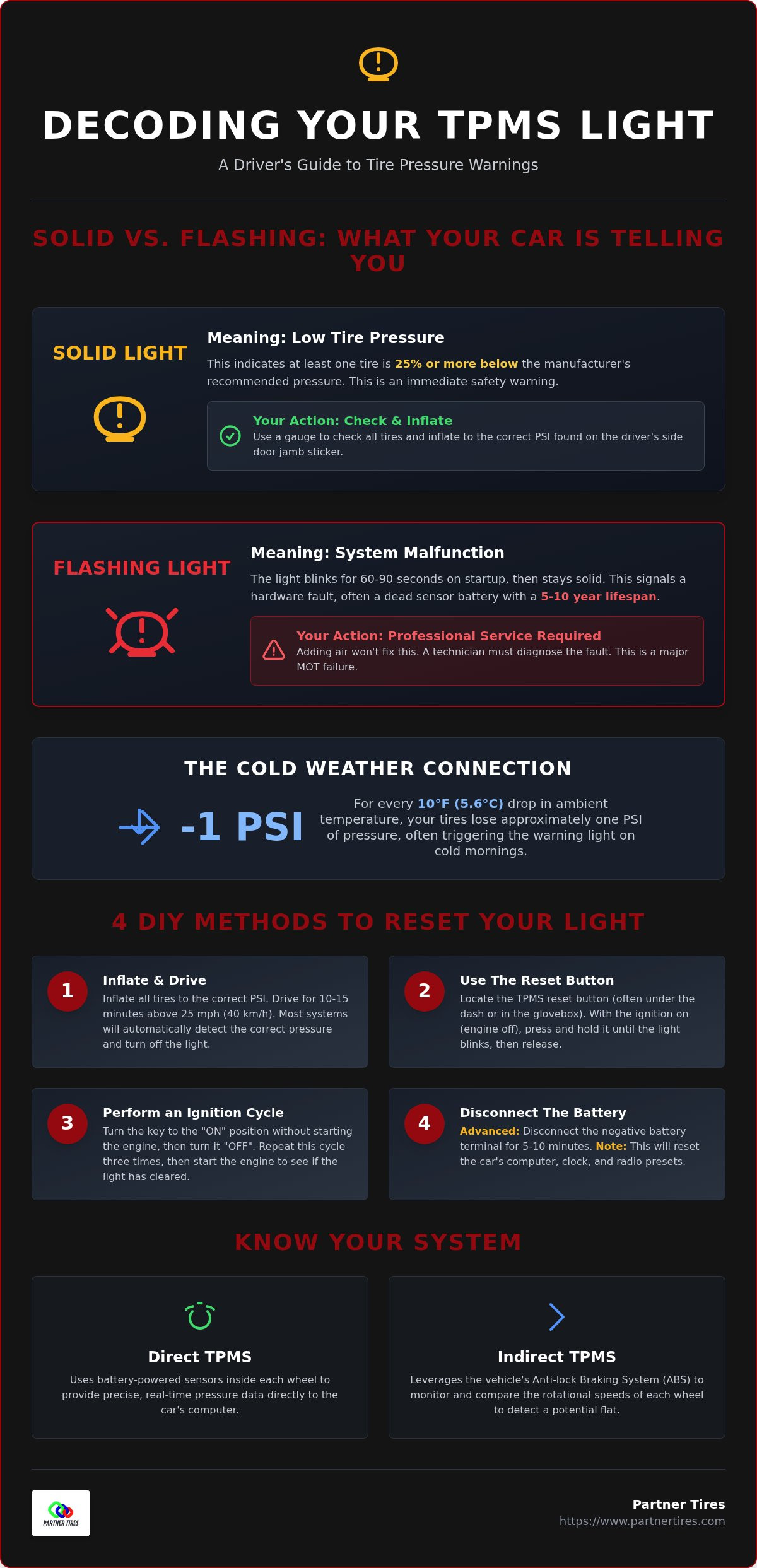
Modern vehicles use two distinct methods to monitor pressure. A direct system employs physical, battery-powered sensors mounted inside each wheel assembly. These sensors transmit real-time pressure data directly to your car's computer. Indirect systems don't measure air pressure. Instead, they utilize the Anti-lock Braking System (ABS) to track how fast each wheel is spinning. An underinflated tire has a smaller diameter and rotates faster than a properly inflated one. You can usually identify your system by checking your owner's manual or looking for a physical reset button on the dash or inside the glovebox. Indirect systems almost always require a manual reset after you add air to synchronize the wheel speed data.
The Alabama Temperature Factor
Birmingham drivers often see the TPMS light during the first cold snap of autumn. This is rarely a coincidence or a sign of a puncture. Physics dictates that for every 10-degree drop in ambient temperature, your tires lose approximately one PSI of pressure. A chilly morning in Hoover or Vestavia can trigger a sensor that was already borderline. These seasonal fluctuations are a primary reason why people search for how to reset TPMS light indicators when their tires appear visually fine. While the light might turn off as the tires warm up during your commute, you should still verify the pressure with a gauge. Consistent monitoring prevents premature wear and keeps your vehicle's handling predictable on local highways. We recommend checking your levels monthly to stay ahead of these atmospheric changes.
Deciphering the TPMS Light: Solid vs. Flashing Indicators
Your dashboard communicates through specific visual patterns. It isn't just a general warning. It's a diagnostic tool. You must understand these signals before attempting to learn how to reset TPMS light displays. A simple button press won't solve every issue. The pattern tells you whether you need a petrol station air pump or a professional technician.
The Solid TPMS Light: Low Pressure Alert
A solid yellow light is a direct pressure warning. It indicates that at least one tire is 25% or more under-inflated. This often occurs during sudden cold snaps in Hoover or Pelham. Your first action is to verify the pressure with a manual gauge. Open your driver-side door and locate the tire information placard on the door jamb. This sticker lists the exact PSI required for your specific vehicle. Never rely on the pressure number printed on the tire sidewall. That number represents the maximum pressure the tire can structurally hold, not what your car needs for safe handling. Once you fill the tires to the correct levels, many modern systems will clear the light automatically after a few miles of driving.
The Flashing TPMS Light: System Malfunction
A flashing light signals a hardware failure. It typically blinks for 60 to 90 seconds when you start the engine, then stays solid. This pattern indicates a system fault rather than a low air condition. Most often, this points to a dead sensor battery. These internal batteries are sealed and generally last five to ten years. If your vehicle was manufactured in the early 2010s, you are likely entering the window for sensor replacement. A flashing light means the TPMS is no longer monitoring your tires. You are essentially driving blind to pressure changes, which increases the risk of a sudden blowout.
You cannot fix a flashing light by adding air. A physical reset button will not clear a genuine hardware fault. This situation requires a professional diagnostic scan to identify which specific sensor has failed. If you are struggling with a persistent warning that won't clear, we provide mobile TPMS sensor service that comes directly to your home or office. We use specialized scanning tools to pinpoint the failure on-site. This ensures your safety system is operational without forcing you to spend hours in a waiting room. Addressing a malfunction early protects your tire investment and ensures your vehicle remains safe on Birmingham highways.
4 Proven Methods to Reset Your TPMS Light at Home
Once you verify your tires meet the manufacturer's PSI specifications, you can proceed with these DIY steps to clear your dashboard. Many drivers assume the light disappears instantly after adding air. This is rarely the case. Most systems require a specific trigger to recognize the new pressure levels. If you are wondering how to reset TPMS light indicators without a trip to the shop, these four methods cover the majority of vehicles on Birmingham roads today.
The Driving Reset Method
The most common way to recalibrate your sensors is through a steady drive. You should maintain a speed of at least 50 MPH for 10 minutes. This allows the computer to re-sync with each sensor's updated data. Be mindful of your route. Heavy stop-and-go traffic on I-65 or I-459 during rush hour can interrupt this process. The system needs consistent wheel rotation to complete its diagnostic loop. If the light remains on after a 15-minute highway trip, your vehicle likely requires a manual trigger from the interior cabin.
Manual Reset Buttons and Menus
Many modern vehicles feature a dedicated reset button or a digital menu option. You can often find a physical button located under the steering wheel or inside the glovebox. To use it, turn the ignition to the "on" position without starting the engine. Press and hold the button until the TPMS light blinks three times, then start the car and let it run for five minutes. On newer models, you may need to navigate through the infotainment screen. Look under "Vehicle Settings" or "Maintenance" to find the tire pressure calibration option. Older vehicles might require a specific ignition key sequence, such as turning the key from "off" to "on" several times in rapid succession.
The Battery Disconnect Technique (Last Resort)
If software menus and driving fail, you can force a hard reset of the Engine Control Unit (ECU). This should be your final DIY attempt. Open the hood and use a wrench to disconnect the positive (red) battery cable. With the car completely powered down, press the horn for 30 seconds to discharge any remaining electricity in the capacitors. Wait at least 15 minutes before reconnecting the cable. While this often clears stubborn codes, it will also reset your clock, radio presets, and seat memory. Use this method only if you are comfortable with basic vehicle maintenance and have exhausted other options for how to reset TPMS light warnings. If the light returns immediately after this step, a hardware fault is likely present.
Troubleshooting a Persistent TPMS Warning
Sometimes you follow every step for how to reset TPMS light indicators, only for the amber symbol to return after a few miles. This cycle signals that your vehicle's ECU is detecting a recurring fault. It is no longer a simple calibration issue. You are likely dealing with a mechanical leak or an electrical hardware failure. Birmingham's demanding road conditions, characterized by deep potholes and uneven surfaces, often accelerate the wear on these sensitive internal components. If you have recently fitted used tires, the sensors inside may be reaching the end of their operational life or could be incompatible with your car's specific frequency.
Detecting Sensor Failure
Hardware does not last forever. TPMS sensor batteries are sealed units with a typical lifespan of five to ten years. Once the battery voltage drops, the sensor becomes intermittent or dies completely. Physical damage is another common culprit. A sharp impact from a Birmingham pothole can crack the sensor housing or dislodge the transmitter. You cannot fix these issues through a dashboard menu. Professional diagnostic scans are required to pinpoint the failure. We use specialized handheld readers to ping each wheel individually. This identifies the specific dead sensor without the need to dismount every tire, saving you time and preventing unnecessary replacement costs.
The Hidden Danger of Slow Leaks
An intermittent light often points to a slow puncture. A small nail or screw embedded in the tread might cause a pressure drop of only a few PSI per week. This is enough to trigger the sensor but subtle enough to miss during a visual inspection. Professional tire repair in Birmingham is the only reliable solution for maintaining tire integrity. We also inspect the valve stems for signs of corrosion or rubber fatigue. Road salt and grime can degrade the valve seals, leading to gradual air loss. If your light returns every few days, stop resetting it and address the underlying leak to avoid a high-speed blowout on the motorway.
Persistent warnings compromise your safety and your vehicle's fuel efficiency. If DIY resets have failed, our mobile technicians can resolve the issue at your home or workplace. Book an expert TPMS sensor service today to ensure your monitoring system is providing accurate, reliable data for every journey.
Professional TPMS Sensor Service in Birmingham
DIY methods for how to reset TPMS light warnings provide a temporary fix for simple pressure drops. They cannot repair physical sensor failures or dead internal batteries. When these manual steps fail, you need specialized diagnostic equipment to restore your safety system. Partner Tires operates as the hardworking backbone of your vehicle's maintenance. We eliminate the frustration of repeated shop visits by bringing professional tire expertise directly to your location. Our mission is to keep your operation moving without the traditional delays of a brick and mortar garage.
Mobile TPMS Repair at Your Home or Work
Traditional tire shops often force you into crowded waiting rooms for hours. We respect your schedule and your financial health. Our technicians serve as a mobile engine for your vehicle's safety, arriving at your home or office in Birmingham, Pelham, or Trussville. We carry advanced diagnostic scanners that communicate directly with your car's ECU. These tools identify the exact sensor frequency and battery status of each wheel assembly. We handle the tire dismounting, sensor installation, and system programming on-site. This direct approach ensures your vehicle is back in service immediately, allowing you to focus on your business or family needs.
Comprehensive Tire Care and Safety
Sensor replacement involves more than just swapping hardware. Every time we break the bead of a tire to install a new sensor, we perform computerized wheel balancing. This precision ensures your tires rotate without vibration, which protects your suspension and improves fuel efficiency. Whether you are maintaining your current set or have recently purchased used tires, our team ensures the monitoring system is perfectly calibrated for your specific model. Our regional expertise allows us to anticipate common issues caused by local road conditions and seasonal temperature shifts.
We also recommend a professional wheel alignment to prevent the uneven wear that can stress your TPMS hardware over time. We serve Hoover, Vestavia, and the greater Birmingham area with grit and an unwavering focus on service. Before we leave, we perform a final safety check and system calibration. This confirms that every sensor is communicating accurately with your dashboard display. You gain the quiet confidence of knowing your safety systems are fully operational without ever leaving your driveway. Our collaborative approach ensures your vehicle remains a reliable asset for your daily commute or commercial operations.
Restore Your Vehicle's Safety Systems Today
Mastering your dashboard alerts keeps your vehicle safe and your maintenance costs low. You now understand the critical difference between a simple low-pressure warning and a flashing system malfunction. While learning how to reset TPMS light indicators helps with minor pressure adjustments, it cannot bypass the reality of a dead sensor battery or physical damage. Driving with a faulty system risks your safety and ensures a major MOT failure under current regulations. These electronic components are essential for your vehicle's operational health.
You don't have to waste your day in a waiting room to fix persistent sensor issues. Partner Tires brings expert diagnostics and professional repair directly to your location. We provide mobile TPMS sensor service in Birmingham at your home or workplace. Our technicians serve the entire region, including Hoover, Vestavia, and Pelham. We handle the technical work so you can stay focused on your schedule. Take charge of your vehicle's health today and drive with total confidence on every Birmingham journey.
Frequently Asked Questions
Why does my TPMS light stay on after I put air in my tires?
Most vehicle systems require a specific recalibration period or a manual reset before the dashboard clears. If you have added air to the correct PSI, you typically need to drive at speeds over 20 MPH for several miles to allow the computer to register the new data. Understanding how to reset TPMS light warnings often involves this simple driving sequence. If the light persists, you may have a hardware malfunction or a second tire with low pressure.
Can I drive with the TPMS light on?
You can technically drive, but you shouldn't ignore the warning. A solid light indicates a tire is significantly under-inflated, which compromises your braking distance and fuel economy. Driving on low pressure also causes internal tire damage and increases blowout risks. If the light is flashing, your safety system is not monitoring your tires at all. You should verify your pressure immediately and seek professional diagnostics to ensure your vehicle is safe for Birmingham highways.
How much does it cost to replace a TPMS sensor in Birmingham?
Costs for sensor replacement vary based on your vehicle's make, model, and the type of sensor required. Standard aftermarket sensors are generally more affordable than original equipment manufacturer parts from a dealership. Since prices fluctuate based on part availability and programming requirements, we recommend contacting a local service provider for a specific quote. We offer mobile sensor replacement at your home or work in areas like Hoover and Vestavia to save you time and dealership fees.
Does the TPMS light come on for the spare tire?
It depends on your vehicle's equipment. Many full-size spare tires include a TPMS sensor that the car monitors. If your spare is low, it can trigger a dashboard light even if your four main tires are perfectly inflated. However, compact "donut" spares rarely have sensors. If you are using a temporary spare after a flat, the light will likely stay on because the computer cannot find the signal from the original wheel you removed.
Will a low battery in my car cause the TPMS light to come on?
A failing car battery can trigger various dashboard warnings, including the tire pressure light. Electronic control units require stable voltage to process sensor data correctly. If your battery is weak, it may cause communication errors between the TPMS receiver and the wheel sensors. If you notice your car is slow to start alongside a persistent light, have your vehicle's charging system and battery health tested by a professional technician in Bessemer or Trussville.
How do I know which tire is low if the light doesn’t specify?
You must use a manual tire pressure gauge to check each wheel individually. Start with the driver-side front tire and work your way around the vehicle. Don't forget to check the spare if it is accessible. Even if a tire looks full, it could be 25% under-inflated, which is enough to trigger the sensor. Comparing your manual readings to the PSI listed on your door jamb is the most reliable way to find the culprit.
Can cold weather in Alabama trigger a false TPMS warning?
Cold snaps in Birmingham frequently trigger warnings that aren't caused by leaks. As temperatures drop, the air inside your tires becomes denser and takes up less volume, leading to a pressure decrease. This is a real drop in pressure, not a false electronic error. While the light might disappear once the tires warm up from driving, you should still add air to meet the manufacturer's recommended cold pressure specifications to ensure optimal safety and tire longevity.
Is there a reset button for TPMS on all cars?
No, the method for how to reset TPMS light indicators varies significantly between manufacturers. Some vehicles feature a physical button under the dash or a reset option within the touchscreen menu. Others use an automatic relearn system that requires you to drive for a set distance at highway speeds. You should consult your owner's manual to determine if your specific car requires a manual trigger or if it recalibrates itself during motion on local roads.


