

The average cost to build a tire rose 22.4% in the second quarter of 2026, making every millimeter of tread on your vehicle a critical financial asset. Most drivers understand that maintenance is necessary, yet many remain uncertain about exactly how often to rotate tires to protect that investment. It's frustrating to face early replacement costs simply because a schedule was confusing or inconvenient. You shouldn't have to sacrifice your Saturday in a dingy waiting room just to keep your car safe.
We understand these challenges and provide a clear, no-nonsense roadmap for your vehicle's health. This guide delivers the precise mileage intervals and warning signs you need to maximize tread life and ensure peak performance on the road. You'll gain a firm grasp of the 5,000 to 7,500 mile rule and discover how your specific drivetrain dictates wear patterns. We also explore how modern mobile services allow you to handle this essential task at home or work without slowing down your operations. It's time to take control of your maintenance costs with Birmingham's local expertise and reliable service.
Key Takeaways
- Master the industry standard 5,000 to 8,000-mile interval and learn why your owner’s manual is the final authority on how often to rotate tires.
- Protect your financial investment by preventing uneven wear, which extends tread life and maximizes your vehicle's fuel efficiency.
- Identify how specific drivetrain configurations, such as Front-Wheel Drive and Rear-Wheel Drive, create unique stress points on your tire tread.
- Recognize immediate warning signs like highway-speed vibrations or visible tread cupping to avoid hazardous driving conditions and early replacement costs.
- Leverage the convenience of mobile tire maintenance in Birmingham to secure professional rotation and computerized balancing at your home or workplace.
The Industry Standard: Finding Your Ideal Rotation Interval
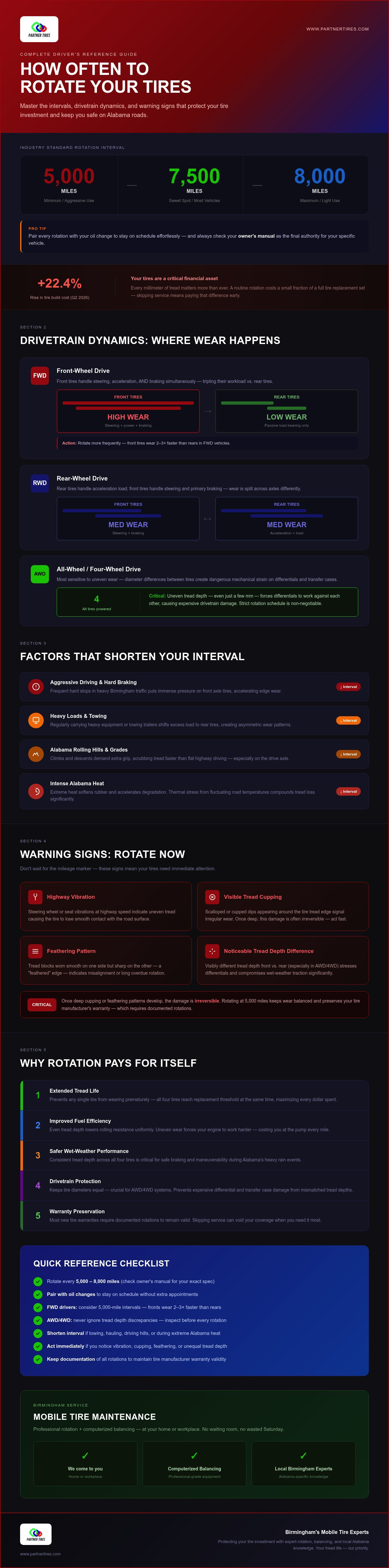
Professional technicians generally recommend a rotation interval between 5,000 and 8,000 miles. This range serves as a reliable baseline for most passenger vehicles on the road today. Most drivers find it efficient to pair this service with their regularly scheduled oil changes. This strategy ensures your vehicle is on a lift or being inspected at consistent intervals, preventing maintenance gaps that lead to premature wear. It's a simple way to keep your maintenance organized and your vehicle safe.
Your vehicle's owner's manual is the ultimate authority for your specific make and model. Manufacturers design these schedules based on the weight distribution and suspension geometry of the car. Ignoring these guidelines can lead to uneven tread depth, which compromises your safety in wet conditions. Understanding how often to rotate tires starts with these manufacturer specs, but local conditions in Birmingham often require a more proactive approach.
To better understand this concept, watch this helpful video:
Birmingham's environment demands a specific maintenance strategy. Intense Alabama heat accelerates the degradation of tire rubber, causing it to soften and wear at an increased rate. This thermal stress, combined with fluctuating road temperatures, can lead to rapid tread loss if tires remain in one position too long. We view proactive rotation as a collaborative effort to maintain your vehicle's operational efficiency and financial health. Partner Tires works behind the scenes to ensure your rubber lasts as long as possible.
Factors That Shorten Your Rotation Window
Several variables can force you to rotate your tires more frequently than the standard 5,000-mile mark. Aggressive driving in heavy Birmingham traffic involves frequent, hard braking that puts immense pressure on the front axle. Carrying heavy equipment or towing trailers regularly increases the load on the rear tires, causing them to wear differently than the front. The rolling hills of the Alabama landscape also demand more grip. This can scrub tread away during climbs and descents. If your daily commute involves these conditions, a more frequent service schedule is a smart investment.
Why the 5,000-Mile Mark Matters
Tire Rotation is the systematic repositioning of tires to ensure even tread wear across all four positions on the vehicle. This practice is vital because it prevents tires from reaching a point of no return. Once uneven wear patterns like cupping or feathering become deep, the damage is often irreversible. Rotating at the 5,000-mile mark keeps the wear balanced and ensures you stay within the limits of your tire manufacturer's warranty. Most new tire warranties require documented rotations to remain valid. This protects you from the high cost of early replacements.
Why Regular Rotation is Non-Negotiable for Tire Life
Neglecting your maintenance schedule leads to uneven tread wear. This isn't just a cosmetic issue. It directly impacts your vehicle's performance and your budget. When tread wears unevenly, rolling resistance increases across the axles. This forces your engine to work harder and consume more fuel. By following professional advice on how often to rotate tires, you ensure that traction remains consistent across all four corners. This balance is critical for safety during sudden maneuvers or heavy braking on Alabama roads.
Consistent rotation protects complex drivetrain components from unnecessary stress. All-wheel drive and four-wheel drive systems are particularly sensitive to tire diameter differences. If one tire wears significantly faster than the others, it creates mechanical strain on differentials and transfer cases. We view tire maintenance as a proactive strategy to avoid these high-cost repairs. Partner Tires works as your hardworking ally to keep your vehicle's mechanical foundation stable and reliable.
The Financial Impact of Neglect
The logic of maintenance is rooted in financial health. A routine rotation service costs a small fraction of a full set of new tires. When you skip these intervals, you face premature replacement costs that could have been deferred for thousands of miles. Keeping your tread even allows you to replace all four tires at once. This strategy lets you take advantage of manufacturer rebates and volume discounts that aren't available when buying tires piecemeal. Regular service also reduces the frequency of emergency tire repair Birmingham visits caused by thinning tread or heat-related failures. We focus on these outcomes to ensure your operational costs stay low.
Performance and Handling Benefits
Maintaining a quiet ride is a primary benefit of regular tire service. Uneven tread creates road noise and vibrations that resonate through the steering wheel and floorboards. This is especially noticeable at highway speeds. Balanced tread ensures that your braking performance remains predictable in wet or slippery conditions. Consistent tread depth prevents hydroplaning by clearing water effectively from under the rubber. Understanding the correct Tire rotation patterns for different drivetrains is essential for achieving this balance. Rotation also complements expert wheel alignment to provide total vehicle stability. You can schedule a professional inspection to ensure your vehicle handles with the precision you expect.
Drivetrain Dynamics: How Your Car’s Power Affects Wear
Your vehicle's drivetrain dictates exactly where tread loss occurs first. Front-Wheel Drive (FWD) vehicles place a massive burden on the front axle. These tires handle steering, the majority of braking force, and the engine's power simultaneously. Consequently, they wear much faster than the rear set. Rear-Wheel Drive (RWD) vehicles distribute these forces differently. The rear tires manage acceleration stress while the front set handles directional changes. Understanding these mechanical realities helps determine how often to rotate tires to ensure longevity.
All-Wheel Drive (AWD) vehicles require a higher level of precision. These systems rely on uniform tire diameters to protect the center differential. Staggered fitments, where rear tires are wider than front tires, and directional tires with one-way tread patterns also limit your rotation options. In these cases, you might only move tires from side to side or front to back on the same side. Following Bridgestone's tire rotation guidelines ensures you apply the correct pattern for your specific setup. Partner Tires technicians assess these variables during every mobile service call to keep your vehicle performing at its peak.
Standard Rotation Patterns Explained
Technicians use specific patterns to counteract drivetrain-specific wear. For FWD vehicles, the Forward Cross pattern is standard. This moves front tires straight back and crosses the rear tires to the front. RWD and 4WD vehicles typically use the Rearward Cross pattern. This moves rear tires straight forward and crosses the front tires to the rear. The X-Pattern serves as a versatile alternative for many modern passenger cars. It involves crossing all four tires to their opposite corners to achieve maximum wear distribution. This systematic approach ensures that every tire spends time on both the drive axle and the steering axle.
The AWD Exception
Precision is paramount for AWD owners. Even a small 2/32-inch difference in tread depth can cause the system's computers to detect a loss of traction. This leads to constant, unnecessary engagement of the center differential. Such mechanical strain can result in catastrophic drivetrain failure over time. AWD systems require balanced traction to prevent mechanical strain. We recommend rotating AWD vehicles every 5,000 miles without fail. This strict adherence protects your vehicle's complex gears and ensures your financial investment remains sound. Regular inspection is the best way to catch these minor variations before they become major liabilities.
Beyond the Odometer: Warning Signs You Need an Immediate Rotation
Mileage is a baseline, not a rigid guarantee. Physical symptoms often appear before you hit the 5,000-mile mark, especially in the challenging Alabama climate. Birmingham's intense heat and hilly terrain accelerate rubber degradation and mechanical stress. If you notice these signs, the question of how often to rotate tires becomes an urgent safety matter. Immediate action prevents permanent tread damage and protects your vehicle's financial value. We prioritize your operational efficiency by identifying these red flags early.
Consistent loss of tire pressure is a subtle warning sign. While often linked to punctures, it can also stem from uneven wear causing poor rim seating or valve stem stress. Noticeable differences in tread depth between the front and rear axles indicate the drive tires are handling too much stress. This imbalance compromises your braking distance and wet-weather traction. We act as the backbone of your vehicle maintenance, catching these issues before they lead to a roadside emergency.
The Visual Inspection Guide
Identify 'cupping' on the tread surface by looking for scalloped dips or high and low spots. These patterns feel like a series of waves when you run your hand over the rubber. This usually points to suspension issues or a long-overdue rotation. The 'Penny Test' remains a reliable tool for quick comparisons. Insert a penny into the tread grooves with Lincoln's head facing down. If you can see the top of his head, your tread is dangerously thin. Compare results across all four tires to spot uneven wear. Check for sidewall damage like cracks or bulges simultaneously. Alabama's summer sun degrades rubber quickly, making these visual checks vital for your safety.
Sensory Cues While Driving
Your vehicle communicates through sound and vibration. Increased road noise that grows louder with speed often indicates uneven tread patterns or 'feathering' on the tire edges. A persistent 'pulling' sensation to one side mimics an alignment problem but can actually be caused by uneven tire diameters. Feeling vibrations in the steering wheel or floorboard at highway speeds is a clear distress signal. Professional computerized wheel balancing during a rotation solves these vibration issues. It ensures each tire rotates smoothly without mechanical wobbling. This precision is the engine that drives your vehicle's stability and comfort. Don't wait for your tires to fail on the road. You can book a mobile tire inspection and rotation to secure your vehicle's safety today.
Maximizing Convenience: Mobile Tire Maintenance in Birmingham
Traditional tire shops consume your most valuable resource: time. Birmingham residents often delay maintenance because they can't afford to lose a Saturday in a waiting room. This uncertainty about how often to rotate tires leads to skipped appointments and higher long-term costs. Partner Tires eliminates these logistical hurdles by bringing the shop directly to your location. We specialize in at home tire installation and mobile maintenance that fits your schedule.
Our mobile units operate throughout the Birmingham metro area with speed and precision. We serve clients in Hoover, Vestavia, Trussville, and Pelham every day. Whether you are at the office or your residence, we ensure your vehicle's mechanical foundation remains secure. This logistical strength allows you to focus on your core operations while we manage the technical details behind the scenes. We function as the backbone of your vehicle maintenance strategy, ensuring your tires are ready for the road without the typical shop inconvenience.
What to Expect from a Mobile Rotation
Technical accuracy defines our mobile rotation process. A professional service begins with a full inspection of tire pressure and tread depth across all four corners. We also test your TPMS sensors to ensure your vehicle's safety systems are reporting accurately. Reliability is our primary promise to the Birmingham community. Every mobile rotation we perform includes computerized wheel balancing. This step is critical for eliminating the highway-speed vibrations that indicate uneven wear. Our technicians provide expert advice on your tread's health. We provide a clear assessment of whether a rotation is sufficient or if your vehicle requires a full replacement. This transparency protects your financial health and prevents unexpected downtime.
Scheduling Your Service
Booking a mobile service is a fast and efficient process. You can schedule a technician to visit your home or office in Birmingham to fit your specific workday. We operate as a hardworking, locally owned ally with a focus on grit and regional expertise. We don't just swap tires; we manage your vehicle's safety lifecycle to ensure maximum tread life. This collaborative effort ensures the right product and service arrive at the right time. Our focus remains on your success and safety on the road. Ready for a smoother ride? Schedule your mobile tire rotation with Partner Tires today!
Secure Your Vehicle's Future on the Road
Managing your vehicle's maintenance is a strategic investment in your financial health. You now understand that how often to rotate tires depends on a combination of manufacturer guidelines, drivetrain dynamics, and the intense Alabama heat. By adhering to the 5,000 to 8,000-mile standard and watching for early warning signs like vibrations or uneven wear, you prevent irreversible tread damage. These proactive steps ensure your tires reach their full mileage potential while keeping your driving experience safe and stable.
Partner Tires serves as the backbone of your maintenance strategy. We eliminate the inconvenience of traditional shops by bringing professional computerized wheel balancing directly to your home or office. Our mobile units operate across Birmingham, Hoover, and the surrounding metro areas to ensure your operations never skip a beat. We handle the technical details so you can focus on your day with total confidence. Book Your Mobile Tire Rotation in Birmingham Now and experience the reliability of a partner committed to your success. Your vehicle is in capable hands.
Frequently Asked Questions
How often should I rotate my tires if I drive an AWD vehicle?
AWD vehicles require rotation every 5,000 miles to protect the center differential. Uniform tread depth is critical because even minor variations cause mechanical strain on the drivetrain. This frequency prevents costly repairs and ensures traction remains balanced across all four wheels. In Birmingham, the combination of hilly roads and summer heat makes this 5,000-mile interval a non-negotiable part of your maintenance strategy. Consistency is the key to operational reliability.
Can I rotate my tires myself at home?
You can rotate tires at home if you have the proper equipment like a heavy-duty jack, jack stands, and a torque wrench. However, DIY rotation lacks the computerized wheel balancing that professional mobile services provide. Without balancing, you might experience vibrations at highway speeds. Most drivers in the Birmingham metro area prefer the efficiency of a mobile technician who handles the labor while ensuring the technical accuracy of the swap.
What happens if I never rotate my tires?
Skipping rotations leads to severe, uneven tread wear and premature tire failure. Front tires on FWD vehicles will bald quickly while rear tires remain thick, creating a dangerous traction imbalance. This neglect increases your total cost of ownership by forcing early replacement of the entire set. It also negatively impacts fuel efficiency. Consistent rotation is the best way to protect your investment and maintain vehicle safety on Alabama highways.
Is tire balancing the same thing as tire rotation?
No, tire rotation and balancing are distinct services that complement each other. Rotation is the systematic movement of tires to different positions on the vehicle. Balancing uses a specialized computer to identify and correct weight imbalances in the wheel assembly. We include computerized balancing in our mobile service because it ensures a smooth ride. Knowing how often to rotate tires is only half the battle; proper balancing completes the job.
Do I need to rotate my tires if they are brand new?
You don't need an immediate rotation for brand-new tires, but you must start the schedule at the 5,000-mile mark. Wear begins the moment rubber touches the pavement. Establishing a routine early prevents uneven patterns from forming in the first place. This is especially important for Birmingham drivers who frequently navigate stop-and-go traffic or hilly terrain. Proactive maintenance from day one secures your manufacturer's warranty and maximizes tread life.
How long does a professional tire rotation usually take?
A professional mobile tire rotation and balancing service typically takes 30 to 45 minutes to complete. This efficiency allows you to get essential maintenance done while you work at your office in Hoover or relax at home in Vestavia. Because our technicians bring the shop to you, there is no downtime spent traveling to a facility. We prioritize speed and precision to respect your busy operational schedule and keep you moving.
Should I rotate my full-size spare tire into the mix?
Yes, if you have a matching full-size spare, you should include it in a five-tire rotation pattern. This ensures all five tires wear at the same rate, providing you with a reliable backup that matches the traction of the others. Don't use a temporary donut spare for this purpose. Including the spare in your plan for how often to rotate tires extends the life of the entire set by 20 percent.
Will tire rotation fix a car that is pulling to one side?
Tire rotation can solve a pull if the issue is caused by uneven tire diameters or conicity in the tread. However, if the car continues to drift after the swap, you likely need a four-wheel alignment. We assess these symptoms during our on-site visits in Birmingham. While rotation manages wear, alignment ensures the wheels are pointed in the correct direction. Both are necessary for total vehicle stability and safety.


