

Your spare tire is a countdown clock for your vehicle's safety, not a permanent replacement. Many drivers treat that compact "donut" as a long-term fix, but ignoring its limits puts your transmission and your safety at risk. You need to know exactly how long can you drive on a spare tire before a simple flat turns into a total mechanical failure. It's stressful to manage a blowout, especially when you're worried about the inconvenience of a traditional tire shop.
We understand that your schedule doesn't stop for car trouble. This guide delivers the definitive answer on spare tire limits and explains how to transition back to a permanent solution safely. You'll learn the critical 50/50 rule for speed and distance, the differences between spare types, and the mechanical risks of driving too far. We also provide a streamlined path to get a new tire installed at your home or office, ensuring your business stays in motion without the wait.
Key Takeaways
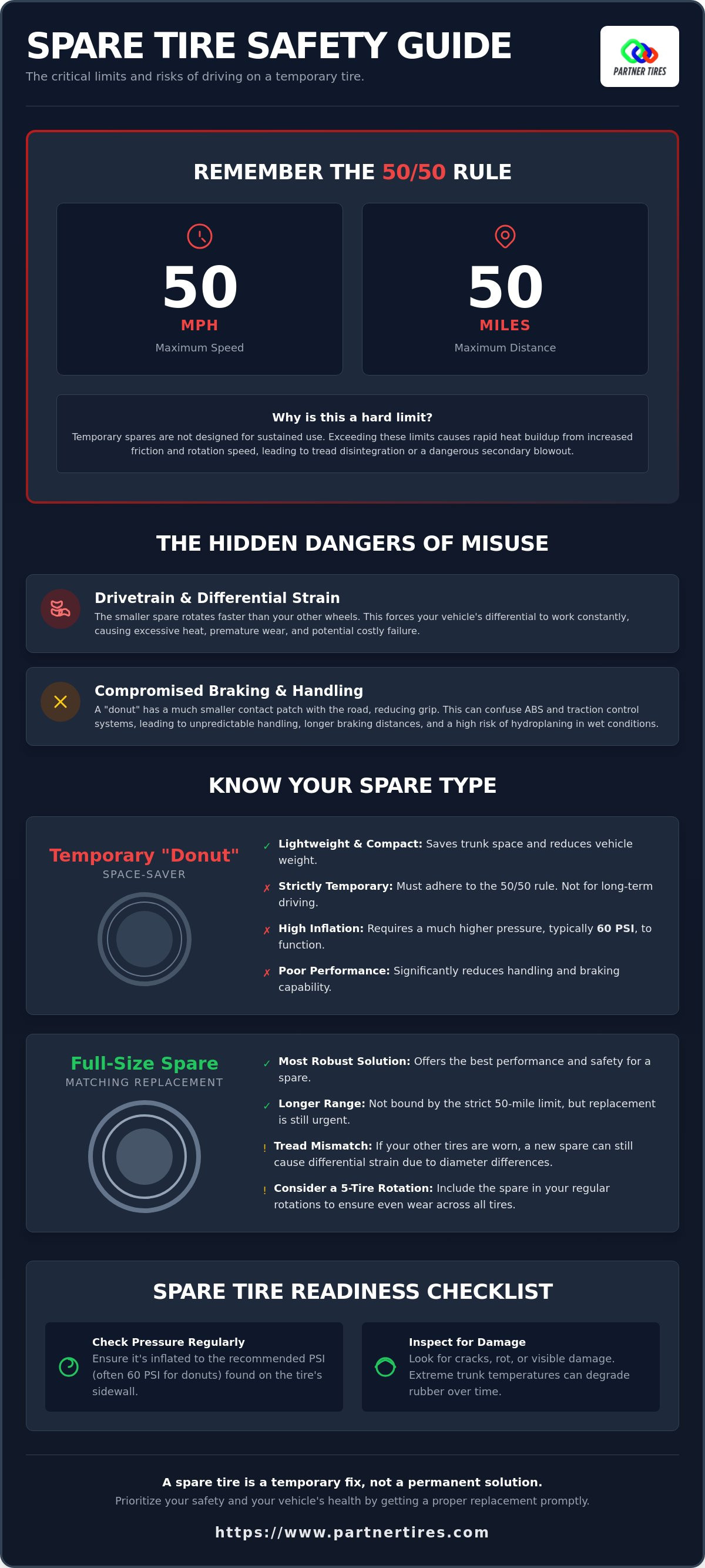
- Adhere to the 50/50 rule by limiting your speed to 50 mph and your distance to 50 miles on any temporary spare tire.
- Identify the critical mechanical risks, including differential strain and reduced braking performance, caused by mismatched tire diameters.
- Verify your spare's readiness by maintaining 60 PSI and monitoring for rubber degradation caused by Alabama's extreme trunk temperatures.
- Get the definitive answer on how long can you drive on a spare tire to protect your vehicle’s transmission and your personal safety.
- Explore how mobile tire replacement services provide a safer, more efficient alternative to driving on a temporary spare for extended periods.
The 50/50 Rule: Understanding Spare Tire Speed and Distance Limits
The 50/50 rule is the industry standard for emergency mobility. It dictates that you should never exceed 50 miles of total travel or a speed of 50 miles per hour while using a temporary tire. Understanding how long can you drive on a spare tire is critical for protecting your vehicle's drivetrain and ensuring your personal safety. These components are engineered as short-term bridges to get you to a service center, not as permanent replacements for standard equipment.
Speed creates friction, and friction generates heat. Because a compact spare has a significantly smaller circumference than a standard wheel, it must rotate much faster to keep pace with the rest of the vehicle. This increased rotation speed causes rapid heat buildup within the thinner rubber compounds. If you push beyond the recommended limits, you risk tread disintegration or a secondary blowout that could leave you stranded again. Understanding Spare Tire Types is the first step in recognizing why these units lack the endurance of your primary tires.
To better understand this concept, watch this helpful video:
Why 50 MPH is the Absolute Ceiling
Centrifugal force acts more aggressively on smaller diameter wheels. At high speeds, the narrow profile of a temporary tire significantly reduces your contact patch with the pavement. This creates a high risk of hydroplaning, particularly during heavy Alabama rainstorms. Your vehicle's ABS and traction control systems are calibrated for four identical tires. A single smaller wheel disrupts these sensors, which can lead to unpredictable handling during sudden maneuvers. Keeping your speed low ensures you maintain enough control to react to traffic changes safely.
Calculating Your Safe Range
Always locate the "Temporary Use Only" or "Max 50 MPH" markings stamped directly onto the tire sidewall. This isn't a suggestion; it's a mechanical boundary. If your commute is 25 miles each way, you'll exhaust the safe life of your spare in a single day. Don't attempt to stretch the use of a donut over several days of short trips. Instead, drive directly to a professional tire repair Birmingham facility to restore your vehicle's integrity. Heavy vehicle loads or towing will further decrease the structural lifespan of the spare.
Comparing Spare Tire Types: Temporary Donuts vs. Full-Size Replacements
Not every backup solution is built the same. The equipment tucked under your trunk floor determines exactly how long can you drive on a spare tire before you compromise your vehicle's safety. Most modern sedans utilize a "donut" or space-saver tire. These are lightweight units inflated to high pressures, typically around 60 PSI, to save weight and storage space. They are strictly temporary and lack the structural reinforcement needed for high-speed travel or heavy cornering.
In contrast, many trucks and SUVs carry a full-size spare. While these look identical to your standard wheels, they often feature a different rubber compound or tread pattern. Comparing Spare Tire Types reveals that even a full-size unit requires specific considerations before you decide to leave it on permanently. Some high-end vehicles even utilize folding spares that remain deflated until needed, requiring a portable air compressor to become functional before you can move the vehicle.
Is a Full-Size Spare Permanent?
A full-size spare is the most robust backup, but it isn't always a "set it and forget it" solution. Safety depends on matching tread depth across the same axle. If your three existing tires have 30,000 miles of wear and you install a brand-new full-size spare, the difference in diameter will stress your differential. This imbalance also affects braking performance because the newer tire will have a different grip level than the aged ones. To maximize your investment, include a full-size spare in a "5th wheel" rotation pattern to ensure even wear across all five tires.
Run-Flat Technology Limits
Run-flat tires eliminate the need for a physical spare by using reinforced sidewalls that support the vehicle's weight after a puncture. Understanding how long can you drive on a spare tire of this type is essential, as they operate in a "limp mode" once pressure is lost. Most manufacturers limit run-flat use to 50 miles at speeds under 50 mph. Once you drive on a run-flat with zero pressure, the internal structure usually sustains enough heat damage that it cannot be safely repaired. Watch for the TPMS warning symbol on your dashboard. If it stays illuminated, your distance window is closing rapidly. If you find yourself needing a permanent replacement, our team can help you find new tires that match your vehicle's specific requirements.
The Hidden Risks of Driving Too Long on a Temporary Spare
Driving on a donut isn't just a safety gamble; it's a financial risk to your vehicle's drivetrain. While you focus on the tire's exterior, your vehicle's internal components struggle to compensate for the imbalance. A temporary tire has a smaller diameter than your standard wheels. This forces the differential to work constantly to manage the speed difference between the two sides of the axle. Overheating occurs quickly. If you ignore the limits of how long can you drive on a spare tire, you risk a total differential failure that far exceeds the cost of a new tire. If the mechanical damage becomes too extensive, especially for those in the Metro Atlanta area, Windward Auto Removal Service provides an option for those looking to get immediate cash for a totaled vehicle.
Safety systems also suffer from this size discrepancy. Your Anti-lock Braking System (ABS) and Traction Control monitor wheel rotation in real time. Because a donut spins faster than your other tires, the computer often perceives this as a loss of traction. This can trigger a dashboard warning light or disable your electronic stability features entirely. Strict adherence to Spare Tire Speed and Distance Limits prevents these costly mechanical setbacks and keeps your safety net active.
Impact on All-Wheel Drive (AWD) Systems
AWD systems are particularly vulnerable to mismatched tire sizes. These vehicles use sophisticated computers to distribute power across all four wheels. A single undersized spare confuses the system's logic, leading to constant mechanical binding in the center differential. This creates excessive heat and rapid wear on expensive transmission components. Specialized repair centers like Speedy Roo Motorsports & Repair Inc highlight that for Japanese AWD systems, even small discrepancies in tire height can trigger severe mechanical strain. Some manufacturers provide specific instructions on spare tire placement, often requiring you to move a full-size tire to the front and place the spare on the rear axle to minimize drivetrain stress. Consult your manual immediately to avoid permanent damage.
Handling and Cornering Deficits
Steering geometry relies on symmetry to maintain stability. A narrow donut tire creates a constant "pulling" sensation that forces you to fight the steering wheel just to stay in your lane. This imbalance makes emergency maneuvers, like swerving to avoid an obstacle, extremely dangerous. Your braking performance drops because the smaller contact patch cannot provide the same friction as a standard tire. The minimal tread depth and narrow profile result in a near-total loss of lateral grip during cornering maneuvers. Knowing how long can you drive on a spare tire ensures you don't push these handling deficits into a high-risk scenario.
Spare Tire Maintenance: Ensuring Your Backup Is Ready for Alabama Roads
Maintenance is the foundation of vehicle reliability. You might know how long can you drive on a spare tire, but that knowledge is useless if the tire is flat when you need it. Most compact spares require a 60 PSI inflation level. This is nearly double the pressure of a standard tire. Because these units have a small air volume, they must operate at higher pressures to support the vehicle's weight safely. A soft spare will overheat almost instantly, leading to a blowout within miles of installation.
Environmental factors in the Southeast pose a unique threat to your emergency equipment. Birmingham summers create extreme temperatures inside vehicle trunks, often exceeding 130 degrees Fahrenheit. This intense heat accelerates the evaporation of essential oils within the rubber compound. Over time, the rubber becomes brittle and prone to structural failure. Even if a tire has never touched the pavement, it has a shelf life. Industry experts recommend replacing any spare tire that is 10 years old, regardless of its visual condition. An aged tire cannot handle the stress of emergency use.
Quarterly Spare Tire Checkup
- Check your spare's air pressure every three months using a high-quality gauge.
- Inspect the sidewalls for dry rot, which appears as fine cracks in the rubber.
- Confirm your lug wrench fits both your standard wheels and your spare rim.
- Verify that your jack is lubricated and functions without binding.
If you discover your backup is compromised, don't wait for an emergency to act. Secure a reliable replacement by browsing our selection of new tires today.
Roadside Safety Tips
Changing a tire on busy corridors like I-65 or Highway 280 requires maximum visibility. Always pull as far off the shoulder as possible to reach a level, firm surface. Soft dirt can cause a jack to slip, leading to catastrophic injury. Use your hazard lights and deploy reflective flares or triangles if you have them. Before heading out of Jefferson County on a long road trip, verify your spare's condition as part of your pre-trip inspection. Knowing how long can you drive on a spare tire won't help if the tire fails due to neglect before you reach a shop.
Carry a high-output flashlight with fresh batteries in your emergency kit. Blowouts rarely happen in convenient, well-lit locations. Having the right tools and a pressurized spare ensures you can transition from a roadside crisis to a safe driving state without unnecessary delays. Proper preparation turns a potential disaster into a manageable mechanical pause.
Mobile Tire Solutions in Birmingham: Getting Back on the Road Safely
Driving on a temporary spare is a high-stakes gamble with your vehicle's drivetrain. You already understand the mechanical risks and the strict 50/50 rule. Instead of white-knuckling your way to a traditional shop, let the shop come to your location. You don't have to stress about how long can you drive on a spare tire when a permanent solution is just a phone call away. Mobile service eliminates the risk of differential damage and keeps you off dangerous highway shoulders. Partner Tires serves as your dependable ally, providing the logistical strength needed to resolve tire emergencies without the typical shop wait times.
We provide a seamless transition from emergency mode to operational stability. Our team understands that time is your most valuable asset in the Birmingham business environment. Our mobile units carry industrial-grade equipment to perform professional at home tire installation across the entire metro area. This proactive approach saves your vehicle's transmission from unnecessary wear. It also ensures you never exceed the safe mileage limits of your temporary tire, protecting your long-term financial investment in your vehicle.
Professional At-Work or At-Home Installation
Our mobile service units function as fully realized tire centers on wheels. We arrive at your driveway or office parking lot ready to execute a complete tire swap. Whether you require premium new rubber or are looking for reliable used tires Birmingham AL drivers can depend on, our inventory meets every logistical requirement. We perform computerized wheel balancing and mounting on-site with the same precision you expect from a stationary facility. This ensures your vehicle returns to factory specifications without you ever leaving your desk or home. We handle the heavy lifting so your schedule remains uninterrupted.
Why Birmingham Drivers Trust Partner Tires
Local expertise is vital when you find yourself stranded. We serve the entire Jefferson County region, including Hoover, Vestavia, and downtown Birmingham. Partner Tires prioritizes rapid response times because we know a flat tire represents a bottleneck in your daily operations. We act as the backbone of your local transportation needs, offering everything from emergency tire delivery to mobile automotive repairs. Our goal is your safety and your vehicle's health. We work behind the scenes to ensure you stay productive and profitable. Contact Partner Tires for mobile installation and get off that spare today!
Restore Your Vehicle’s Safety and Performance
Safety on the road isn't a suggestion; it's a requirement for every driver. You now understand the strict limitations of the 50/50 rule and the severe mechanical stress that mismatched tires place on your drivetrain. Knowing how long can you drive on a spare tire protects your transmission from costly repairs and ensures your vehicle's safety systems remain functional. Don't push your luck on Birmingham's busy highways with a temporary solution that was never meant for the long haul.
Partner Tires provides the logistical strength to get you back to peak performance without the wait. We deliver comprehensive mobile service across Birmingham, Hoover, and Vestavia. Our technicians perform expert computerized wheel balancing on-site to ensure a smooth, professional result. We maintain a robust inventory of new and high-quality used tires available for immediate delivery to your home or office. This eliminates the need for a dangerous trip to a traditional shop.
Skip the dangerous drive—Book Mobile Tire Installation in Birmingham now. We act as the backbone of your automotive needs so you can focus on what matters. Drive with confidence knowing your vehicle is in capable hands.
Frequently Asked Questions
Is it okay to drive on a spare tire for a week?
No, you shouldn't drive on a spare tire for a week or any extended period. These tires aren't designed for daily commuting or the heat generated by repeated use. Most manufacturers recommend a maximum distance of 50 miles to prevent failure. Driving on a spare for several days increases the risk of a secondary blowout and puts unnecessary strain on your vehicle's mechanical components.
What happens if you go over 50 mph on a spare tire?
Exceeding 50 mph on a spare tire causes rapid heat buildup that leads to tread disintegration. Smaller tires must rotate much faster than standard wheels to maintain the same vehicle speed. This excessive friction can cause the tire to fail catastrophically without warning. You also face significantly reduced braking power and unpredictable handling during sudden lane changes or emergency stops.
Can I drive on the highway with a donut spare?
You can drive a donut spare on the highway only if you stay in the far-right lane and keep your speed under 50 mph. High-speed highway traffic creates a dangerous environment for a vehicle with limited traction and stability. It is often safer to take side roads or call for a mobile tire installation to avoid the risks of highway driving altogether.
Do spare tires have a mileage limit?
Yes, temporary spare tires have a strict mileage limit of 50 miles. Knowing how long can you drive on a spare tire is essential for your safety and your car's health. While full-size spares offer more range, the rubber compounds in donuts are thinner and wear down quickly. You should drive directly to a professional service center to minimize the risk of being stranded twice.
Will a spare tire ruin my transmission or AWD system?
A spare tire can ruin your transmission and AWD system if you ignore the recommended limits. The difference in tire diameter forces your differential to work constantly to compensate for the speed variance between wheels. This leads to rapid overheating and premature gear wear. Modern AWD computers may also disable safety features or malfunction due to the mismatched rotational data being sent to the sensors.
Do I need to put the spare tire on the front or the back?
You should ideally place the spare tire on the rear axle for maximum stability. This is critical for front-wheel-drive vehicles where the front tires handle steering, most of the braking force, and power delivery. If you have a front flat, the safest method is to move a full-size rear tire to the front and place the spare on the back to maintain steering control.
Should I check the air pressure in my spare tire regularly?
You must check your spare tire's air pressure at least once every three months to ensure it remains reliable. Most donut spares require 60 PSI, which is significantly higher than a standard tire. Because they have a small air volume, even a minor leak can leave the tire unusable when you need it most. Include this check in your quarterly maintenance routine to avoid an emergency.
Can a spare tire be repaired if it gets a nail in it?
No, a temporary spare tire cannot be safely repaired if it sustains a puncture. These tires feature minimal tread depth and thin sidewalls that don't provide enough internal structure for a permanent plug or patch. If your spare gets a nail or a cut, you must replace it immediately. Operating on a patched spare is a significant safety risk that our mobile team can help resolve.


