

You are cruising down I-65 toward downtown Birmingham when that dreaded yellow horseshoe light flashes on your dashboard. It is a stressful moment that leaves you wondering if you have a dangerous puncture or just a glitchy computer. Identifying the signs your TPMS sensor is bad is the first step to regaining your peace of mind and staying safe on the road. We know there is nothing more frustrating than an unreliable dashboard light that forces you to waste your afternoon at a tire shop. You deserve a solution that respects your time and your safety.
This guide provides the clarity you need to handle tire pressure issues with professional precision. We will show you exactly how to tell the difference between a low tire and a failing component. You'll learn why the intense Alabama heat triggers these systems and how most sensor batteries reach their limit after seven to ten years. We are going to break down five clear indicators of sensor failure. You will also discover how to fix these issues without leaving your driveway or office. It is time to clear that dashboard light and get back to business.
Key Takeaways
- Understand why sealed TPMS units fail and why you cannot simply recharge their internal batteries once they expire.
- Identify the specific signs your TPMS sensor is bad, such as a flashing dashboard light during startup or persistent warnings despite correct inflation.
- Master the manual gauge test to distinguish between a dangerous puncture and a simple sensor malfunction.
- Recognize how local environmental factors like Alabama humidity and road heat impact the lifespan of your vehicle's safety sensors.
- Streamline your maintenance by utilizing mobile diagnostics that resolve sensor issues at your location without a trip to the tire shop.
What is a TPMS Sensor and Why Does it Fail?
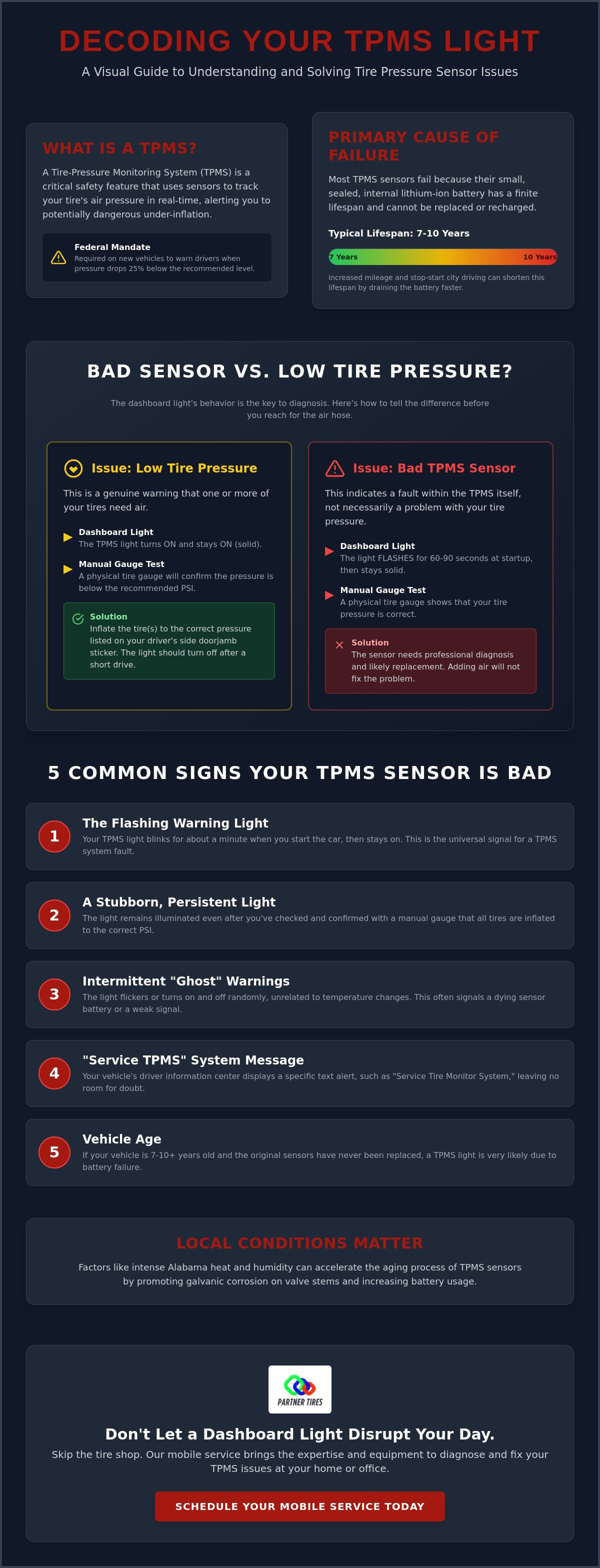
A Tire-pressure monitoring system (TPMS) is a critical safety feature that keeps you informed about your vehicle's foundation. It uses small electronic sensors to track air pressure in real-time. This system ensures your tires stay within the manufacturer's recommended range. Proper inflation directly impacts your fuel economy and tire longevity. Under federal regulation FMVSS No. 138, these systems must alert you when pressure drops 25 percent below the recommended level. When the system works, it saves you money and prevents dangerous blowouts on highways like I-65.
Most vehicles in Birmingham use a direct TPMS. This means a physical sensor sits inside each wheel. These sensors transmit data wirelessly to your car's computer. Indirect systems rely on wheel speed sensors from the anti-lock brake system to estimate pressure. If your dashboard shows individual tire pressures, you have a direct system. These physical sensors are the components that eventually wear out. Understanding the signs your TPMS sensor is bad starts with knowing how these parts interact with your wheels.
To better understand why these lights stay on, watch this helpful video:
Every direct TPMS sensor contains a small lithium-ion battery. These units are completely sealed to protect the electronics from moisture and road debris. Because they are sealed, you cannot simply recharge or replace the battery. Once the power runs out, the entire sensor is dead. This is a common reason for failure in older vehicles. Since Alabama doesn't have a mandatory vehicle inspection program, it's up to you to monitor these signals for safety.
The Components of a TPMS Sensor
Each sensor is a complex piece of hardware designed for a harsh environment. The primary parts include:
- Valve Stem Assembly: The physical port where you add air, often made of aluminum or rubber.
- Pressure Transducer: The internal component that measures the actual PSI.
- Radio Transmitter: The part that sends data to the vehicle's computer.
The valve stem is particularly vulnerable to road grime. Constant exposure leads to galvanic corrosion, which makes the stem brittle or causes air leaks. If you are purchasing used tires, check the sensor health during the tire mounting process. Older sensors in used wheels often fail shortly after installation.
How Long Should TPMS Sensors Last?
You can expect your sensors to last between seven and ten years. This lifespan fluctuates based on your annual mileage and local driving habits. Birmingham traffic requires frequent stops and starts. Every time your wheels move, the sensors wake up and transmit data. This increased transmission rate drains the internal battery faster than steady highway cruising. The average battery life of a lithium-ion TPMS cell is approximately seven to ten years before the voltage drops below functional levels. Recognizing the signs your TPMS sensor is bad becomes much more likely as your vehicle approaches this age threshold.
5 Common Signs Your TPMS Sensor Is Bad
Your vehicle's computer is designed to catch problems before they become safety hazards. However, even the most reliable systems can fail. Recognizing the signs your TPMS sensor is bad saves you from unnecessary stress and potential roadside emergencies. When your dashboard starts sending mixed signals, it's usually one of these five specific indicators. Ignoring these warnings can lead to poor fuel economy or an undetected flat tire during your commute through Birmingham.
The most frequent symptom is a warning light that stays illuminated despite having perfectly inflated tires. If you have verified the pressure with a manual gauge and the light won't turn off, the sensor has likely failed. Modern vehicles also use audible chimes or "Service TPMS" text messages on the driver information center. These are direct alerts that the system is no longer monitoring your safety effectively. Intermittent warnings that flicker on and off without any change in outside temperature are another red flag. These "ghost" warnings often point to a sensor that is struggling to maintain a connection with the vehicle's receiver.
Decoding the Blinking Dashboard Light
There is a major difference between a solid light and a blinking one. A solid light typically indicates low air pressure. However, if the TPMS light flashes or blinks for 60 to 90 seconds every time you start your car, you are dealing with a system fault. This specific sequence is the car's way of telling you that one or more wheel units are not responding. Understanding how TPMS works helps you realize that this blinking usually signals a dead internal battery. Once that blinking stops, the light usually stays solid for the remainder of your drive.
Inconsistent and Inaccurate Readings
Digital displays have made monitoring tire health easier, but they can also hide hardware failures. You might notice that one tire's pressure reading is "stuck" on a specific number, even after you add air. This indicates a "lazy" sensor that is no longer reacting to physical pressure changes. In other cases, the display might show a series of dashes or an "Error" message where the PSI number should be. This happens when the sensor stops transmitting data entirely due to internal component damage or extreme road vibration.
Always verify your digital readout with a high-quality manual pressure gauge. If your manual gauge shows 35 PSI but your dashboard insists the tire is at 28 PSI, the sensor's calibration has failed. These inaccuracies make it impossible to trust your vehicle's safety data. If you are experiencing these confusing readouts, it's time to schedule a TPMS sensor service to restore your vehicle's diagnostic accuracy. Reliable data is the foundation of safe driving, especially when navigating heavy traffic on I-459 or the Red Mountain Expressway.
A failing sensor is more than just an annoyance; it is a gap in your vehicle's safety net. When the transmitter fails, you lose the ability to detect slow leaks that could lead to a blowout. Professional diagnostics can quickly identify which specific wheel is causing the problem. This targeted approach ensures you only replace what is necessary, keeping your maintenance costs manageable and your vehicle operational.
Bad Sensor vs. Low Tire Pressure: How to Tell
Distinguishing between a real leak and a faulty component is the first step in avoiding unnecessary downtime. The manual gauge test is the only way to confirm your suspicions. It provides the ground truth that your vehicle's computer might be missing. If your manual gauge shows a healthy 32 PSI while your dashboard insists you are at 20 PSI, you have found one of the most reliable signs your TPMS sensor is bad. This simple comparison prevents you from overinflating your tires in a misguided attempt to satisfy a broken sensor.
Physical damage can also mimic electronic failure. Inspect your valve stems for cracks or corrosion. An aluminum stem that has corroded may leak air slowly, causing a valid low-pressure warning. However, if the stem is intact and the tire holds air overnight but the light remains on, the issue is electronic. Don't forget to check your spare tire. Many vehicles, especially full-sized SUVs common in Birmingham, include a fifth sensor in the spare. A low spare tire often triggers a dashboard light that seems impossible to clear through normal inflation of the four main tires.
The Role of External Temperature
Environmental factors play a major role in system accuracy. The "Rule of 10" states that tire pressure changes by approximately 1 PSI for every 10-degree shift in temperature. Alabama mornings can be 20 degrees cooler than the afternoon peak. This swing can trigger a legitimate low-pressure light at 6:00 AM that disappears by lunch. This is natural pressure loss, not a sensor malfunction. Birmingham's intense summer heat can also mask slow leaks. The heat expands the air inside the tire, temporarily raising the PSI and hiding a puncture that would be obvious in cooler weather. Always check your pressure when the tires are "cold" or have been sitting for at least three hours.
DIY Troubleshooting Steps
Before assuming a replacement is necessary, try a system reset. Most vehicles have a TPMS reset option within the driver information menu. This forces the computer to re-evaluate the data coming from the wheels. If the light returns immediately after a reset, the hardware is likely compromised. You may also need a "relearn" process if you recently rotated your tires. This procedure tells the car's computer which sensor is at which corner of the vehicle. If these steps fail to resolve the warning, it is time to seek expert tire repair in Birmingham to diagnose the specific transmitter fault.
Knowing when to stop DIY-ing is essential for your safety. A faulty sensor leaves you blind to real punctures. If you find yourself checking your tires daily with a manual gauge because you don't trust the dash, you are wasting valuable time. Professional diagnostic tools can pinpoint the exact wheel and the specific nature of the failure within minutes. This efficiency gets you back on the road with a system you can actually rely on for your daily commute.
Why TPMS Sensors Fail: Alabama Heat and Road Conditions
Birmingham's climate presents a unique set of challenges for vehicle electronics. While the system is designed for durability, local environmental factors often accelerate hardware degradation. Identifying the signs your TPMS sensor is bad often reveals an environmental cause rather than a simple manufacturing defect. High humidity levels combined with intense road heat create a punishing atmosphere for the sensitive transmitters located inside your wheels. Beyond the weather, our local infrastructure plays a role. Jarring impacts from potholes on busy stretches like Hwy 280 can physically dislodge internal components or crack the sensor housing. This physical trauma leads to immediate electronic failure or slow air leaks at the mounting point.
Chemical interference is another common culprit. Many drivers reach for emergency "fix-a-flat" tire sealants to handle a puncture. These liquid sealants are devastating to TPMS hardware. The thick material can easily clog the sensor's pressure port, rendering it unable to read PSI levels. This often results in a "stuck" reading or a total loss of signal. If you have used a sealant recently, you have likely compromised the sensor's ability to function. Professional intervention is usually required to clean the wheel and replace the fouled unit to restore system integrity.
Corrosion and the Valve Stem
Galvanic corrosion is a primary threat in the Southeast. This chemical reaction occurs when moisture interacts with the different metals in your valve assembly. Most TPMS sensors use aluminum stems which are highly prone to seizing. If a technician uses a standard brass valve core instead of a specialized nickel-plated core, the two metals will eventually bond together. This makes it impossible to adjust air pressure without breaking the stem. Additionally, moisture trapped inside the tire from poorly maintained shop air compressors can rot the sensor from the inside out. Maintaining a dry, clean environment inside the tire is essential for long-term sensor health.
Battery Drain Factors
Your driving environment dictates how hard the sensor batteries must work. Sensors typically enter a "sleep mode" when the vehicle is parked to conserve energy. However, frequent stop-and-go traffic in Hoover or Downtown Birmingham keeps these sensors in a constant state of high-frequency transmission. This rapid data exchange drains the limited power supply much faster than steady highway driving. Extreme heat accelerates the self-discharge rate of TPMS batteries, significantly shortening their operational lifespan during Alabama summers. When the voltage drops, the transmitter's signal becomes weak and inconsistent. If your dashboard warnings are becoming more frequent as the temperature rises, it is time to schedule a TPMS sensor service to ensure your safety foundation remains solid. We provide the technical expertise needed to diagnose these battery failures before they leave you stranded.
Professional TPMS Service in Birmingham: We Come to You
Don't ignore the signs your TPMS sensor is bad. A malfunctioning system leaves you vulnerable to unexpected tire failure on the highway. Traditional tire shops require you to sacrifice hours in a lobby. We eliminate that friction by bringing the shop to your driveway. Our mobile units are fully equipped to handle diagnostics and replacements on-site. This efficiency ensures your vehicle stays safe without disrupting your professional schedule. We act as your hardworking ally, providing the technical backbone for your daily commute.
Driving with an unmonitored tire is a liability. You lose the early warning system that prevents ruined rims and dangerous blowouts. Our technicians use advanced computerized tools to pinpoint the exact wheel causing the fault. We don't guess; we use data to drive our repairs. You can bundle this repair with at home tire installation or a standard tire rotation. This integrated approach saves you money and maximizes the lifespan of your inventory. We prioritize your financial health by delivering precise solutions that prevent secondary damage.
Our Mobile Diagnostic Process
We use specialized scanning tools to communicate with your sensors through the tire sidewall. This allows us to verify battery life and signal strength without removing the wheel. It's a fast-paced, efficient process designed for the busy professional. If a replacement is necessary, we install the new hardware and perform a precision "relearn" procedure. This step ensures your car's computer correctly identifies the new sensor's location and signal frequency. We ensure the right product is installed correctly the first time.
Convenience for Birmingham Drivers
Our service area covers the entire metro region. Whether you are in Hoover, Vestavia, Trussville, or downtown, we provide the logistical support you need. You don't have to wait in a cramped chair while your car is serviced. We work on your vehicle while you stay productive at the office or relax at home. This directness ensures that your time is never wasted on unnecessary fluff. Success on the road starts with reliable data from your tires. Take control of your vehicle's safety and Schedule your TPMS service today. We are the engine that drives your mobility and safety.
Restore Your Vehicle's Safety Foundation Today
Your dashboard should provide certainty, not confusion. We have explored how Alabama heat and road vibration compromise your vehicle's electronic sensors over time. Recognizing the signs your TPMS sensor is bad is only the first step toward a safer commute. The real solution lies in professional diagnostics that respect your schedule and your vehicle's integrity. Whether you are dealing with a blinking warning light or inconsistent pressure readings, ignoring the problem puts your safety at risk. It's a liability you don't have to carry.
Partner Tires is your locally owned and operated ally in Birmingham. We provide mobile service at your home or work, ensuring your day stays on track while we handle the technical details. Our technicians use advanced computerized tools to deliver precision repairs. We also include expert computerized wheel balancing with our tire services to ensure a smooth ride. Don't let a faulty sensor leave you guessing on I-65 or the Red Mountain Expressway. It's time to maintain your vehicle's reliability and protect your financial health. Schedule Mobile TPMS Repair in Birmingham today. We are ready to get you back on the road with confidence.
Frequently Asked Questions
Can I drive with a bad TPMS sensor?
You can technically drive with a faulty sensor, but it is not recommended for long-term safety. A bad sensor leaves you blind to real-time pressure drops and slow leaks. This increases the risk of a blowout on high-speed roads like I-65. It's better to address the issue promptly to restore your vehicle's safety net and protect your tires from uneven wear.
How much does it cost to replace a TPMS sensor in Birmingham?
TPMS replacement costs vary based on your vehicle's make and model. The total typically includes the price of the sensor hardware and the labor for mounting and programming. Factors like whether you need a single unit or a full set of four will impact your final investment. Choosing a mobile service can also save you the indirect costs of taking time off work to visit a traditional tire shop.
Why is my TPMS light flashing then staying solid?
A light that flashes for 60 to 90 seconds before staying solid indicates a system malfunction rather than low pressure. This sequence is one of the primary signs your TPMS sensor is bad or has a dead battery. The car's computer has lost communication with one or more wheel units. You need a diagnostic scan to identify which specific sensor has failed and requires professional replacement.
Do I need to replace all four sensors if one goes bad?
You are not required to replace all four sensors simultaneously. However, since these sensors share the same battery lifespan, the others will likely fail soon after the first one. Most lithium-ion TPMS batteries last seven to ten years. If your vehicle is in this age range, replacing the full set during a single service visit saves you from repeated labor costs and multiple trips for repairs.
Can I replace a TPMS sensor myself at home?
Replacing a sensor is rarely a DIY project for most drivers. The process requires "breaking the bead" to separate the tire from the rim. You also need specialized electronic tools to program the new sensor to your vehicle's computer. Without professional mounting equipment and diagnostic scanners, you risk damaging the tire or the new hardware. Professional mobile service is a much more efficient alternative.
Will a bad TPMS sensor cause a flat tire?
A faulty sensor does not physically cause a flat tire. However, it prevents you from receiving a warning when a real puncture occurs. If you have a slow leak and a dead sensor, you might continue driving until the tire is completely destroyed. This leads to expensive rim damage and safety hazards. Maintaining a working system is the best way to catch leaks before they become roadside emergencies.
Do used tires come with TPMS sensors?
Used tires might still have sensors attached to the wheels, but their battery life is often unknown. If you are purchasing used wheels, the internal batteries may already be near the end of their operational lifespan. It is a professional best practice to test these sensors during mounting. If the batteries are weak, installing new units now prevents the inconvenience of a dashboard warning light appearing next month.
How do I reset my TPMS light after adding air?
Most modern vehicles reset automatically after you drive for about 10 to 20 minutes at speeds over 20 MPH. If the light persists, check your driver information menu for a "TPMS Reset" or "Tire Learn" option. Ensure all tires, including the spare if applicable, are at the correct PSI. If the light won't clear after these steps, it is one of the clear signs your TPMS sensor is bad.


