
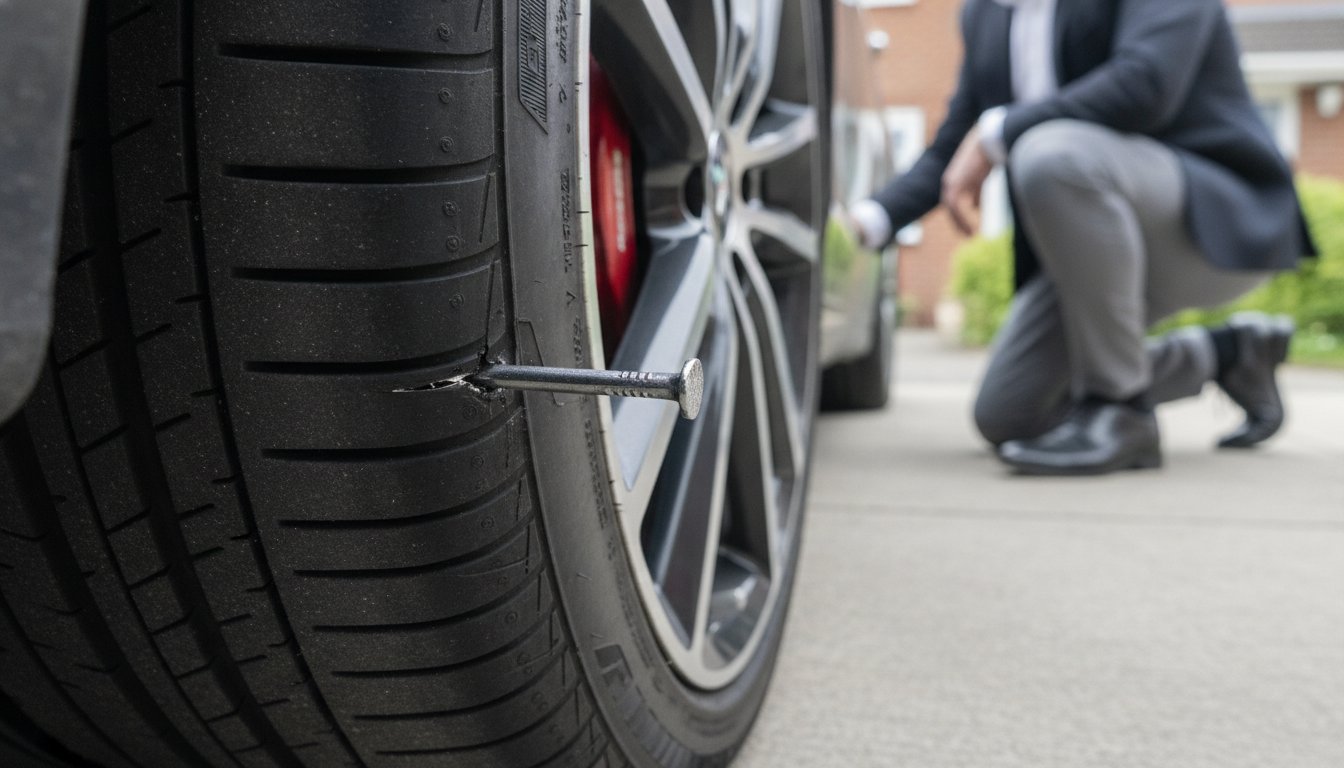
You are walking to your car, ready for a busy workday, when you spot a sharp silver glint buried in your tread. That sinking feeling is immediate. Knowing what to do if you have a nail in your tire can mean the difference between a simple fix and a dangerous roadside blowout. Most drivers assume this discovery guarantees an afternoon wasted in a cramped waiting room or an expensive, unbudgeted replacement. We understand that your time and safety are your most valuable assets. You need a solution that keeps your vehicle operational without the usual logistical headaches.
This guide provides the immediate steps to take to secure your vehicle. We will explain how to determine if the puncture is repairable based on U.S. Tire Manufacturers Association standards, which require damage to be in the tread and under 1/4 inch in diameter. You will also learn how to get a professional, industry-standard patch-plug repair without ever leaving your driveway. Our goal is to ensure your car is safe, your costs stay low, and your workday remains uninterrupted. Let's get your tires back in peak condition with minimal friction.
Key Takeaways
- Leave the nail in place to maintain pressure; removing it prematurely turns a slow leak into an immediate flat.
- Assess the puncture location to see if it falls within the repairable tread area or the non-repairable sidewall "Danger Zone."
- Discover what to do if you have a nail in your tire to prevent the structural failure caused by heat and centrifugal force.
- Insist on the industry-standard patch-plug combination for a permanent repair that meets all safety regulations.
- Utilize mobile tire repair at your home or office to keep your vehicle safe without disrupting your professional schedule.
Immediate Action: What to Do (and Not Do) When You See a Nail
Finding a sharp object in your tread is a high-stress moment. Your first instinct might be to grab a pair of pliers and yank it out. Stop right there. Knowing what to do if you have a nail in your tire starts with one rule: leave the nail alone. It currently acts as a temporary seal. Removing it creates an open channel for pressurized air to escape, likely leaving you stranded with a flat in minutes. This mistake can turn a simple repair into a total tire replacement.
To better understand this concept and see how a puncture behaves, watch this helpful video:
The "Don’t Pull It" Rule Explained
The nail is wedged into the rubber. It fills the hole it created. While it isn't a permanent fix, it maintains enough internal pressure to keep the tire bead seated on the rim. If you pull it, you lose that mechanical blockage. The air will rush out. This transforms a manageable repair into a roadside emergency. Keep the nail in place until you can reach a professional service provider or arrange for mobile assistance.
Checking for Immediate Air Loss
Use a reliable tire pressure gauge immediately. Don't rely on a visual check. Modern radial tires can be dangerously low on air while still looking relatively full. Check the PSI against the manufacturer's recommendation found on your driver-side door jamb. If the pressure is significantly below the target level, the tire is unsafe for any distance.
- Listen for a hiss: An audible leak indicates the puncture is large or the nail has shifted. This situation is urgent.
- Monitor the TPMS: If your dashboard light is on, the tire has already lost at least 25 percent of its air.
- Avoid high speeds: Centrifugal force can move the nail and expand the hole.
If the tire is holding air, you might be tempted to finish your commute. Exercise extreme caution. Avoid high speeds and heavy cargo. High velocity increases internal heat and stresses the puncture site. While some high-end vehicles utilize Run-flat tire technology to provide a limited safety buffer, standard tires do not have this luxury. Driving on an under-inflated tire with a foreign object can cause the internal structure to shred. This makes a professional repair impossible and forces you into a much higher financial outlay for a new tire. Understanding what to do if you have a nail in your tire involves prioritizing safety over convenience.
Repair vs. Replace: Understanding the Puncture Location
Identifying what to do if you have a nail in your tire requires a quick visual inspection. Not every puncture is a candidate for a fix. The location of the metal determines whether you need a simple patch or a full replacement. We follow strict industry-approved tire repair standards to ensure your vehicle remains safe on the road. Professional technicians prioritize structural integrity over temporary convenience. This approach protects your safety and your long term financial health.
According to the 2026 U.S. Tire Manufacturers Association (USTMA) guidelines, a repair is only permissible if the damage is confined to the tread area. The hole must not exceed 1/4 inch (6mm) in diameter. If the nail is larger, or if it entered at an extreme angle that shredded the internal steel belts, the tire's structural integrity is compromised. A hole that exceeds these dimensions cannot be safely sealed with a standard plug-patch combination. Understanding these limits is essential for any driver facing a tire emergency.
The Anatomy of the Tread and Shoulder
The "Safe Zone" is the area between the outer tread grooves. This part of the tire is reinforced with heavy steel belts designed to handle the impact of the road. The shoulder is the transition area where the tread meets the sidewall. Punctures here are high-risk. This area experiences intense heat and pressure during turns. A plug in the shoulder will likely fail under these dynamic loads. If the nail is within an inch of the sidewall, most experts will recommend a replacement to avoid a catastrophic failure later.
Why Sidewall Punctures Are Terminal
The sidewall is the "Danger Zone." It doesn't have the steel reinforcement found under the tread. Instead, it's designed to flex constantly as you drive. This movement prevents a patch or plug from ever forming a permanent bond. A sidewall puncture is a terminal injury for a tire. Attempting a repair here invites a high-speed blowout. If you find a nail in this area, your only safe option is to seek a professional tire replacement. We provide efficient mobile solutions to help you resolve these issues without the need for a tow truck. Prioritizing a new tire in these cases is a necessary investment in your vehicle's operational reliability.
Can You Drive with a Nail in Your Tire?
Many drivers treat a nail like a minor inconvenience. If the tire isn't immediately flat, they assume they have plenty of time. This is a dangerous gamble. Driving with a foreign object in your rubber introduces unpredictable variables into your commute. While you are deciding what to do if you have a nail in your tire, the puncture is actively degrading. Every mile you travel increases the risk of a sudden, violent failure. Safety isn't just about the current air pressure; it's about the structural integrity of the tire under load.
How Centrifugal Force Worsens Punctures
At highway speeds, your tires rotate thousands of times per minute. This creates immense centrifugal force. This force pulls at the nail, causing it to wiggle and shift within the tread. As it moves, it acts like a saw, widening the original hole and shredding the internal steel belts. What started as a tiny puncture can quickly expand beyond the 1/4-inch limit set by the U.S. Tire Manufacturers Association guidelines. Once that threshold is crossed, a safe, professional repair is no longer an option. You've turned a fixable problem into a mandatory replacement.
The Hidden Dangers of Low Pressure
Low air pressure is the primary driver of tire blowouts. When a tire is under-inflated, the sidewalls flex excessively. This friction generates extreme internal heat. This heat weakens the adhesives holding the tire layers together. Eventually, the casing separates, leading to a blowout. You might not feel the pressure drop immediately, but the internal damage is often irreversible. If you continue to drive on a "slow leak," you risk shredding the inner liner. This makes the tire scrap metal.
Driving on a failing tire doesn't just ruin the rubber. If the tire loses all pressure while the vehicle is moving, the heavy metal rim will crush the deflated sidewall and strike the pavement. This turns a low-cost repair into an expensive wheel replacement. Replacing a damaged alloy rim can cost hundreds of dollars more than the tire itself. It's a high price to pay for a few miles of convenience.
If you notice the tire pressure dropping quickly or hear a rhythmic tapping sound against the asphalt, pull over. Don't attempt to limp the vehicle to a shop. This is the moment to call for Roadside Assistance. Professional mobile units can often perform a Flat Tire Repair on-site. This saves you from the danger of a highway blowout and the massive cost of a new wheel. Your safety and your vehicle's financial health depend on making the right call as soon as you spot the damage.
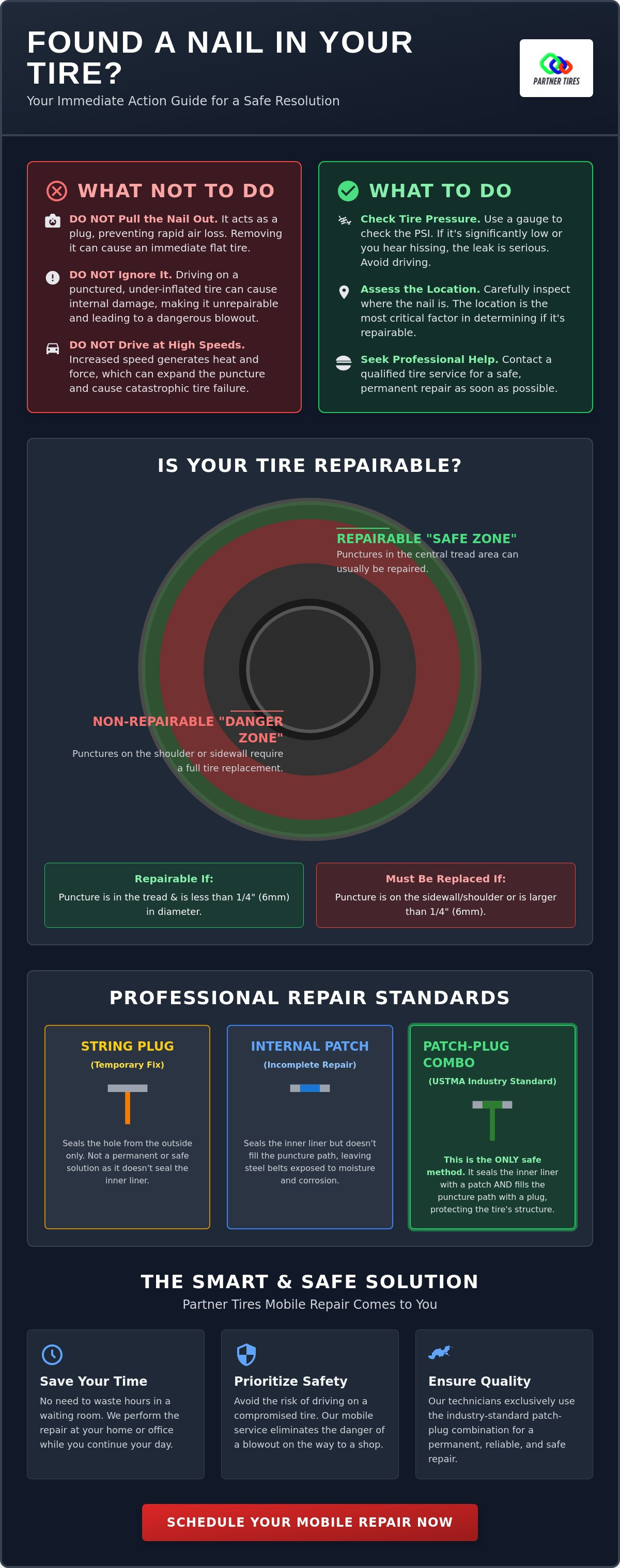
Professional Repair Standards: Plug vs. Patch vs. Plug-Patch
Knowing what to do if you have a nail in your tire involves distinguishing between a temporary stopgap and a permanent, safe repair. Many drivers rely on inexpensive "rope plug" kits found at local auto parts stores. While these are useful in a absolute emergency, they do not meet the safety requirements for long term road use. A professional repair is a multi step technical process. It ensures the tire can handle the heat and pressure of daily driving without failing. Our commitment to reliability means following the industry gold standard every time.
Why DIY Plugs Are Not a Permanent Solution
A standard rope plug is inserted from the outside of the tire. It fills the hole, but it fails to address the inner liner. The inner liner is the layer that actually holds the air. Because a plug alone doesn't create a secondary seal on this liner, moisture can eventually seep into the tire's internal structure. This leads to the corrosion of the steel belts. Over time, this rust weakens the tire from the inside out, potentially causing a tread separation. A proper repair requires an internal patch that bonds to the liner, combined with a rubber stem that fills the puncture channel.
The Importance of Internal Inspection
A tire must be removed from the wheel for a proper fix. This is the only way to perform a comprehensive internal inspection. When a tire runs low on air, even for a short distance, the sidewalls experience extreme flexion. This creates "secondary damage" like heat discoloration or shredded rubber dust inside the casing. If a technician sees these signs, the tire is no longer safe to operate. External plugs skip this critical diagnostic step, leaving you at risk for a blowout on a compromised casing. This is why we prioritize a thorough breakdown of the wheel assembly before any repair is finalized.
- Computerized Wheel Balancing: Any time a tire is removed and repaired, the weight distribution changes. Re-balancing is essential to prevent vibrations.
- TPMS Sensor Service: Modern vehicles rely on Tire Pressure Monitoring Systems. We ensure the sensor is properly handled and reset during the repair process.
- Inner Liner Preparation: The internal surface must be buffed and cleaned to allow the chemical vulcanizing fluid to create a permanent bond.
Understanding what to do if you have a nail in your tire means choosing a service that values precision over speed. Cutting corners on a repair might save fifteen minutes today, but it risks your safety and your vehicle's financial health tomorrow. If you need a reliable, industry-standard solution delivered directly to your location, you can schedule a professional flat tire repair with our mobile team. We bring the shop to you, ensuring your tire meets all safety regulations without disrupting your schedule.
Mobile Tire Repair in Birmingham: The Safer Alternative
Traditional advice often suggests limping your vehicle to a local tire shop in Birmingham. We disagree with this approach. Driving on a compromised tire introduces unnecessary risk to your safety and your vehicle's internal components. When you are deciding what to do if you have a nail in your tire, the most logical decision is to keep the vehicle stationary. Our mobile units bring professional-grade equipment directly to your location. This eliminates the need for a tow truck. It prevents further internal casing damage caused by heat and friction. We prioritize your safety by removing the hazard of a roadside blowout.
Serving the Birmingham Metro Area
Partner Tires operates as a steadfast logistical ally for drivers throughout the region. We provide specialized mobile services in Birmingham, Hoover, and Vestavia. We understand that a flat tire is a disruption to your operational efficiency. Our technicians arrive equipped to handle everything from a standard plug-patch repair to full at home tire installation. We focus on getting you back to your schedule with minimal downtime. This regional expertise ensures that help is never far away when your workday is on the line.
Mobile Solutions for Work or Home
Convenience shouldn't come at the expense of technical precision. Our mobile service mirrors the speed and accuracy of a fixed location. If our on-site inspection reveals that the nail is located in the non-repairable "Danger Zone" of the sidewall, we don't leave you stranded. We transition seamlessly to new tire sales and mounting on the spot. This comprehensive approach protects your vehicle's financial health. You avoid the high costs of multiple service calls or secondary damage to your expensive rims.
Knowing what to do if you have a nail in your tire often comes down to who you trust with your repairs. You shouldn't have to compromise your safety for the sake of your busy schedule. By utilizing mobile repair, you protect your tire casing from shredding and your wheels from impact damage. Partner Tires acts as the engine that keeps your day moving forward. We provide a reliable, no-nonsense solution that prioritizes your success on the road. Let us handle the logistics so you can focus on your business.
Secure Your Vehicle and Your Schedule
A nail in your tread doesn't have to derail your entire workday. By leaving the object in place and assessing the puncture location, you maintain control over the situation. Prioritizing an internal patch-plug repair over a temporary rope plug ensures your safety for thousands of miles to come. Knowing exactly what to do if you have a nail in your tire prevents a minor inconvenience from escalating into a dangerous roadside emergency or an expensive wheel replacement. We focus on your vehicle's health so you can focus on your business.
Partner Tires acts as a dependable foundation for your automotive needs with 24/7 Roadside Assistance. Our mobile units deliver precision service directly to your driveway or office. Every mobile installation includes computerized balancing to ensure optimal performance on the road. We serve Hoover, Vestavia, and the greater Birmingham area with grit and regional expertise. Don’t risk a blowout—book Partner Tires for mobile flat tire repair in Birmingham today. Your vehicle is a vital tool for your daily success. Trust the experts who work behind the scenes to keep you moving forward safely.
Frequently Asked Questions
How long can I drive with a nail in my tire if it is not leaking?
You should not drive on a tire with a nail, even if it isn't currently leaking air. Centrifugal force causes the metal to shift during rotation, which widens the hole and damages internal steel belts. This turns a simple repair into a mandatory replacement. Immediate action is required to maintain your vehicle's operational safety.
Is it cheaper to repair or replace a punctured tire?
A professional repair is always more cost-effective than a full replacement. Fixing a puncture in the tread area preserves your initial investment in the rubber. If you ignore the damage, the internal structure will eventually shred, forcing you to buy a new unit. Early intervention protects your financial health and prevents secondary damage to your rims.
Can a nail in the sidewall be patched?
No, a nail in the sidewall cannot be safely patched under any circumstances. The sidewall experiences intense flexion during every rotation of the wheel. This constant movement prevents a patch from forming a permanent, reliable bond. A sidewall puncture is a terminal failure that requires a full tire replacement to ensure vehicle stability and driver safety.
What happens if I pull the nail out myself?
Pulling the nail out yourself will likely cause the tire to deflate instantly. The nail currently acts as a temporary mechanical plug that holds back pressurized air. Removing it opens the puncture channel and leaves you with a flat tire in minutes. Keep the object in place until a professional can perform a proper internal inspection and repair.
Will a nail in my tire cause a blowout on the highway?
A nail puncture is a leading cause of high-speed blowouts. As you drive, heat builds up in the under-inflated area, which weakens the internal adhesives and rubber layers. This eventually causes the tire casing to separate or fail catastrophically. Understanding what to do if you have a nail in your tire helps you avoid these high-risk situations on the road.
Does my tire warranty cover nail punctures?
Standard manufacturer warranties usually cover factory defects rather than road hazards like nails. However, if you purchased a specific Tire Replacement Warranty or a road hazard plan, the cost of the repair might be covered. Review your service contract or contact your provider to verify your specific level of financial protection.
How much does a professional tire patch cost in Birmingham?
Professional repair rates in the Birmingham metro area vary based on the service type and your specific location. Traditional dealers and mobile service providers have different overhead structures that influence their final service fees. Contact a local expert to get an accurate quote for an industry-standard patch-plug combination that meets all safety regulations.
Can I use Fix-a-Flat for a nail puncture?
Aerosol sealants are temporary emergency measures and are not a permanent fix for a puncture. These products leave a chemical residue that can interfere with your TPMS Sensor Service components and prevent a patch from bonding later. If you use a sealant, inform your technician immediately so they can properly clean the tire and rim during the professional repair process.


