
Is that glowing dashboard light a minor nuisance or a budget-breaking repair? Most drivers in Homewood feel a sense of dread when the tire pressure warning stays on, fearing a massive bill or a lost afternoon stuck in a tire shop waiting room. You already know that ignoring a safety feature isn't an option, but you shouldn't have to sacrifice your entire workday to address it. Understanding the TPMS sensor replacement cost Homewood residents face is the first step toward getting back on the road with confidence.
This guide provides the clarity you need to manage your vehicle maintenance without the stress. We will break down the variables that influence your final bill, including the difference between OEM and aftermarket components. You'll also discover how mobile service eliminates logistical headaches by bringing professional equipment directly to your home or office. We'll even examine whether your sensor requires a full replacement or if a professional diagnostic scan can identify a simpler fix. Our goal is to ensure your vehicle remains operational while protecting your bottom line and your schedule.
Key Takeaways
- Identify the primary causes of sensor failure, including battery depletion and road salt corrosion, to better anticipate maintenance needs.
- Compare the financial benefits of aftermarket sensors against the specialized performance of original equipment manufacturer parts.
- Evaluate the total TPMS sensor replacement cost Homewood residents can expect based on vehicle type and service location.
- Understand the technical requirements for sensor programming that make professional installation more reliable than DIY attempts.
- Discover how mobile tire services protect your schedule by performing diagnostics and replacements at your home or workplace.
Understanding TPMS and Why Replacement Costs Vary in Homewood
A Tire-Pressure Monitoring System (TPMS) is a vital safety component that monitors your vehicle's air pressure in real time. It acts as an early warning system to prevent tire failure and maintain optimal fuel economy. When this system malfunctions, it compromises your safety and operational efficiency. The TPMS sensor replacement cost Homewood residents encounter is often driven by the hardware's environment. These sensors endure constant vibration and temperature fluctuations throughout the year.
To better understand how these sensors work and why they eventually fail, watch this helpful video:
Managing the TPMS sensor replacement cost Homewood owners expect involves understanding specific failure points. Battery life remains the primary reason for service. Most internal batteries last between five and ten years. Because these units are sealed to prevent moisture ingress, you cannot simply swap the battery; the entire sensor must be replaced. In Homewood, road conditions and seasonal humidity also contribute to valve stem corrosion. This oxidation can snap the stem or damage the internal circuitry, necessitating a professional diagnostic scan and hardware replacement.
Direct vs. Indirect TPMS: Which Do You Have?
Direct TPMS uses a physical sensor mounted inside each wheel to provide real-time data. This system is precise but accounts for the majority of repair expenses. Indirect TPMS relies on ABS wheel speed sensors to estimate pressure based on tire rotation. Since indirect systems don't use dedicated wheel sensors, they don't incur traditional hardware replacement costs. If your vehicle was manufactured after 2008, it likely utilizes a direct system that will eventually require professional service.
Common Signs Your Sensor Needs Replacement
Identifying a failing sensor early prevents unnecessary downtime. Watch for these indicators on your instrument cluster:
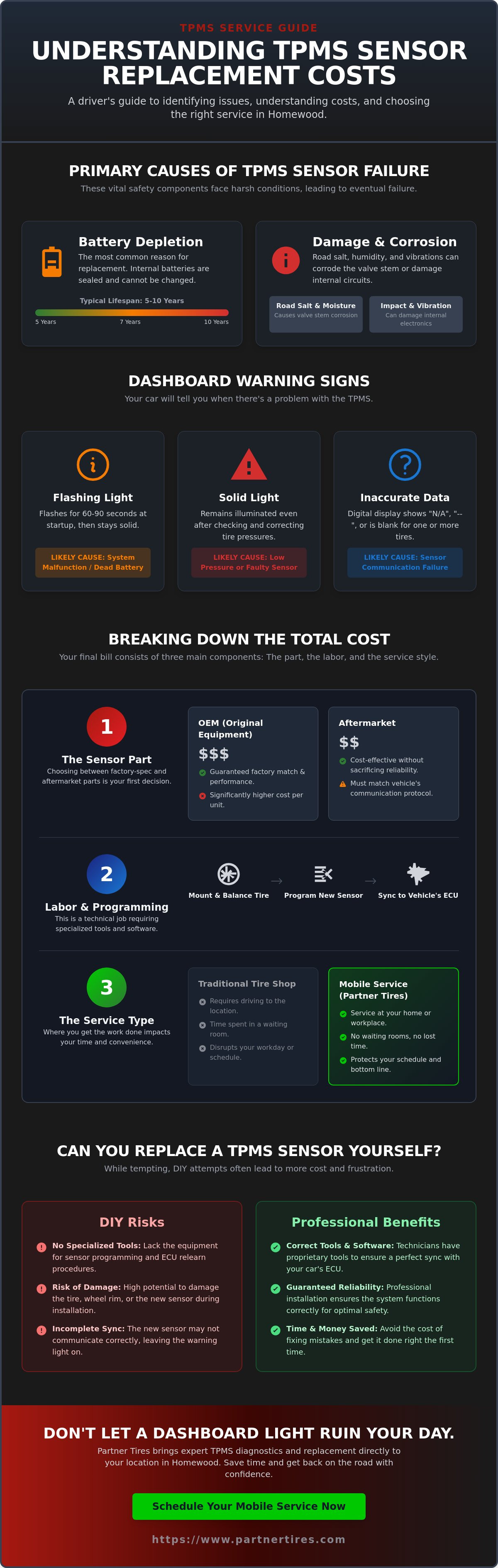
- Flashing Warning Light: If the TPMS light flashes for 60 to 90 seconds upon startup before staying solid, the sensor battery is likely dead.
- Persistent Solid Light: A warning light that stays on after you have properly inflated your tires suggests a faulty or damaged sensor.
- Inaccurate Data: Digital displays that show "N/A" or blank spaces for specific wheels indicate that the sensor is no longer communicating with the vehicle's computer.
Breaking Down TPMS Sensor Replacement Costs in 2026
Budgeting for vehicle maintenance requires clear data and a realistic view of current market trends. The TPMS sensor replacement cost Homewood drivers encounter is rarely a flat fee. It fluctuates based on the technology required for your specific vehicle and the quality of the replacement parts selected. These systems must meet federal safety standards for TPMS, which ensures that every component performs under pressure to prevent accidents. Choosing between Original Equipment Manufacturer (OEM) parts and aftermarket alternatives is your first major decision. OEM sensors provide a guaranteed match to your vehicle's factory specifications, often including the exact frequency used when the car was new. In contrast, aftermarket options offer a cost-effective path without sacrificing reliability, provided the technician selects a brand that matches your vehicle's communication protocol.
Labor rates also impact your final investment. This isn't a simple "plug and play" procedure that can be done in a driveway. Technicians must use specialized equipment to break the tire bead, remove the old hardware, and install the new unit without damaging the tire or the wheel rim. Once the physical installation is complete, the new sensor must be synced to your car’s Engine Control Unit (ECU). This programming step requires proprietary software and handheld tools that communicate with each wheel. Different manufacturers use different "relearn" procedures; some require a stationary sync, while others require a specific driving cycle. This technical overhead is why professional service across the Birmingham-Hoover-Homewood corridor is the standard for local drivers.
The Three Components of Your Final Bill
- The Sensor Unit: This is the hardware itself. High-end European imports or heavy-duty trucks often require more complex, expensive sensors compared to domestic economy models.
- Labor Charges: This covers the professional time spent dismounting the tire, installing the sensor, and re-mounting and balancing the wheel to ensure a smooth ride.
- Programming and Syncing: Technicians must "teach" your vehicle the unique ID of the new sensor so the ECU recognizes the signal and clears the dashboard warning.
Replacement vs. Rebuild: Can You Save Money?
You don't always need a completely new sensor unit. If your sensor is leaking air but still communicating with the car's computer, a "Service Kit" might be the solution. These kits include new rubber seals, nuts, and valve cores. They are an efficient way to stop leaks caused by road salt or physical damage to the valve stem. However, if the internal battery has failed, a rebuild is impossible. Since these batteries are encased in epoxy to protect them from the elements, you must replace the entire unit. Understanding the full TPMS sensor replacement cost Homewood residents pay helps you decide if a simple rebuild is a viable alternative for your situation. If you’re unsure which component is failing, a professional diagnostic scan can pinpoint the issue before you commit to hardware purchases.
Factors That Influence TPMS Service Prices in Alabama
Service provider selection directly impacts your final invoice. Dealerships in the Birmingham area often maintain the highest overhead, which reflects in their premium labor rates and parts markups. Independent tire shops typically offer more competitive pricing but require you to leave your vehicle for several hours. Mobile service providers have changed this dynamic by eliminating the "time cost" of traditional repairs. For many professionals, the true TPMS sensor replacement cost Homewood residents face includes the lost wages or billable hours spent in a waiting room. Choosing a service that comes to your location turns a logistical hurdle into a background task. This efficiency is a core pillar of modern fleet and personal vehicle management in Jefferson County.
Vehicle classification also dictates technical requirements. A domestic economy car uses standardized sensors that are widely available. In contrast, high-end European imports or performance vehicles often utilize specific frequencies and proprietary communication protocols. Understanding how TPMS sensors work at an engineering level clarifies why these specialized components cost more. Technicians must use advanced diagnostic tablets to bypass security gateways in newer luxury models to complete the syncing process. Regional labor market trends in 2026 show that specialized technical training for these systems continues to drive value for consumers who prioritize accuracy and safety over the lowest possible bid.
Vehicle Complexity and Sensor Technology
Heavy-duty trucks and towing vehicles require high-pressure sensors designed for extreme loads. These units are more robust than those found in passenger cars. Luxury brands often require an "OBD-II relearn," where the technician connects a tool to the vehicle's computer to manually register each sensor ID. Some domestic models use a "drive cycle" relearn, which requires driving at a specific speed for a set duration. Each method requires different levels of technician involvement and specialized equipment, influencing the overall service price.
Bundling Services to Lower Your Cost
Efficiency drives down costs. The most strategic time to address sensor issues is during a new tire installation. Since the tires are already off the rims, the labor required to swap a sensor is minimal. You can also combine sensor maintenance with your regular tire rotation and balancing. Replacing all four sensors at once is often recommended if your vehicle is over seven years old. While the initial parts investment is higher, you avoid paying the same labor and setup fees four separate times as each individual battery fails. This proactive approach secures your vehicle's safety and protects your financial health over the long term.
Can You Replace a TPMS Sensor Yourself?
Attempting a DIY repair to lower the TPMS sensor replacement cost Homewood drivers face is a common thought for many car owners. However, the gap between a standard garage toolset and the requirements for tire safety technology is significant. Replacing a sensor involves more than just unscrewing a valve stem. It requires breaking the seal of the tire bead without damaging the sidewall or the rim. Most home mechanics don't own a pneumatic bead breaker or a calibrated torque wrench designed for delicate aluminum components. One slip can turn a simple sensor swap into a much more expensive tire replacement or rim repair.
The software side presents an even larger hurdle. A standard OBD-II code reader, which many hobbyists use to clear engine lights, cannot communicate with individual tire sensors. You need a dedicated TPMS activation tool. These devices trigger the sensor's internal transmitter and "handshake" with the vehicle's computer. Even universal aftermarket sensors require specific software flashing before installation to ensure they speak the same language as your car. Purchasing these tools for a single use often costs more than the professional service itself. Relying on professional expertise ensures the hardware and software work in perfect synchronization.
The Tools You Probably Don’t Have
Professional technicians use high-frequency activation tools that are essential for "waking up" new sensors and registering their unique ID codes. Precision is also critical during the physical installation. Valve stems must be seated at an exact angle and torque to prevent slow air leaks. Over-tightening can crack the sensor housing, while under-tightening leads to flat tires. Universal sensors also arrive "blank" from the factory. They require a specialized database and programmer to flash the correct vehicle-specific firmware before they will function. Without these, the sensor is just a piece of plastic inside your wheel.
Safety and Liability Considerations
Safety systems are not just suggestions; they are engineering requirements. Since 2007, federal law has mandated that all new vehicles include a functioning TPMS. This system integrates with your car’s electronic stability control (ESC). When the computer receives a low-pressure signal, it adjusts braking and engine power to help you maintain control during a skid. A faulty or poorly calibrated sensor can feed incorrect data to these systems, potentially leading to dangerous handling in an emergency. Additionally, insurance adjusters may investigate whether active safety systems were functioning correctly if a collision occurs. Ensuring your sensors are professionally installed protects both your vehicle and your legal standing. For guaranteed accuracy and safety, schedule a professional TPMS sensor service to handle the technical details.
Mobile TPMS Repair: Partner Tires Brings the Shop to Homewood
Traditional tire shops force you to sacrifice productivity. You drive to the facility, wait for hours, and pay for the overhead of a brick-and-mortar building. Partner Tires disrupts this model by delivering professional automotive logistics directly to your location. Our mobile units provide on-site diagnostics and programming at your home or office in Homewood. This eliminates the need for towing or coordinating a ride from a service center. We manage the TPMS sensor replacement cost Homewood residents face by operating an efficient, direct-to-consumer fleet. This approach saves you time and secures your vehicle's safety without the typical logistics headache.
Transparency is a core pillar of our operations. Brick-and-mortar stores often add miscellaneous "shop fees" or environmental surcharges to your final bill. Our pricing remains straightforward, reflecting the practical costs of parts and labor. Managing the TPMS sensor replacement cost Homewood owners expect means choosing a provider that values efficiency over traditional overhead. Whether you need a single sensor sync or a full set of high-quality used tires, we provide the hardware you need without the unnecessary markup. We act as a dependable foundation for your daily commute or business fleet.
The Partner Tires Advantage in Jefferson County
We serve Homewood, Mountain Brook, and Vestavia with rapid response times. Our mobile units are not just delivery trucks; they are fully equipped service centers. We utilize the latest computerized balancing and TPMS programming tools to ensure your vehicle meets factory specifications. This regional expertise allows us to act as the backbone of your vehicle's maintenance schedule. We respect your time. We prioritize your operational success. Our technicians arrive ready to work, ensuring your car is back in service with minimal delay.
Schedule Your Mobile TPMS Service Today
Booking a service is a simple, logical process. We offer at-home or at-work repairs that fit into your busy schedule. Beyond sensor replacement, we provide comprehensive tire repair services that come to your driveway. This supportive partnership ensures you never have to choose between your job and your vehicle's safety. Our goal is your financial health and your vehicle's reliability. Get a fast quote for TPMS replacement in Homewood today and experience a more efficient way to maintain your vehicle.
Secure Your Vehicle Safety and Efficiency
Maintaining your car shouldn't disrupt your professional or personal schedule. We've examined how hardware selection and specialized programming requirements dictate the TPMS sensor replacement cost Homewood residents can expect. You now have the data to choose between OEM and aftermarket solutions while understanding the technical risks of DIY attempts. Professional calibration remains the only way to ensure your safety systems respond correctly during an emergency.
Partner Tires operates as a hardworking ally for local drivers. We are locally owned Birmingham experts equipped with a full mobile diagnostic and programming suite. Our team has been serving Homewood and surrounding areas since day one with a commitment to grit and no-nonsense service. We eliminate the waiting room so you can focus on your own operational success. Our goal is to protect your financial health while keeping your tires in peak condition.
Book Your Mobile TPMS Replacement in Homewood Now. We are ready to bring professional-grade service directly to your location today.
Frequently Asked Questions
How much does it typically cost to replace one TPMS sensor in Homewood?
The total investment for a single sensor depends on your vehicle's make and the choice between OEM or aftermarket parts. The TPMS sensor replacement cost Homewood drivers pay is influenced by the hardware price, labor for dismounting the tire, and the technical programming required for the ECU. You should request a quote that includes the sensor, mounting, and the mandatory electronic syncing process to avoid unexpected fees.
Can I drive with a faulty TPMS sensor or a blinking light?
You can technically drive with a faulty sensor, but it's not recommended for safety. A malfunctioning system cannot alert you to sudden pressure drops or slow leaks. This increases the risk of a blowout and poor fuel economy. In some modern vehicles, a persistent TPMS error may also disable or limit the effectiveness of your traction control and electronic stability systems.
Do I have to replace all four TPMS sensors if only one is bad?
You don't have to replace all four at once. However, if your sensors were installed at the same time, the remaining batteries are likely near the end of their lifespan. Replacing all four during a single service visit is often more efficient. This proactive approach saves you from paying repeated labor and programming fees as each individual battery fails over the coming months.
How long do TPMS sensor batteries usually last in Alabama weather?
Internal batteries typically last between five and ten years. The high heat and humidity in Jefferson County can accelerate battery drain and contribute to valve stem corrosion. Since these batteries are sealed within the sensor housing, you cannot replace them individually. Once the battery dies, the entire sensor unit must be swapped to restore system functionality and clear dashboard warnings.
Will my TPMS light reset itself after I replace the sensor?
Most vehicles require a manual relearn procedure to recognize a new sensor. While some European and domestic models have an auto-relearn feature that triggers after 20 minutes of driving, many require a technician to sync the new sensor ID to the computer. This process uses a handheld diagnostic tool to ensure the vehicle's ECU is communicating correctly with each specific wheel location.
Is TPMS sensor replacement covered under my vehicle warranty?
Coverage depends on your specific warranty type and the cause of the failure. New vehicle bumper-to-bumper warranties usually cover sensor malfunctions within the first few years. However, powertrain warranties typically exclude these components. Most extended warranties and insurance policies view sensors as wear items, especially if the failure is due to a dead battery or physical road damage.
What is the difference between a TPMS reset and a TPMS relearn?
A reset recalibrates the system to your current tire pressure, which is common after adding air or rotating tires. A relearn is a more technical process where the car's computer registers the unique ID of a new sensor hardware unit. Relearning is mandatory whenever a sensor is replaced. This ensures the vehicle receives data from your tires rather than a nearby car's signal.
Can a mobile mechanic program a new TPMS sensor on-site?
Professional mobile units carry the same computerized activation tools and OBD-II programmers found in traditional shops. This capability manages the TPMS sensor replacement cost Homewood owners face by eliminating towing fees and waiting room downtime. A technician can perform a full diagnostic scan, install the hardware, and complete the syncing process in your driveway or at your workplace.


