

Most drivers assume a blinking tire icon means they simply need a quick stop at an air pump, but they're usually wrong. If you notice your tire pressure light flashing on and off, your car isn't just complaining about low air; it's signaling that the monitoring system itself is failing. It's an unsettling sight during your morning commute through Hoover or Vestavia, especially when the fear of a sudden blowout is at the back of your mind. You deserve a reliable explanation so you can focus on your work instead of second-guessing your dashboard symbols.
We recognize that your busy schedule doesn't leave room for the inconvenience of a traditional tire shop. This guide will help you identify exactly why your TPMS light is acting up and explain the critical difference between a simple low-pressure alert and a hardware malfunction. You'll discover how to resolve the issue without ever leaving your driveway in Birmingham. Whether it's the intense Alabama heat affecting your sensors or a battery reaching its five-year limit, we provide the logistical clarity you need. We'll show you how a professional diagnostic scan and mobile TPMS sensor service can restore your vehicle's safety and get your day back on track.
Key Takeaways
- Distinguish between a standard low-pressure alert and a Malfunction Indicator Lamp (MIL) signal to avoid unnecessary panic.
- Learn why a tire pressure light flashing on and off signals a system failure that requires a computerized diagnostic scan.
- Identify how Alabama heat and local road hazards like Highway 280 potholes impact your sensor battery life and hardware integrity.
- Follow a reliable two-step safety protocol to verify your actual tire pressure before addressing dashboard electronics.
- Access efficient mobile TPMS sensor service at your home or office to eliminate the downtime of a traditional repair shop.
Decoding the Flashing Tire Pressure Light on Your Dashboard
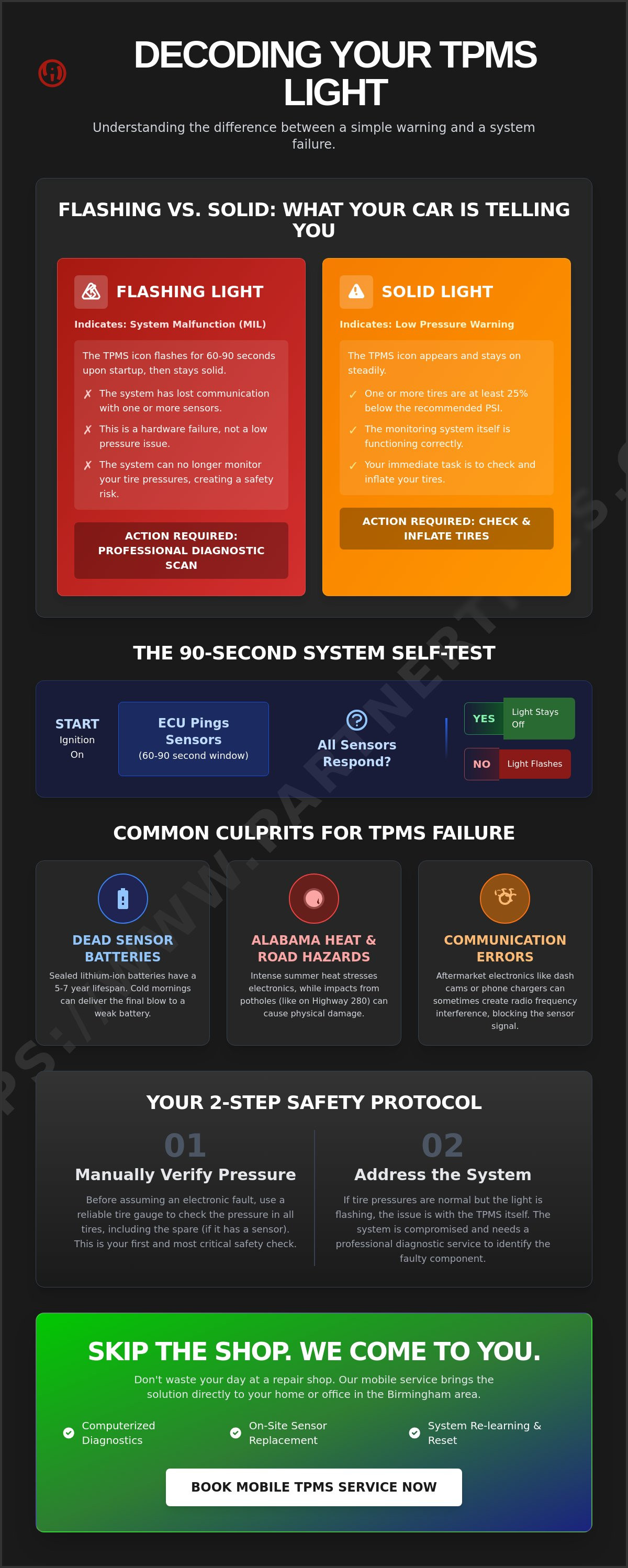
A tire pressure light flashing on and off is the vehicle's way of alerting you to a hardware malfunction. This specific visual pattern is technically known as a Malfunction Indicator Lamp (MIL) signal. Unlike a standard low-pressure warning, this sequence usually involves the icon blinking for approximately 60 to 90 seconds before it transitions to a steady, solid glow. This signal tells you that the central computer has lost communication with one or more wheel sensors. It's a technical breakdown within the electronics, not just a physical air issue in the rubber.
To better understand this concept, watch this helpful video:
Blinking vs. Solid: Why the Pattern Matters
The visual behavior of the icon dictates your immediate response. A solid light generally means at least one tire has dropped 25% or more below the manufacturer’s recommended PSI. This requires a visit to an air pump. However, a flashing light indicates that the system itself is compromised. Ignoring a flashing light is significantly riskier than ignoring a solid one. When the light stays solid, you know you have low air. When it flashes, you lose your eyes on the road entirely. You won't know if you develop a genuine leak because the computer can no longer process data from the wheel. It creates a dangerous blind spot in your vehicle's safety profile.
The Role of the Tire Pressure Monitoring System (TPMS)
Your vehicle relies on a Tire-pressure monitoring system (TPMS) to maintain safety and fuel efficiency. This technology became a mandatory safety feature for all passenger vehicles sold in the United States starting in 2007. Small, battery-powered sensors mounted inside each wheel assembly transmit real-time pressure data to the dashboard wirelessly. Essentially, the TPMS serves as a wireless safety network for your tires. When these internal components fail due to age, road impact, or environmental stress, the system triggers the alert to notify you that the network is down. This ensures you don't rely on faulty data during high-speed travel on Birmingham highways. If you notice your tire pressure light flashing on and off, the car is telling you that its safety net is no longer active.
Why Your TPMS Light Flashes Before Staying Solid
Every time you turn the ignition, your vehicle performs a "Startup Self-Test." The onboard computer pings every sensor. It ensures the entire safety network is operational. If a sensor fails to respond within that initial window, the system triggers a specific alert. This window typically lasts 60 to 90 seconds. This is why you see the tire pressure light flashing on and off before it settles into a solid glow. It is a diagnostic countdown. According to official guidance from the NHTSA, this specific flashing pattern is the universal indicator for a system malfunction rather than a simple pressure drop. It tells you that the computer has stopped looking for air pressure and started looking for a technician.
Dead Sensor Batteries: The 5-to-7 Year Cycle
TPMS units rely on internal lithium-ion batteries. These power cells are sealed within the sensor housing. They typically have a lifespan of five to seven years. Because they are encased in a protective epoxy to withstand road vibration and extreme moisture, you cannot replace the battery individually. When the voltage drops below a certain threshold, the sensor's signal becomes too weak for the vehicle's receiver to detect. This failure often manifests on cold Birmingham mornings. Low temperatures cause battery voltage to dip naturally. This "kills" a weak sensor that might have functioned fine during a warm afternoon. If one sensor dies, the others are usually right behind it. They were likely installed as a set and have endured the same road conditions and mileage.
Communication Errors and System Glitches
Hardware failure isn't always about the sensor itself. Electronic interference can disrupt the radio frequency signal. High-powered aftermarket phone chargers, GPS units, or dash cams can create electronic "noise" that drowns out the sensor's transmission. We also see issues when a driver switches to a spare tire or a set of wheels that lack sensors entirely. The computer expects four distinct signals. If it only finds three, it initiates the malfunction sequence. Physical damage to receivers located in the wheel wells or chassis can also break the communication chain. If you've recently had a rotation or new tires installed, the sensors might need to be "relearned" to their new positions. Failure to do this often results in the tire pressure light flashing on and off during the next drive. For professional help identifying the source of the break, you can schedule a diagnostic scan to pinpoint the exact failure point. This ensures you aren't replacing parts that still have life in them.
Common Culprits: From Alabama Heat to Sensor Age
The local climate plays a massive role in how your Tire Pressure Monitoring System behaves. Birmingham experiences high humidity and intense summer heat, which directly impacts internal sensor health. When the temperature fluctuates, the air inside your tires expands and contracts. A 10°F change in ambient temperature causes a 1 PSI shift in pressure. While a solid light might indicate a simple pressure drop during a cold snap, a tire pressure light flashing on and off usually points to hardware that has finally surrendered to these environmental stresses. Your car is signaling that the internal electronics can no longer provide a reliable reading.
Road conditions also dictate sensor longevity. Highway 280 and I-65 are notorious for potholes that deliver a "pressure shock" to the wheel assembly. This physical impact can dislodge delicate internal components or crack the sensor housing. Additionally, using cheap, non-OEM sensors often leads to communication gaps. These budget alternatives frequently fail to "talk" to your car's specific computer. This results in a persistent malfunction signal that won't go away with a simple air fill-up. You need a solution that matches the technical requirements of your vehicle's make and model.
Environmental Stress on TPMS Hardware
Corrosion is a primary enemy of older TPMS designs. Many systems utilize aluminum valve stems that react poorly to road salt and Birmingham's humidity. Over time, this chemical reaction causes the stem to become brittle or seized. Extreme heat also degrades the rubber seals that keep the sensor airtight. Once a seal fails, moisture enters the sensor housing and shorts out the electronics. This damage is often invisible from the outside but becomes obvious when your tire pressure light flashing on and off appears during your morning commute through Hoover or Vestavia. These sensors have a predictable lifespan of five to seven years before the internal battery or the housing itself fails.
Physical Damage During Tire Service
Physical failure isn't always the fault of the road. Improper tire mounting is a common culprit. If a technician isn't careful with the tire machine, they can "shear off" the sensor inside the rim. We also strongly advise against using liquid tire sealants like Fix-a-Flat. These chemicals can gum up the sensor port, rendering it useless and requiring a full replacement. To avoid these issues, always request a professional TPMS sensor service during your next new tire installation. This proactive step ensures your sensors are handled with precision and that the seals are refreshed before they fail. Proper maintenance preserves your vehicle's safety network and prevents the frustration of unexpected dashboard warnings.
What to Do When Your Tire Pressure Light Starts Flashing
Immediate action is required when safety systems fail. If you see your tire pressure light flashing on and off, do not panic, but do not ignore it. Safely pull over to a level surface away from traffic. Perform a quick visual inspection of all four tires to check for obvious punctures or sagging sidewalls. Even if the tires look full, the flashing pattern indicates a communication breakdown that requires further investigation to ensure your vehicle remains roadworthy.
Follow this logical protocol to secure your vehicle and protect your investment:
- Verify PSI manually: Use a high-quality manual pressure gauge. The dashboard might display hyphens or error codes instead of numbers during a system failure.
- Observe the light: Note if the light continues to flash or if it eventually stays solid. A light that flashes for 60 to 90 seconds and then stays on confirms a hardware fault.
- Avoid the reset button: Pressing "reset" without fixing the underlying issue is a temporary mask for a permanent problem. It does not repair the sensor and can leave you vulnerable.
- Seek professional input: If the light persists after you've confirmed your air levels are correct, the system needs a digital interrogation to find the broken link.
Manual Pressure Verification: Don’t Trust the Dash
Electronic errors can lead to misleading information on your instrument cluster. Always verify your air levels against the specific PSI requirements listed on the sticker inside the driver-side door jamb. While you are already at the wheel, perform the "Penny Test" to check your tread depth. Insert a penny into the tread with Lincoln's head upside down. If you can see the top of his head, your tires are dangerously worn. Reliable data comes from physical checks, not just sensors. If your manual readings are correct but the tire pressure light flashing on and off remains, you have confirmed a system malfunction that requires technical intervention.
The Danger of Driving with a Flashing TPMS
Operating a vehicle with a compromised TPMS is essentially driving blind. You lose the early warning system that prevents high-speed blowouts. A small nail could cause a slow leak that you won't notice until the tire fails entirely on I-65. Beyond safety, a malfunctioning system will cause your vehicle to fail a formal safety inspection. It is an active fault code that must be cleared by a professional. To resolve this safely and quickly, you can schedule a diagnostic scan to identify the failed component without the guesswork. This ensures your safety network is fully operational before your next commute.
Professional TPMS Diagnostics and Mobile Repair in Birmingham
Partner Tires provides the logistical solution to your dashboard alerts. We use computerized diagnostic scans to identify the exact failed sensor within minutes. This precision eliminates the guesswork that often leads to unnecessary parts replacement. When you see your tire pressure light flashing on and off, you don't have to disrupt your workday or wait in a crowded lobby. Our mobile technicians bring the repair shop to your location in Hoover, Vestavia, or Homewood. We handle everything from the initial diagnostic interrogation to the final sensor programming right in your driveway.
Our commitment to reliability means we don't just clear codes; we restore your vehicle's safety network. We provide a full-service experience that includes professional mounting and computerized wheel balancing with every sensor replacement. This ensures your new hardware is calibrated perfectly for the road ahead. Proactive maintenance is a central pillar of our service. If one sensor has failed due to age, the remaining batteries are likely close to their limit. Replacing them as a set prevents future downtime and keeps your vehicle's safety systems consistent.
On-Site Diagnostic Scanning: Speed and Precision
Our mobile units are equipped with advanced handheld diagnostic tools designed to "ping" each wheel individually. This wireless communication allows us to read the internal data of every sensor without removing the tire. We identify the specific battery life, internal temperature, and signal strength of your hardware. You receive a clear, no-nonsense report on which parts actually need replacement. This transparency ensures you only pay for the repairs necessary to stop the tire pressure light flashing on and off. We value your time and your financial health, so we focus on getting the job done right the first time.
Mobile Service: Why We Come to You
Skip the inconvenience of a traditional Birmingham tire shop. We offer Expert Tire Repair in Birmingham, AL wherever you are parked. Whether you are at your home in Hoover or your office in Homewood, our team arrives ready to work. We specialize in on-site TPMS sensor service, including the complex relearning procedures required by modern vehicle computers. This mobile approach respects your busy schedule and keeps your fleet or family vehicle in top condition without the logistical headache of a service center visit. We are the backbone of your vehicle's maintenance, providing the expertise you need exactly where you need it.
Schedule your mobile TPMS diagnostic with Partner Tires today.
Restore Your Vehicle's Safety Network Today
Understanding the signal behind a flashing TPMS icon is the first step toward reclaiming your peace of mind on the road. A tire pressure light flashing on and off isn't a suggestion to add air; it is a clear warning that your safety monitoring hardware has failed. Whether the cause is a dead sensor battery or corrosion from intense Alabama humidity, ignoring the fault creates a dangerous blind spot during your daily commute. You need a solution that prioritizes your schedule and your safety.
Partner Tires has served Birmingham, Hoover, and the surrounding communities since 2026 with a focus on logistical efficiency. We eliminate the downtime of traditional shops by bringing professional diagnostic tools directly to your home or office. Our technicians perform on-site TPMS programming and relearning to ensure your system communicates perfectly with your vehicle's computer. We even include computerized wheel balancing to guarantee a smooth, safe ride after every sensor replacement. Don't let a dashboard error slow your progress or compromise your financial health. Book a Mobile TPMS Diagnostic in Birmingham Now and drive with confidence again.
Frequently Asked Questions
Is it safe to drive with a flashing tire pressure light?
You can drive short distances to reach a service provider, but operating with a malfunctioning TPMS is fundamentally risky. The flashing light indicates the system cannot monitor your air pressure. If you develop a puncture or a leak while the system is down, you won't receive a warning. This increases the chance of a high-speed blowout on Birmingham highways.
How much does it cost to replace a TPMS sensor in Birmingham?
Replacement costs depend on your vehicle's specific make, model, and the type of sensor required. Professional service includes the hardware, specialized mounting, and the digital relearning process. While prices fluctuate across the Birmingham area, mobile service often provides better logistical value by eliminating the time and fuel costs of visiting a traditional shop.
Can I replace just one TPMS sensor or do I need all four?
You can replace a single failed sensor, but we often recommend replacing the full set if they are the same age. TPMS batteries have a consistent lifespan. If one has failed, the others are likely near their limit. Replacing them all at once prevents multiple service calls and ensures your entire safety network remains operational for years to come.
How long do tire pressure sensor batteries typically last?
Most tire pressure sensor batteries last between five and seven years. These power cells are sealed inside the sensor housing and cannot be charged or replaced individually. High mileage and extreme environmental heat can accelerate battery depletion. Once the voltage drops, the sensor stops transmitting, which triggers the tire pressure light flashing on and off on your dashboard.
Why did my tire light start flashing after a tire rotation?
Your vehicle's computer expects each sensor to be in a specific corner of the car. Moving the wheels during a rotation can confuse the receiver if a "relearn" procedure isn't performed. If the system cannot locate the sensors in their new positions, it will trigger a malfunction alert. A quick diagnostic scan can resync the network and restore communication.
Can cold weather cause my TPMS light to blink?
Cold weather typically causes a solid light due to natural pressure drops, but it can trigger a blink if a sensor battery is already weak. Low temperatures reduce battery voltage. If a battery is near the end of its life, a cold morning might push it below the operational threshold. This causes the system to report a hardware failure instead of just low air.
Do I need to reprogram my car after getting a new sensor?
Every new sensor has a unique identification code that must be registered with your vehicle’s central computer. Without this programming, the car won't recognize the new hardware. Professional mobile technicians use handheld tools to perform this "relearning" process on-site. This ensures the tire pressure light flashing on and off is cleared and the system is fully functional.
Will a flashing TPMS light drain my car battery?
A flashing TPMS alert will not drain your vehicle's main lead-acid battery. The dashboard icon uses a negligible amount of power. The error code stays in the computer's memory, but it doesn't create an active electrical draw when the engine is off. Your primary concern should be the lack of tire monitoring rather than your car's starting power.


