
That "great deal" on a used car in Birmingham could actually cost you an extra $1,000 before you even finish your first tank of gas. It's a common trap for buyers who focus on the engine but overlook what's touching the pavement. You want a reliable vehicle, not a mounting list of immediate repairs. A diligent pre-purchase used car tire check ensures you aren't inheriting someone else's maintenance debt. Alabama's intense heat accelerates tire aging, and without a state-mandated safety inspection, the responsibility to spot defects falls entirely on you.
We understand the anxiety of negotiating with a private seller. You deserve a transparent transaction that protects your financial health. With tire prices having increased by over 20% recently, skipping an inspection is a gamble you can't afford. This guide provides a clear DIY checklist to help you identify hidden dry rot and dangerous wear patterns. You'll learn why tire age matters as much as tread depth and how to use these facts to lower the asking price. We'll show you exactly how to protect your investment and keep your new ride safely on the road.
Key Takeaways
- Protect your financial health by identifying hidden wear patterns that could lead to an immediate $1,000 replacement bill.
- Perform a thorough pre-purchase used car tire check using the "Penny Test" to ensure tread depth meets Alabama's legal safety standards.
- Spot high-risk defects like sidewall bubbles and dry rot which are often accelerated by the intense Alabama heat.
- Verify tire age using the DOT date code because rubber degrades over time regardless of how much tread remains.
- Leverage mobile tire installation in Birmingham to replace faulty tires quickly at your home or the seller's location.
Why the Pre-Purchase Used Car Tire Check is Non-Negotiable
Tires represent the only four points of contact between your vehicle and the Birmingham pavement. No matter how advanced the engine or transmission is, the car's performance is limited by the rubber beneath it. Modern safety features like Anti-lock Braking Systems (ABS) and Traction Control cannot function correctly if the tires lack grip. If the tread is gone, these systems are essentially useless during a sudden stop on I-65. Conducting a thorough pre-purchase used car tire check is the most effective way to protect your safety and your wallet.
To better understand why these inspections are critical, watch this helpful video:
Buying a used car involves significant financial risk. A full set of high-quality tires for a modern SUV can easily exceed $1,000. This is a massive hidden cost that many buyers overlook while distracted by a clean interior or a shiny paint job. Proper Tire maintenance is often the first thing a neglectful owner ignores. If the tires are in poor condition, it's a strong indicator that other critical services like oil changes or brake inspections were also skipped.
The Financial Impact: Negotiation vs. Expense
Worn tires aren't just a safety hazard; they're your best negotiation tool. If a pre-purchase used car tire check reveals that the tread is near the legal limit, you have a concrete reason to demand a price reduction. Even tires that look decent might be nearing the end of their life cycle. A set that requires replacement in three months is effectively a large bill waiting to happen. Compare this to other common repairs. While a small sensor might be a minor fix, tires are a high-ticket item that directly impacts your initial investment and your car's resale value.
Tires as a Maintenance Proxy
Look closely at the brands on the car. If you see four different tire brands or mismatched tread patterns on the same axle, the previous owner likely cut corners. This suggests they managed the car on a tight budget and may have ignored larger mechanical needs. Uneven wear patterns are even more telling. They often signal expensive suspension problems or a car that's badly out of alignment. Additionally, be wary of brand-new, ultra-cheap tires. Sellers often install the lowest-grade rubber possible just to make a quick sale and hide long-term neglect. These "shiny" new tires can be a red flag for a vehicle that hasn't received professional care.
The 5-Minute DIY Tire Inspection Checklist
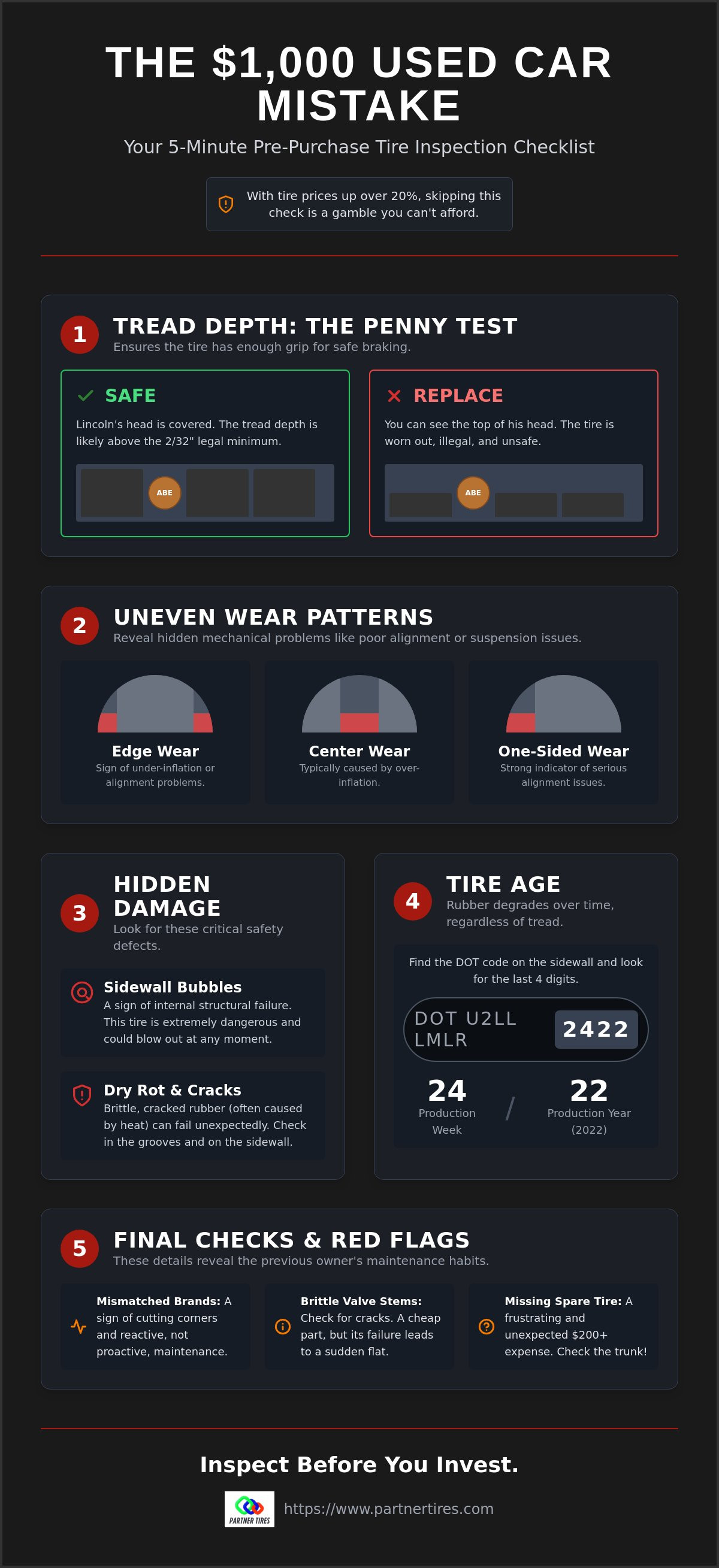
You don't need a professional garage or expensive equipment to perform an effective pre-purchase used car tire check. Most critical defects are visible to the naked eye if you know where to look. Start by walking around the vehicle and checking for mismatched brands or tread patterns on the same axle. Mixing different tire models can cause unpredictable handling and braking, especially on wet Birmingham roads. Consistency across all four wheels is a sign of a disciplined owner who followed standard NHTSA tire safety guidelines.
Next, inspect the valve stems. Gently wiggle each stem to check for cracks in the rubber or audible air leaks. A brittle valve stem is a cheap part, but its failure leads to a flat tire at the worst possible moment. Finally, open the trunk. Verify that the spare tire, jack, and lug wrench are present and in good condition. Discovering a missing spare after you've already bought the car is a frustrating $200 expense that most buyers fail to anticipate.
Mastering the Penny Test and Tread Depth
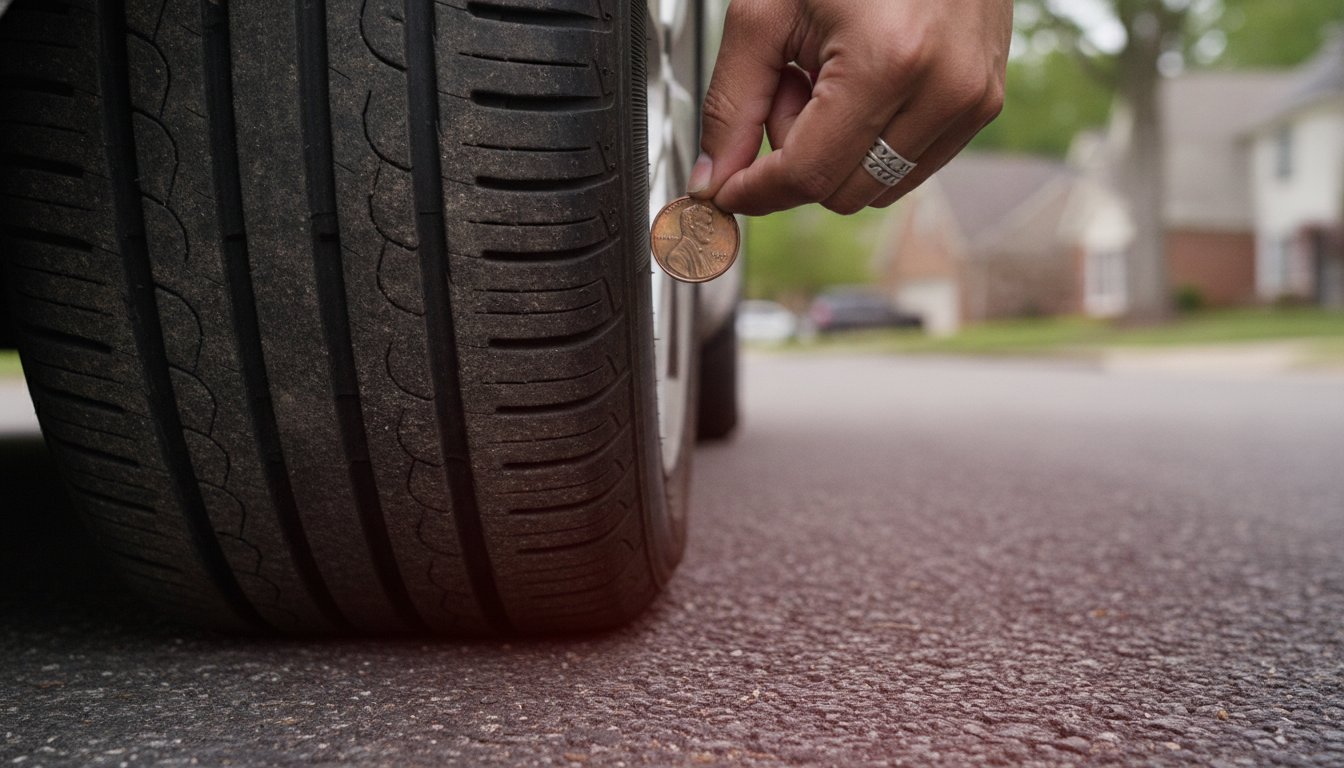
The "Penny Test" remains the most reliable DIY method for measuring tread. Insert a penny into the tire groove with Abraham Lincoln's head pointing down toward the center of the wheel. If you can see the top of his head, the tread is too thin. Perform this check in at least three places: the inner edge, the middle, and the outer edge. Consistency is key here. In Alabama, the legal minimum tire tread depth is 2/32 of an inch. If any tire fails this test, you are looking at an immediate safety risk and a mandatory replacement cost.
Identifying Uneven Wear Patterns
The way a tire wears down tells the story of the vehicle's mechanical health. If the rubber is heavily worn on just the inner or outer edges, the car likely needs a four-wheel alignment to prevent the new tires from being ruined. Look for "cupping" or scalloped dips in the tread, which often indicate worn-out shocks or struts. Center wear usually points to chronic over-inflation by the previous owner. If your inspection reveals these issues, Partner Tires can provide a professional assessment and mobile installation services to get the vehicle road-ready. Identifying these patterns early allows you to factor suspension repairs into your final offer.
Beyond Tread: Spotting Hidden Damage and Dry Rot
A successful pre-purchase used car tire check must go deeper than just looking at the tread depth. Even a tire with deep grooves can be structurally unsound and dangerous to drive. You need to inspect the rubber for signs of internal failure that could lead to a blowout on the highway. Look closely for exposed cords or steel wires peeking through the rubber. This is an immediate safety failure. If you see metal, the tire is finished. You should also check the tire's surface for plugs or patches. While professional repairs are common, a poorly executed plug in the sidewall is a major liability that compromises the tire's integrity.
Sellers often try to hide these defects with tire shine or heavy cleaning. Don't let a glossy finish distract you from the actual condition of the material. Identifying these issues before you sign the paperwork allows you to negotiate a better price or walk away from a dangerous vehicle. Understanding how to make your tires last longer begins with ensuring you start with a healthy set of rubber.
The Danger of Sidewall Damage
Inspect the sidewalls for any "bubbles" or bulges. These look like small knots or goose eggs on the side of the tire. They indicate that the internal carcass has been pinched or damaged by an impact, such as hitting a Birmingham pothole or a curb. Sidewall damage cannot be repaired. If you find a bubble, the tire requires immediate replacement. While you are looking at the sidewall, check for heavy "curb rash" or deep gouges. While some scuffing is cosmetic, deep cuts can expose the internal structure. Excessive curb rash also suggests the previous owner was careless, which often leads to bent rims or knocked-out alignments.
Alabama Heat and Tire Dry Rot
Alabama's climate is notoriously hard on rubber. High-heat cycles and constant UV exposure break down the chemical bonds in your tires. This process, known as dry rot, turns flexible rubber into a brittle, dangerous material. You can spot this by looking for fine, spider-web cracks in the sidewalls or deep in the tread grooves. Interestingly, vehicles with very low mileage are often the most susceptible. If a car sits for months in the sun without moving, the anti-oxidant chemicals in the rubber don't circulate. This lack of use actually accelerates the aging process. Never assume a "garage queen" with low miles is safe until you've performed a thorough pre-purchase used car tire check to rule out dry rot.
Decoding the DOT Date Code: Age vs. Appearance
Tires have a definitive expiration date that has nothing to do with how much tread is left. Even if a tire looks brand new, the internal rubber compounds degrade over time. This chemical breakdown is invisible to the naked eye but significantly increases the risk of a catastrophic blowout. During your pre-purchase used car tire check, you must verify the age of every tire on the vehicle. Alabama's high heat cycles accelerate this aging process, making the 6-year rule critical for Birmingham drivers. While a tire might last ten years in cooler climates, the intense Southern sun often renders them unsafe much sooner.
If you find outdated or mismatched tires during your inspection, contact Partner Tires for a professional assessment and mobile replacement services. We specialize in providing high-quality rubber that meets the specific demands of Alabama roads. Don't let a seller convince you that "plenty of tread" means the tires are safe. Structural integrity is a matter of chemistry, not just appearance.
How to Read a Tire Date Code
Locate the "DOT" stamp on the tire sidewall to find the manufacture date. This stamp is followed by a series of letters and numbers, but you only need the final four digits. These digits represent the week and year the tire was produced. For example, a code of "2225" indicates the tire was manufactured in the 22nd week of 2025. Tires exceeding 10 years of age are universally considered unsafe for road use because the internal structural components inevitably degrade over time. If the code is only three digits long, the tire was made before the year 2000 and should be scrapped immediately.
Performance Matching and TPMS
Check that all tires match the vehicle's required load and speed ratings. Using a tire with a lower load rating than the manufacturer specifies is a major safety violation. You should also pay close attention to the dashboard during your test drive. A lit TPMS (Tire Pressure Monitoring System) light often indicates a failing sensor or a slow leak. Addressing a TPMS sensor service can be an unexpected expense after a purchase. Factor the cost of sensor replacement into your negotiation if the light remains on after the tires are properly inflated. Ensuring the electronics and the rubber are both in peak condition is the only way to guarantee a reliable vehicle.
Beyond safety sensors, many used car buyers look to upgrade their vehicle's cabin technology once the deal is closed. For those interested in high-quality audio or mobile electronics upgrades, Music In Motion offers professional insight into how modern installations can enhance a used vehicle's interior and driving experience.
How Partner Tires Simplifies Your Used Car Purchase
Identifying a failure during your pre-purchase used car tire check shouldn't necessarily end the deal. It should start a negotiation. Partner Tires acts as your logistical backbone in these moments. We provide the professional data and service needed to finalize your purchase with total confidence. Our team understands that a used car is an investment in your daily operation. We work behind the scenes to ensure that investment is protected from day one. By offering a clear path from inspection to installation, we turn a potential deal-breaker into a manageable maintenance step.
We prioritize your financial health by offering transparent solutions that fit your budget. Whether you need a premium set of new rubber or a cost-effective alternative, we have the inventory ready for immediate dispatch. Our goal is to keep your vehicle on the road and your money in your pocket. We don't just sell tires; we provide the stability your new vehicle requires to perform safely on Birmingham roads.
The Mobile Advantage for Used Car Buyers
Driving a vehicle with compromised tires to a traditional shop is a significant safety risk. We eliminate this danger by bringing the shop to you. Our mobile units offer professional at home tire installation across Birmingham, Bessemer, and the surrounding metro area. We arrive with state-of-the-art equipment to handle mounting and computerized wheel balancing on-site. You can schedule an install at the seller's location or your own driveway immediately after the title transfer. This level of efficiency respects your busy schedule and ensures your car is road-ready without an extra trip to a service center.
Affordable Solutions: New vs. Quality Used Tires
A new car purchase often stretches your initial budget. Choosing high-quality used tires in Birmingham is a smart way to bridge the gap while maintaining safety standards. Every used tire we sell undergoes a rigorous multi-point inspection process. We verify tread depth, check for structural defects, and confirm manufacture dates to ensure reliability. If your pre-purchase used car tire check reveals an immediate need for replacement, use our quote as a negotiation tool. Presenting the seller with a professional estimate for replacement tires is a powerful way to justify a lower asking price. Contact us for a free quote today and secure the deal you deserve.
Drive Your New Car with Confidence
A thorough pre-purchase used car tire check is the difference between a smart investment and an immediate $1,000 financial burden. You now have the tools to identify dangerous dry rot, decode aging DOT codes, and spot mechanical issues hidden in tread wear patterns. Don't let a seller's "as-is" condition compromise your safety or your budget. Use your findings to negotiate a fair price that reflects the vehicle's true maintenance needs.
Partner Tires stands ready as your dependable foundation for this transition. As Birmingham's #1 Mobile Tire Service, we provide the expert alignment and TPMS support needed to keep your vehicle operational. Every installation includes computerized balancing to ensure your first drive is smooth and safe. We work behind the scenes so you can focus on the road ahead. Our goal is to be the engine that drives your success from the moment you take the keys.
Get a Free Tire Quote to Use for Your Negotiation and start your next chapter with a reliable set of rubber.
Frequently Asked Questions
How do I check the age of used car tires?
Locate the four-digit DOT code on the tire sidewall to determine the exact manufacture date. The first two digits represent the week of production, while the last two digits indicate the year. For example, a code of "1224" means the tire was made in the 12th week of 2024. If you find tires older than six years during your pre-purchase used car tire check, you should factor replacement costs into your offer.
Is it safe to buy a car with mismatched tires?
Buying a car with mismatched tires is generally unsafe because it leads to unpredictable handling and uneven braking. Different tread patterns and rubber compounds react differently to Birmingham's wet or hot road surfaces. If the tires on the same axle do not match, the vehicle's stability and safety systems may not function correctly. You should plan for an immediate replacement to ensure consistent performance and safety.
Can I drive on tires that have dry rot cracks?
Driving on tires with dry rot cracks is dangerous and significantly increases your risk of a sudden blowout. Dry rot indicates that the rubber has become brittle and lost its structural integrity due to Alabama's intense heat and UV exposure. Even if the tread looks deep, cracked sidewalls are a sign of internal failure. These tires require immediate replacement before you take the vehicle on the highway or high-speed roads.
What is the minimum legal tread depth in Alabama?
The legal minimum tire tread depth in Alabama is 2/32 of an inch. You can verify this quickly using the "Penny Test" by inserting a penny into the tread groove with Lincoln's head facing down. If the top of his head remains visible, the tires are legally worn out and must be replaced. Most safety experts recommend replacing tires at 4/32 of an inch to maintain traction during heavy rain.
How much does it cost to replace all four tires on a used car?
A full set of four tires typically costs between $300 and $1,500 depending on the vehicle type and tire quality. For a standard sedan, prices usually range from $500 to $900. Larger SUVs and trucks require more specialized rubber, with costs often ranging from $700 to over $1,500. Identifying these costs during a pre-purchase used car tire check allows you to negotiate a lower price with the seller.
Should I worry about a blinking TPMS light during a test drive?
A blinking TPMS light is a red flag that usually indicates a sensor failure or a significant system error. While a solid light might just mean the tires need air, a blinking light often requires professional diagnostic tools and sensor replacement. This suggests the previous owner may have neglected electronic maintenance. It is a specific repair cost that you should use as leverage during your price negotiations.
Does Partner Tires offer mobile inspections for used cars?
Partner Tires specializes in professional mobile tire installation and replacement rather than mechanical inspections. If your own inspection reveals defects, we are the primary partner for immediate on-site replacement in the Birmingham metro area. We bring new or high-quality used tires directly to your home or the seller's location. This ensures the vehicle is road-ready and safe without requiring an extra trip to a traditional tire shop.
How long do tires typically last in the Birmingham heat?
Tires in Birmingham typically reach the end of their safe service life within six years due to extreme heat and UV cycles. While some manufacturers suggest a ten-year maximum, the Alabama climate accelerates the breakdown of rubber compounds. High temperatures cause the structural bonds in the rubber to degrade faster than in cooler climates. You should always prioritize the manufacture date over visual tread appearance when evaluating tires in the South.


